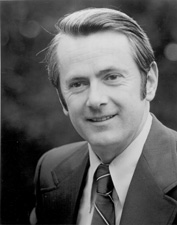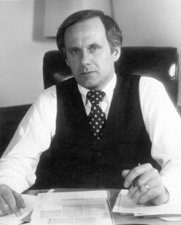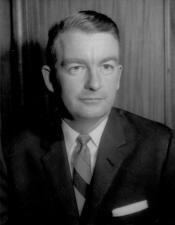
Maurice James Murphy Jr. (October 3, 1927 – October 27, 2002) was an American politician and lawyer from New Hampshire who served as a Republican United States Senator from 1961 to 1963. Over the course of a brief but notable public career, he held the offices of Attorney General of New Hampshire and appointed United States Senator, contributing to the legislative process during one term in the Senate and representing the interests of his constituents during a significant period in American history.
Murphy was born in Dover, New Hampshire, and attended local schools, graduating from Dover High School and St. Mary’s Academy. Shortly after World War II, he entered military service, serving as an enlisted man in the United States Army in 1946 and 1947. He pursued higher education following his initial military service, enrolling at the College of the Holy Cross, from which he graduated in 1950. He then studied law at Boston College Law School, earning his law degree in 1953. Murphy returned to military duty during the Korean War era, serving again as an enlisted man in the United States Army in 1953 and 1954.
After completing his legal education and military service, Murphy was admitted to the bar and commenced the practice of law in Portsmouth, New Hampshire, in 1955. He quickly became involved in state government and public affairs. From 1957 to 1958 he served as legal counsel to the New Hampshire Senate, providing legislative and legal advice to the state’s upper chamber. He then joined the staff of Governor Wesley Powell, serving as the governor’s administrative assistant from 1959 to 1961, a role that placed him at the center of state executive decision-making and helped establish his reputation within New Hampshire’s Republican Party.
Murphy’s rise in state office continued in 1961. After serving for several months as deputy attorney general of New Hampshire, he was appointed by Governor Powell as Attorney General of New Hampshire and took office on November 4, 1961. His tenure as attorney general was brief, lasting approximately one month, because of an unexpected vacancy in the United States Senate. On November 26, 1961, H. Styles Bridges, the longest-serving U.S. Senator at that time and a prominent conservative Republican from New Hampshire, died in office. On December 7, 1961, Governor Powell appointed Murphy as United States Senator to fill the vacancy until a special election could be held in November 1962. Powell’s decision to appoint Murphy, rather than the late senator’s widow, Doloris Bridges, was controversial. William Loeb, the influential publisher of the Manchester Union Leader, ran a front-page editorial attacking Powell for passing over Mrs. Bridges, and many political observers had expected that she would be chosen to succeed her husband.
As a member of the United States Senate from 1961 to 1963, Murphy participated in the democratic process during a period marked by the early years of the Kennedy administration and significant civil rights debates. During his eleven months in the Senate, he aligned with the Republican Party and contributed to the legislative work of the chamber. Among his recorded votes, he supported the 24th Amendment to the United States Constitution, which prohibited the use of poll taxes in federal elections, reflecting his participation in key voting rights legislation of the era. His appointed term concluded with the special election of 1962, in which he sought to retain his seat.
In the 1962 special election, Murphy ran in the Republican primary in an effort to keep his Senate seat. He faced strong opposition from Doloris Bridges, as well as from two sitting Republican members of the U.S. House of Representatives from New Hampshire, Perkins Bass and Chester Merrow. In a crowded and hard-fought primary, Murphy finished third behind Bass and Mrs. Bridges. Governor Powell was also defeated in his own primary that year. In his election night remarks, Powell attributed part of his political downfall to Loeb’s opposition and remarked that he was “paying the penalty for appointing a Catholic to the U.S. Senate,” a reference to Murphy’s religion and the controversy surrounding his appointment. With the end of his appointed term and his primary defeat, Murphy’s brief service in the Senate concluded in 1963.
Following his departure from the Senate, Murphy returned to New Hampshire and resumed the practice of law. He remained active in civic and regional affairs, particularly in the Portsmouth area. He served on the Portsmouth Economic Commission and the Portsmouth Housing Authority, contributing to local economic development and housing policy. He was elected chairman of the board of the Portsmouth-Kittery Armed Services Committee, an organization focused on supporting the Portsmouth Naval Shipyard and regional military interests that later became known as the Seacoast Shipyard Association. In addition, he served on the New Hampshire Boundary Commission from 1973 to 1975, participating in the resolution and clarification of state boundary issues.
Murphy also developed a substantial career in banking and corporate governance. Beginning in 1968, he became chairman of the board and general counsel of the Portsmouth Savings Bank in Portsmouth, New Hampshire, positions he held for two decades until 1988. In these roles, he oversaw legal affairs and helped guide the institution’s growth and operations, extending his influence beyond public office into the financial and business life of the state. Throughout these years he continued to reside in the New Hampshire seacoast region, maintaining close ties to the communities he had long served.
In his personal life, Murphy was married to Mary E. Doody, with whom he had three children. The family lived for many years in the seacoast area, and at the time of his death he resided in Stratham, New Hampshire. Maurice James Murphy Jr. died on October 27, 2002. He was interred in Prospect Hill Cemetery in Greenland, New Hampshire. His wife, Mary E. Doody Murphy, survived him and later died in 2016.
Congressional Record