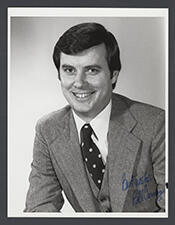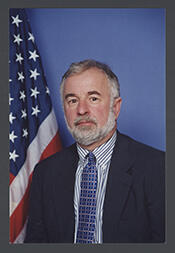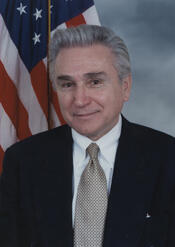
Maurice Dunlea Hinchey (October 27, 1938 – November 22, 2017) was an American politician who served as a U.S. Representative from New York from 1993 to 2013 and was a member of the Democratic Party. He was born on the Lower West Side of Manhattan in New York City to a working-class family, the son of Rose (Bonack) Hinchey, who was of Ukrainian descent, and Maurice D. Hinchey, the son of Irish immigrants. He grew up in Saugerties, New York, after his family moved to the Hudson Valley, an area that would remain central to his personal life and political career.
After graduating from high school, Hinchey enlisted in the United States Navy, serving in the Pacific aboard the destroyer USS Marshall. Following his honorable discharge, he spent two years working as a laborer in a cement plant. To finance his higher education, he worked as a toll collector on the New York State Thruway while attending college. He earned a Bachelor of Arts degree in 1968 and a Master of Arts degree in 1970 from the State University of New York at New Paltz. His early experiences in the military, industrial labor, and public service employment informed his later political identity as a progressive populist with a strong interest in labor, environmental protection, and government accountability.
Hinchey first sought public office in 1972 with an unsuccessful campaign for the New York State Assembly. At the time, Ulster County was a longstanding Republican stronghold. In 1974, however, he ran again and was elected, becoming the first Democrat to represent Ulster County in the Assembly since 1912. He served in the Assembly from 1975 to 1992, sitting in the 180th through the 189th New York State Legislatures. During his tenure, he served on the Ways and Means, Rules, Banks, Health, Higher Education, Labor, Energy, and Agriculture committees, but he was particularly noted for his work as chair of the Assembly Environmental Conservation Committee, a position he held for 14 years. In that role, he brought environmental issues to the forefront of state policy, including leading a major investigation into the toxic waste disaster at Love Canal in Niagara Falls, one of the nation’s first major toxic dump sites. Under his leadership, the committee helped secure passage of the country’s first law regulating acid rain and gained attention for its investigation into the infiltration of the waste removal industry by organized crime.
In 1992, when Representative Matthew F. McHugh retired after 18 years in the U.S. House of Representatives, Hinchey sought and won the Democratic nomination for the district, which had been renumbered from the 28th to the 26th after New York lost three congressional seats following the 1990 census. In the November general election, he defeated Republican Broome County legislator Robert Moppert by a 50–47 percent margin, and in the 1994 Republican Revolution wave election he again narrowly prevailed over Moppert by about 1,200 votes. Hinchey thus entered Congress in January 1993 and went on to serve ten consecutive terms, remaining in office until his retirement at the end of his term in January 2013, for a total of 20 years in Congress. Over the course of his congressional career, he represented districts that included large portions of the Hudson Valley, the Catskills, and the Southern Tier, often running in historically Republican areas but maintaining his seat through a combination of progressive advocacy, strong environmental credentials, and diligent constituent service.
Hinchey’s district was significantly reconfigured after the 2000 census, when New York again lost congressional seats. In the intense redistricting negotiations, he was initially threatened with the dismemberment of his district or with being forced into a race against a senior Republican incumbent such as Ben Gilman or Sherwood Boehlert. The final plan, however, left Hinchey as one of the political “winners”: Republicans agreed to eliminate Gilman’s district, leading to Gilman’s retirement, while Democrats accepted a configuration that combined the districts of Representatives Louise Slaughter and John LaFalce, prompting LaFalce’s retirement. Hinchey’s district was renumbered the 22nd and drawn in a narrow, contorted shape across eight counties from the Hudson River through the Catskills and Binghamton to Ithaca, linking some of the most politically liberal communities in the Southern Tier and former “Borscht Belt” region. This gerrymandered configuration resembled the earlier 26th District he had represented. In 2010, he was elected to his tenth and final term, defeating Republican George Phillips of Binghamton by a 52–48 percent margin.
During his two decades in the House of Representatives, Hinchey served on the powerful Committee on Appropriations, including the Subcommittee on Defense and the Subcommittee on Interior, Environment, and Related Agencies, positions that enabled him to direct federal support to programs important to his district and to advance environmental and conservation priorities. He was active in numerous caucuses, including the Congressional Progressive Caucus, the Congressional Native American Caucus, the Congressional Narcotics Abuse and Control Caucus, the Education Caucus, the International Conservation Caucus, the Renewable Energy and Energy Efficiency Caucus, the Steel Caucus, and the Congressional Arts Caucus. He was widely regarded as a progressive populist, noted for his liberal positions on social and economic issues and his advocacy for integrity in government. He was one of the earliest and most outspoken opponents of the 2003 Iraq War and was among only 11 co-sponsors of Representative Dennis Kucinich’s resolution to impeach President George W. Bush. In 2005, he was one of 31 House members who voted to uphold an objection to counting Ohio’s 20 electoral votes in the 2004 presidential election, a move intended to prompt a formal debate about alleged election irregularities.
Environmental policy and energy issues were central themes of Hinchey’s congressional service. Building on his state-level work, he became a leading critic of hydraulic fracturing in the Marcellus Shale and opposed shale gas drilling in upstate New York. In the 2010 midterm elections, he clashed with his opponent over gas drilling and hydraulic fracturing, and he publicly urged the federal government to slow drilling in New York and Pennsylvania, a request the Obama administration declined. Along with Representative Diana DeGette of Colorado and Senator Bob Casey of Pennsylvania, he introduced the “FRAC Act,” legislation to remove certain federal exemptions for hydraulic fracturing and require public disclosure of chemicals used in the process. He supported the Clean Air Act and opposed the Bush administration’s rollback of the New Source Review component, warning that it would increase acid rain and pollution in regional lakes. Hinchey was a strong supporter of solar and clean energy initiatives. He was an original co-sponsor of the Small Business Clean Energy Financing Act, which helped provide about $630 million in loans to environmentally friendly energy companies between 2006 and 2009. He helped organize The Solar Energy Consortium (TSEC), a nonprofit dedicated to building a solar energy industry and creating green jobs in New York’s Hudson Valley, and he backed the Home Star Energy Retrofit Act, which offered rebates to homeowners who improved energy efficiency. He also appeared in the 2010 documentary “Gasland,” discussing the FRAC Act and his opposition to unregulated hydraulic fracturing. In June 2008, he publicly suggested that public ownership of oil refineries might be worth considering to address national energy concerns, although he acknowledged it was unlikely to be adopted.
Hinchey was also a prominent advocate for reform of federal marijuana policy, particularly with respect to medical cannabis. In 2001 he introduced what became known as the Hinchey–Rohrabacher amendment, designed to bar the Department of Justice from interfering with the implementation of state medical marijuana laws. The amendment was first voted on in 2003 and failed 152–273, and it was defeated several more times during his tenure. After his retirement, a version of the measure passed in 2014 as the Rohrabacher–Farr amendment and was signed into law, marking a significant federal shift on medical cannabis enforcement. In 2009, the House Appropriations Committee approved a provision authored by Hinchey in the report accompanying the fiscal year 2010 Justice Department appropriations bill, requesting clarification of the Department’s policy on enforcing federal laws against individuals involved in state-sanctioned medical marijuana activities.
On social and domestic policy, Hinchey consistently took progressive positions. He supported abortion rights and was a co-sponsor of the Freedom of Choice Act and the Freedom of Access to Clinic Entrances Act, which sought to protect access to women’s health clinics, while stating his opposition to late-term abortions except when necessary to protect the health of the mother. He was an advocate for family planning programs, including the federal Title X program. In March 2010, he voted to repeal the “Don’t Ask, Don’t Tell” policy, thereby ending the practice of discharging service members from the armed forces solely for being homosexual or for engaging in or being suspected of engaging in homosexual acts. He supported the Aid to States for Medicaid, Teacher Employment and Other Purposes legislation in August 2010, which provided $10 billion to the Education Jobs Fund for teacher hiring and training, increased Federal Medical Assistance Percentages (FMAP) for states in need, and extended the period for states to receive enhanced FMAP. That same month he voted for the “Offshore Drilling and Other Energy Laws Amendments,” which tightened regulation of offshore oil and gas operations, strengthened safety requirements for blowout preventers, and increased penalties for oil and hazardous substance spills in the Gulf of Mexico. In 2011 he voted in favor of H.R. 2433, the Veterans Opportunity to Work Act of 2011, which amended Title 38 of the United States Code to improve employment and training programs for veterans. In November 2011, he also voted to reaffirm “In God We Trust” as the national motto and to encourage its public display in government buildings, public schools, and other institutions.
Beyond his legislative duties, Hinchey was involved in a range of governmental and civic bodies. He served on the Board of Visitors for the United States Military Academy at West Point and was a member of the National Conference of State Legislators, the National Guard and Reserve Components Congressional Members Organization, and the New York State Council of Governments. He sat on the board of directors of Ulster-Greene ARC and WAMU Public Radio and participated in the Eastern Regional Conference of the Council of State Governments, chairing its Environment Committee. In recognition of his efforts to commemorate the 400th anniversary of Henry Hudson’s exploration of the river that bears his name and to strengthen ties between the United States and the Netherlands, Hinchey was made an Officer of the Order of Orange-Nassau on September 4, 2009, by the Ambassador of the Netherlands on behalf of Queen Beatrix.
Maurice D. Hinchey retired from Congress at the conclusion of his tenth term in January 2013, concluding a 20-year career in the U.S. House of Representatives and nearly four decades in elective office. He died on November 22, 2017. Throughout his career, from his early days in the New York State Assembly through his long service in Congress, he was regarded as a political progressive known for his liberal stands on environmental protection, civil liberties, social policy, and government reform, and for his steadfast representation of his Hudson Valley and upstate New York constituents during a significant period in American political history.
Congressional Record