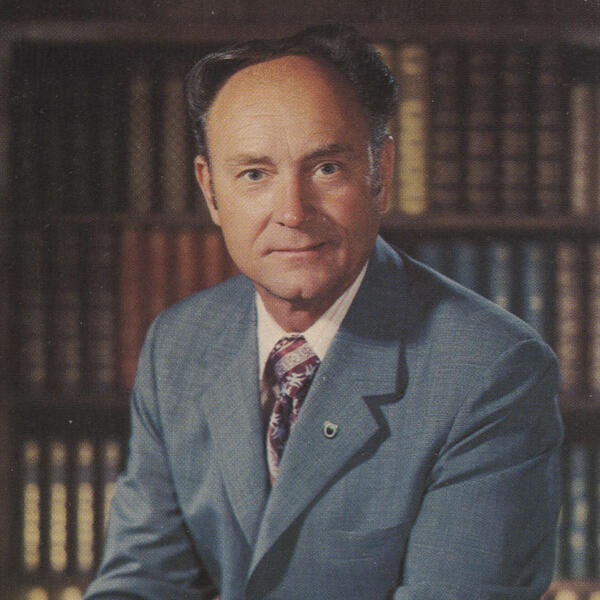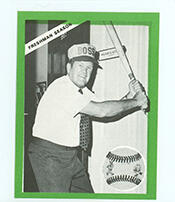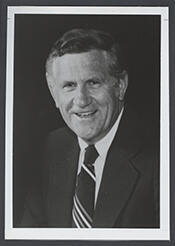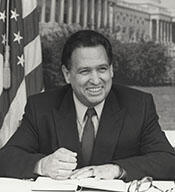
Matthew Gilbert “Marty” Martínez (February 14, 1929 – October 15, 2011) was an American politician who represented California in the United States House of Representatives from 1981 to 2001. Over the course of ten terms in Congress, he served as U.S. representative from California’s 30th congressional district from 1982 to 1993 and from California’s 31st congressional district from 1993 to 2001. During his congressional career he was affiliated with both major parties, serving primarily as a Democrat but later joining the Republican Party after a 2000 primary defeat. Throughout his tenure, he participated actively in the legislative process and represented the interests of his Southern California constituents during a significant period in late twentieth-century American political history.
Martínez was born on February 14, 1929. When he was young, his family moved to Los Angeles, California, where he attended the city’s public schools. He graduated from Roosevelt High School in Los Angeles in 1949. Before completing high school, he entered the United States Marine Corps in 1947, serving on active duty until 1950 and attaining the rank of private first class. After his military service, he pursued technical training and, in 1956, received a certificate of competence from Los Angeles Trade–Technical College, preparing him for a career in skilled trades and small business.
Following his formal training, Martínez spent roughly fifteen years in private enterprise. He owned and operated a custom furniture upholstery company and also worked as a building contractor, gaining experience in small business management, construction, and the concerns of working-class and entrepreneurial communities in the Los Angeles area. His involvement in local civic and business organizations during these years helped lay the groundwork for his later political career. He became active in groups such as the Monterey Park Chamber of Commerce, the Latin Business Association, Rotary International, and the Navy League, on whose board he served as a director. He was also associated with organizations including the San Gabriel Valley YMCA board of directors, Hispanic American Democrats, the National Association of Latino Elected and Appointed Officials, the Communications Workers of America, the Veterans of Foreign Wars, and the American Legion, reflecting his combined interests in community service, labor, Latino representation, and veterans’ affairs.
Martínez formally entered public life in 1971, when he was appointed to the Monterey Park Planning Commission. He served on the commission until 1974, when he was elected to the Monterey Park City Council. He remained on the council until 1980 and served two terms as mayor of Monterey Park, first in 1974 and again in 1980. His local government experience, particularly in land use, municipal services, and community development, established him as a prominent political figure in the San Gabriel Valley. In 1980, he advanced to state office by defeating incumbent Jack R. Fenton in the Democratic primary for California’s 59th State Assembly district. He then won election to the California State Assembly without facing a major-party opponent in the general election, serving in Sacramento and building a record as a Democratic legislator from a rapidly changing, heavily Latino district.
Martínez’s congressional career began in 1982, when Representative George E. Danielson resigned from the U.S. House of Representatives to accept a judicial appointment. Martínez ran in the special election to fill the vacancy and won, thereby entering the House of Representatives as a Democrat from California’s 30th congressional district. He was subsequently reelected nine times by varying margins, ultimately serving ten terms in Congress from 1981 to 2001. After redistricting, he represented California’s 31st congressional district from 1993 until the end of his service. In his first term, he was assigned to the House Committee on Education and Labor, where he focused on employment, training, and social welfare issues. During the 99th Congress (1985–1987), he chaired the Subcommittee on Employment Opportunities, and in 1991 he became chairman of the Human Resources Subcommittee, positions that gave him influence over federal employment, job training, and social services policy. In 1992, he was appointed to the House Committee on Foreign Affairs and served on the Subcommittee on International Security, International Organizations and Human Rights, broadening his legislative portfolio to include international and human rights issues.
Over the course of his House tenure, Martínez was generally regarded as a reliable Democratic vote on most major issues, reflecting the priorities of his largely working-class and Latino constituency. At the same time, he held several positions that placed him at odds with more liberal elements of his party. A Roman Catholic and a member of the National Rifle Association of America, he opposed certain forms of gun control and supported restrictions on abortion, including a vote to ban so‑called partial-birth abortion. These stances later became focal points in intraparty challenges. His service in Congress coincided with major national debates over education, labor, social welfare, and foreign policy, and he participated in the broader democratic process as a long-serving representative from the Los Angeles area.
In 2000, Martínez faced a serious primary challenge from State Senator Hilda Solis, who ran against him from the left in the Democratic primary. Solis criticized him as being out of touch with the district, particularly highlighting his vote to ban partial-birth abortion and his opposition to gun control measures. In the primary election, Solis defeated Martínez by a wide margin, 62 percent to 29 percent. Following this defeat, Martínez’s voting pattern in the House shifted markedly; he began to vote overwhelmingly with Republicans. On July 27, 2000, he formally switched his party affiliation from Democrat to Republican, asserting that the Democratic Party had abandoned him and no longer reflected his views. Although he completed his term as a Republican, there was no Republican candidate on the ballot in his district for the 2000 general election, and he declined to mount a write-in campaign. His service in Congress concluded on January 3, 2001, at the close of the 106th Congress, ending two decades of continuous representation.
Beyond his public career, Martínez had a substantial family life. He was married to Elvira Yorba Martínez, and the couple had five children: Matthew Adrian, Michael Gilbert, Diane, Susan, and Carol Ann. Public service became a family tradition; his daughter Diane Martínez served in the California State Assembly from 1992 to 1998, extending the family’s involvement in state and local politics. After leaving Congress, Martínez remained engaged in political and community affairs and stayed active within Republican circles, continuing to comment on issues affecting his former district and the broader Latino community.
Matthew G. Martínez spent his later years in Virginia. On October 15, 2011, he died at his home in Fredericksburg, Virginia, after suffering from congestive heart failure. His death marked the passing of a prominent Hispanic American legislator whose career spanned local government, the California State Assembly, and ten terms in the U.S. House of Representatives, and who is remembered among both lists of Hispanic and Latino Americans in the United States Congress and American politicians who switched parties while in office.
Congressional Record