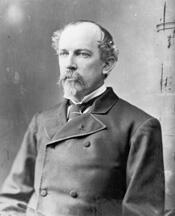
Matthew Calbraith Butler (March 8, 1836 – April 14, 1909) was a Confederate soldier, American military commander, attorney, and Democratic politician from South Carolina. He served as a major general in the Confederate States Army during the American Civil War, as a three-term United States Senator from South Carolina during the Reconstruction era and its aftermath, and later as a major general of United States Volunteers during the Spanish–American War. In the United States Senate, he represented South Carolina from 1877 to 1895, participating in the legislative process during three terms in office and serving on several key committees.
Butler was born at Eagle’s Crag near Greenville, South Carolina, into a large and prominent family of politicians and military men. His grandfather, William Butler, served as a United States Representative, and his father, William Butler Jr., was also elected to Congress, beginning his service in 1841. Through his mother, Jane Tweedy Perry of Rhode Island, Butler was connected to the U.S. Navy’s distinguished Perry family; she was the sister of Commodore Oliver Hazard Perry and Commodore Matthew Calbraith Perry, for whom Butler was named. His uncle Andrew Butler served as a United States Senator from South Carolina, and another uncle, Pierce Mason Butler, was Governor of South Carolina. Among his extended kin were Congressman Preston Brooks, who infamously assaulted Senator Charles Sumner on the Senate floor in 1856 and at whose home Butler lived as a young man; James Bonham, killed at the Battle of the Alamo; and Confederate General Milledge Luke Bonham.
In 1848 Butler accompanied his father to Arkansas, but he returned to South Carolina in 1851 to live with his uncle in Edgefield. He received his early education at the Edgefield Academy and then attended South Carolina College (now the University of South Carolina), where he was a member of the Delta Kappa Epsilon fraternity. He graduated in 1856, studied law, and was admitted to the South Carolina bar in 1857. Butler began practicing law in Edgefield and quickly entered public life. He was elected to the South Carolina House of Representatives in 1860, but he resigned his seat in 1861 following the outbreak of the American Civil War. On February 25, 1858, he had married Maria Calhoun Pickens, daughter of Francis Wilkinson Pickens, who would soon be elected governor of South Carolina, further linking Butler to one of the state’s leading political families.
With the secession of South Carolina and the onset of the Civil War, Butler joined the Confederate Army and served in the cavalry of the Army of Northern Virginia. He initially served in Hampton’s Legion, attaining the rank of captain on June 12, 1861, and major on July 21, 1861. When the legion’s cavalry battalion was consolidated with the 4th South Carolina Battalion to form the 2nd South Carolina Cavalry Regiment on August 22, 1862, Butler was elected its colonel. He participated in many major actions with Hampton’s Legion and the 2nd South Carolina Cavalry and lost his right foot to an artillery shell at the Battle of Brandy Station. Promoted to brigadier general in February 1864, he was thereafter widely known as “General Butler.” He led a brigade in Wade Hampton’s division of the Cavalry Corps and, when Hampton assumed command of the corps, Butler rose to division command. Late in the war he transferred with Hampton to the Carolinas, leading a division at the Battle of Bentonville, where he was again wounded.
Financially ruined by the war, Butler returned to Edgefield and resumed the practice of law. He reentered politics and was elected to the South Carolina House of Representatives beginning in 1866. During Reconstruction he aligned with the Democratic Party but also participated in the short-lived, biracial Union Reform movement, running unsuccessfully for lieutenant governor in 1870. His name became prominently associated with the violent political struggles of the era. In July 1876 he appeared in court in Hamburg, South Carolina, to represent two white farmers who complained of being denied passage on Main Street by a local company of the black militia, part of the state’s National Guard, during an Independence Day parade. In the course of the proceedings, Butler demanded that the militia surrender their arms to him, a demand they refused. The confrontation helped precipitate the Hamburg massacre, in which hundreds of white paramilitary “Red Shirts” descended on the town, attacked the armory where the militia had taken refuge, killed two freedmen in the streets (including the town marshal), and later murdered five black prisoners; one white man was also killed in the early exchange of gunfire.
Following the withdrawal of federal troops from South Carolina in 1877 under a national political compromise, Reconstruction effectively ended in the state, and the Democratic Party consolidated its control after the contested 1876 elections. The South Carolina legislature elected Butler to the United States Senate that year. During Senate hearings on his election, he was accused by Edgefield African American leader Harrison N. Bouey of having threatened to kill him and other local black leaders. Nonetheless, Butler took his seat and served three consecutive terms, from March 4, 1877, to March 3, 1895. As a Democratic senator from South Carolina, he participated actively in the legislative process and represented the interests of his constituents during a period marked by the end of Reconstruction, the rise of Jim Crow, and significant debates over economic and foreign policy. He served on the Senate Committees on Foreign Relations, Territories, Military Affairs, Naval Affairs, Interstate Commerce, and Civil Service and Retrenchment. In 1890, while still in the Senate, Butler introduced a controversial bill to provide federal aid to African Americans who chose to emigrate to Africa, a proposal intended to promote racial separation that sparked national debate. In 1894 he was defeated for reelection in the state legislature by Benjamin R. Tillman, a fellow Democrat who had gained popularity as governor and who represented a newer, agrarian populist strain in South Carolina politics.
After leaving the Senate in 1895, Butler practiced law in Washington, D.C. His long military experience and national prominence led to his return to uniform during the Spanish–American War. In 1898 he was appointed a major general of United States Volunteers, one of a small number of former Confederate officers—along with Fitzhugh Lee, Thomas L. Rosser, and Joseph Wheeler—who were commissioned in the U.S. Army during that conflict. Following the American victory, Butler was assigned to supervise the evacuation of Spanish troops from Cuba, an important administrative and logistical task in the early phase of American occupation. He was honorably discharged from the U.S. Army on April 15, 1899. That same year he joined the Pennsylvania Commandery of the Military Order of Foreign Wars, reflecting his continued association with military and veterans’ organizations.
In his later years Butler remained active in historical and business pursuits. In 1903 he was elected vice president of the Southern Historical Society, an organization devoted to preserving and interpreting the history of the Confederacy and the American South. In 1904 he relocated to Mexico, where he served as president of a mining company, engaging in international business at a time of expanding American economic interests abroad. Having been a widower for many years following the death of his first wife, Maria Calhoun Pickens, he married Nannie Whitman in 1906. The couple later returned to Washington, D.C., where Butler lived in semi-retirement. He died there on April 14, 1909. His body was returned to Edgefield, South Carolina, for burial in Willow Brook Cemetery. In later years, the Matthew C. Butler Camp No. 12 of the South Carolina Society of the Military Order of the Stars and Bars was named in his honor, reflecting his enduring place in the state’s military and political memory.
Congressional Record