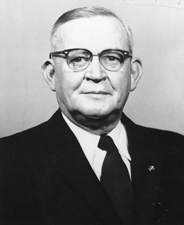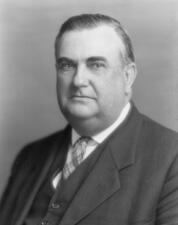
Marvel Mills Logan (January 7, 1874 – October 3, 1939) was an American politician, attorney, and jurist who served as a Democratic United States Senator from Kentucky from 1931 until his death in 1939. Over a public career spanning more than four decades, he held a succession of local, state, and federal offices, including Attorney General of Kentucky and justice, then chief justice, of the Kentucky Court of Appeals, before his election to the Senate during the early years of the Great Depression.
Logan was born on a farm near Brownsville, Edmonson County, Kentucky, on January 7, 1874. Raised in a rural setting, he was educated in local schools and early in life turned to teaching as his first profession. He taught school for two years and also conducted a training school for teachers, reflecting an early interest in public education and civic improvement. In 1896, he married Della Haydon Logan (1873–1951); the couple had four children. That same year he completed his legal studies, was admitted to the bar, and began the practice of law in Brownsville.
Logan’s legal and political career developed rapidly at the local and county levels. He practiced law in Brownsville and became active in community affairs, serving as chairman of the board of trustees of Brownsville. He was elected county attorney of Edmonson County, serving from 1902 to 1903. His growing reputation as a lawyer and public servant led to positions in the state government, where he advanced through a series of increasingly responsible legal posts.
At the state level, Logan served as assistant Attorney General of Kentucky from 1912 to 1915 and then as Attorney General of Kentucky from 1915 to 1917. Following his term as attorney general, he was appointed chairman of the Kentucky Tax Commission, serving from 1917 to 1918, where he helped oversee state tax policy and administration during the World War I era. In 1918 he moved from Brownsville to Louisville, Kentucky, continuing his law practice in the state’s largest city. In 1922 he relocated to Bowling Green, Kentucky, where he again engaged in private practice while remaining active in public affairs. During these years he served as a member of the State Board of Education, the State Board of Sinking Fund Commissioners, and the State Board of Printing Commissioners, roles that placed him at the intersection of education policy, state finance, and public administration. In 1929, reflecting his prominence beyond strictly political circles, Logan was elected Grand Sire (now known as Sovereign Grand Master) of the Independent Order of Odd Fellows, governing that fraternal organization at an international level.
Logan’s judicial career culminated in service on Kentucky’s highest court. He was elected a justice of the Kentucky Court of Appeals, then the state’s court of last resort, serving from 1926 to 1930. In 1931 he became chief justice of that court. His tenure on the bench enhanced his standing as a jurist and public figure and provided a platform for his subsequent election to the United States Senate. His judicial experience, combined with his earlier executive and administrative roles, gave him a broad understanding of state law and governance that he later brought to his work in Congress.
In 1930, Logan was elected as a Democrat to the United States Senate from Kentucky. He defeated Republican John M. Robsion, who had been appointed to fill the seat of Frederic M. Sackett after Sackett resigned to become United States ambassador to Germany. Democrat Ben M. Williamson won the special election for the remainder of Sackett’s unexpired term, which ended on March 3, 1931, while Logan was elected to the full term beginning March 4, 1931. A member of the Democratic Party, Logan thus entered the Senate at the outset of the New Deal era and represented Kentucky in the upper chamber during a significant period in American history marked by the Great Depression and the early stages of global instability preceding World War II. He was re-elected in 1936, narrowly defeating former governor and senator J. C. W. Beckham in the Democratic primary, and went on to win the general election, securing a second term.
During his Senate service, which extended from March 4, 1931, until his death on October 3, 1939, Logan participated actively in the legislative process and represented the interests of his Kentucky constituents. He served as chairman of the Committee on Mines and Mining during the Seventy-third through Seventy-fifth Congresses, a role of particular importance to a state with significant coal and mineral resources. In the Seventy-sixth Congress he served on the Committee on Claims. His committee assignments placed him at the center of issues involving natural resources, labor, and federal liability. In 1933, Logan chaired a special Senate subcommittee dispatched to Louisiana to investigate allegations of corrupt activities by the political machine of Senator Huey Long during the 1932 election of John H. Overton to the Senate. The subcommittee’s inquiry reported that the election had been affected by fraud, including the use of dummy candidates and “deducts,” or compulsory political contributions taken from public employees’ pay for the Long organization, but no action was ultimately taken against Overton.
Marvel Mills Logan died in office in Washington, D.C., on October 3, 1939, while serving his second term in the United States Senate. His death brought to a close a career that had spanned local, county, state, and federal service. He was buried in Fairview Cemetery in Brownsville, Kentucky, returning to the community near where he had been born and where his public life had begun. His service is recorded among the members of the United States Congress who died in office between 1900 and 1949, and his career has been memorialized in congressional tributes, including memorial services held in the House of Representatives with eulogies honoring his contributions as a senator from Kentucky.
Congressional Record