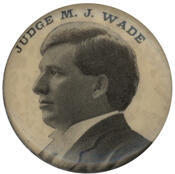
Martin Joseph Wade (October 20, 1861 – April 16, 1931) was a United States representative from Iowa and a United States district judge of the United States District Court for the Southern District of Iowa. A member of the Democratic Party, he served one term in the United States House of Representatives from 1903 to 1905 and later held a long tenure on the federal bench. His service in Congress and on the judiciary occurred during a significant period in American history, and he participated in the democratic process while representing the interests of his constituents and later adjudicating major federal cases.
Wade was born on October 20, 1861, in Burlington, Chittenden County, Vermont. In his early childhood he moved with his parents to Iowa, where the family settled on a farm in Butler County. At that time the area was described as largely a broad, unbroken prairie, and the family experienced the usual hardships of pioneer life. He attended the common schools of Iowa and then St. Joseph’s College in Dubuque, Iowa, an institution that later became Columbia University (distinct from the New York institution of the same name). His early education in rural Iowa and at Catholic institutions helped shape both his professional discipline and his later connections to the University of Iowa and the Iowa legal community.
Wade pursued legal studies at the University of Iowa College of Law, receiving a Bachelor of Laws degree in 1886. That same year he was admitted to the bar and entered private practice in Iowa City, Iowa. He practiced law there from 1886 to 1893, building a reputation as a capable attorney. In 1890 he joined the faculty of the University of Iowa, beginning a long association with legal education. From 1890 to 1894 he served as a lecturer in law, and from 1894 to 1903 he was Professor of Medical Jurisprudence, teaching the intersection of law and medicine at a time when that field was still emerging. His prominence in the profession was reflected in his election as president of the Iowa State Bar Association, a position he held in 1897 and 1898.
In addition to his academic work, Wade advanced rapidly in the state judiciary. He was appointed and then served as a judge of the Iowa District Court for the Eighth Judicial District from 1893 to 1902. On that court he presided over a wide range of civil and criminal matters, gaining practical judicial experience and public visibility. His tenure on the district court bench, combined with his leadership in the bar association and his teaching at the University of Iowa, established him as one of the leading legal figures in Iowa at the turn of the twentieth century.
Wade entered national politics as a Democrat from Iowa’s 2nd congressional district. In 1902 he was elected to the United States House of Representatives for the 58th Congress, succeeding Republican John N. W. Rumple, who did not seek reelection for health reasons. Wade defeated Republican attorney W. H. Hoffman in the general election. In autobiographical information submitted to Congress after his election, Wade noted that he had refused to make any campaign speeches during the race because he considered it improper for a sitting judge to engage in active political advocacy. He served in the House from March 4, 1903, to March 3, 1905. During his single term he contributed to the legislative process as a Democratic member of the House of Representatives and represented the interests of his Iowa constituents during a period of rapid economic and political change in the United States.
Wade was an unsuccessful candidate for reelection in 1904 to the 59th Congress. He was defeated in the general election by Republican Albert F. Dawson amid a broader Republican landslide that year, and he left Congress on March 3, 1905. After his congressional service, he returned to private practice in Iowa City, resuming the work he had begun two decades earlier. He practiced law there from 1905 to 1915 and remained active in Democratic Party affairs. He served as a delegate to the Democratic National Convention in 1904, while still in Congress, and again in 1912, reflecting his continuing influence in party politics. One of his congressional staffers, Irvin S. Pepper, later followed him into elective office and was elected to Wade’s former House seat in 1910 after Dawson’s retirement.
Wade’s federal judicial career began during the administration of President Woodrow Wilson. On February 26, 1915, Wilson nominated him to a seat on the United States District Court for the Southern District of Iowa, filling the vacancy created by the death of Judge Smith McPherson. The United States Senate confirmed his nomination on March 3, 1915, and he received his commission the same day. As a United States district judge, Wade presided over significant federal cases for more than fifteen years. His most notable and controversial work on the bench came during World War I, when he presided over the Davenport sedition trials in 1917 and 1918. In one of those cases he sentenced Daniel Wallace to twenty years in prison for delivering a speech opposing the military draft and criticizing the United States’ allies, a sentence that reflected the era’s stringent enforcement of wartime sedition laws.
Wade continued to serve on the United States District Court for the Southern District of Iowa until his death. His judicial service terminated on April 16, 1931, when he died in Los Angeles, California, while on a visit to that state. Following his death, his body was returned to Iowa, and he was interred in St. Joseph’s Cemetery in Iowa City. His papers are preserved in the University of Iowa Libraries Special Collections and Archives, and his published works are available through collections such as Project Gutenberg and the Internet Archive, documenting the career of a lawyer, legislator, and federal judge who played a notable role in Iowa and national legal history in the late nineteenth and early twentieth centuries.
Congressional Record