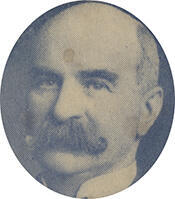
Martin Emerich (April 27, 1846 – September 25, 1922) was a Democratic U.S. Representative from Illinois who served one term in the United States House of Representatives from 1903 to 1905. Over the course of a long public career that spanned two states, he held legislative, executive, and advisory posts at the municipal, county, and state levels before his election to Congress, and later became associated with the commercial and manufacturing life of Chicago.
Emerich was born in Baltimore, Maryland, on April 27, 1846. He attended the public schools of Baltimore, receiving a basic education that prepared him for a career in business and public affairs. After leaving school he entered the importing business, gaining early experience in commerce and trade in a major Atlantic port city. His familiarity with the economic and social conditions of Baltimore’s working population would later inform his service in local and state government.
Emerich’s formal public service began in Baltimore in 1870, when he was appointed ward commissioner of the poor, a position that involved oversight of relief and assistance to the city’s indigent residents. He continued to rise in Maryland politics and government, serving as a member of the Maryland House of Delegates from 1881 to 1883. Concurrently, he was appointed aide-de-camp to Governor William T. Hamilton, serving in that capacity from 1880 to 1884, and subsequently as aide-de-camp to Governor Elihu E. Jackson from 1884 to 1887. These roles placed him in close proximity to the state’s chief executives and gave him experience in the ceremonial and administrative functions of the governor’s office during a period of post–Civil War adjustment and economic development in Maryland.
In 1887 Emerich moved west to Chicago, Illinois, where he continued his involvement in business and public life. Upon his arrival in Chicago he engaged in mercantile pursuits, participating in the city’s rapidly expanding commercial sector. By 1896 he had shifted his focus to manufacturing, entering the brick-making industry at a time when Chicago’s growth created a strong demand for building materials. His civic engagement paralleled his business activities: he served as a member of the Board of Commissioners of Cook County from 1892 to 1894, contributing to the administration of one of the nation’s largest counties, and in 1897 he held the office of assessor of South Chicago, where he was responsible for property assessment and related fiscal matters in that important industrial district.
Emerich’s accumulated experience in Maryland and Illinois politics led to his election to the national legislature. A member of the Democratic Party, he was elected as a Democrat to the Fifty-eighth Congress and served as a Representative from Illinois from March 4, 1903, to March 3, 1905. During this single term in the U.S. House of Representatives, he participated in the legislative process at a time of significant economic and political change in the United States, representing the interests of his Illinois constituents and contributing to debates and votes on national policy. His service in Congress occurred during the early years of the twentieth century, a period marked by issues of industrial regulation, labor, and urban growth, in which the perspectives of a businessman and local official from Chicago were of particular relevance.
Emerich chose not to seek renomination in 1904 and thus did not stand for a second term. At the conclusion of his service in Congress in 1905, he retired from public office. He returned to private life in Chicago, where he had established his business and political base, and withdrew from active participation in electoral politics, although his earlier roles left a record of sustained engagement in public affairs across several decades and jurisdictions.
Martin Emerich died on September 25, 1922, while on a visit to New York City, at the age of seventy-six. His remains were returned to Chicago, Illinois, where he was interred in Rosehill Cemetery, a burial place for many of the city’s prominent figures. His career reflected the mobility and public-mindedness of late nineteenth- and early twentieth-century American politicians who combined business pursuits with service at multiple levels of government.
Congressional Record