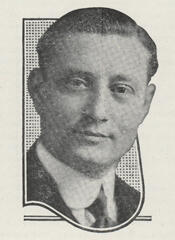
Martin Luther Davey (July 25, 1884 – March 31, 1946) was an American Democratic politician from Ohio who served as a Representative from Ohio in the United States Congress from 1917 to 1929 and later as the 53rd governor of Ohio. A prominent figure in Ohio’s political and business life in the early twentieth century, he combined a career in elective office with leadership in his family’s nationally known tree-care enterprise.
Davey was born on July 25, 1884, in Kent, Portage County, Ohio. He was one of seven children of John Davey, widely known as the “tree doctor” and founder of the Davey Tree Expert Company, and Bertha Reeves, the daughter of a minister. Two of the children, including his sister Mary and another sibling, died before reaching maturity; his surviving siblings were Belle, Wellington, James (Jim), and Paul. The family’s finances were often strained, and from an early age Martin contributed to the household income. As a child he made and sold his own horseradish, turning all profits over to his family, and he also worked on his father’s farm and in the family greenhouse. These experiences, together with his natural aptitude for salesmanship and his ability to cultivate friendships with customers, helped shape his later business and political career. As a young man he attended a country fair where he heard William Jennings Bryan deliver the famous “Cross of Gold” speech, an event that deeply impressed him and inspired his ambition to enter politics.
Davey was educated in the public schools of Kent and graduated from Kent High School. After high school he moved to Cleveland, Ohio, where he worked for the Oliver Typewriter Company. Beginning at a salary of $10.00 a week plus commission, he quickly distinguished himself as an excellent salesman and soon was earning about $200.00 a month, a substantial income for the time. Seeking further advancement, he enrolled at Oberlin College. At Oberlin he was active in athletics, playing football and competing on the track team, and he stood third in his class academically when he interrupted his studies to assist in the development of the growing family business, the Davey Tree Expert Company, founded in 1880 in Kent. He later returned to his studies for a time, but his education was permanently cut short after his marriage and the birth of his first child. In 1907 he married Berenice Chrisman of Kent; the couple had three children: Evangeline, Mary Bernice, and Martin Luther Jr. Mary Bernice died in childhood. Evangeline later married Alexander M. Smith, while Martin L. Jr. went on to work in the family business.
Davey’s public career began at the local level. Active in Democratic Party politics, he was elected mayor of Kent, serving from 1913 to 1918. His tenure as mayor coincided with a period of growth and modernization in the community, and it provided him with administrative experience and a public platform that facilitated his entry into national politics. In 1918 he was elected as a Democrat to the United States House of Representatives to fill the unexpired term of Elsworth R. Bathrick. He was re-elected in November 1918, thereby beginning a continuous period of service in Congress that extended through the 1920s. Although he lost a bid for re-election in 1920, he returned to the House after winning election again in 1922 and was subsequently re-elected in 1924 and 1926. In all, Martin Luther Davey served five terms in the U.S. House of Representatives, from 1917 to 1929, representing Ohio’s 14th congressional district. During these years he participated in the legislative process at a time marked by World War I, the postwar transition, and the onset of the Roaring Twenties, and he represented the interests of his constituents as a member of the Democratic minority in a predominantly Republican era.
After leaving Congress in 1929, Davey turned his attention to statewide office. In 1928 he made his first bid for governor of Ohio as the Democratic nominee but was defeated. He remained an influential figure in the state party and continued his involvement in business, particularly in the management and expansion of the Davey Tree Expert Company, which by then had become a leading firm in arboriculture and tree care. In 1934 he again sought the governorship and was elected, taking office as the 53rd governor of Ohio. He served two two-year terms, from 1935 to 1939, during the depths of the Great Depression, when state governments were grappling with unemployment, relief administration, and the implementation of New Deal–related programs. In 1938 he was defeated for renomination by fellow Democrat Charles W. Sawyer, ending his consecutive service in the governor’s office. Davey remained a significant Democratic figure and in 1940 was again his party’s nominee for governor, but he lost the general election to the incumbent Republican governor, John Bricker.
In his later years Davey continued his association with the family’s enterprises and maintained a respected position in Ohio public life. The Davey Tree Expert Company, headquartered in Kent, remained closely identified with the Davey family, including his father John, his brother Paul, and his son Martin Jr. The family’s prominence in the community and state is reflected in several commemorations. Davey Elementary School in Kent, located adjacent to the historic John Davey House property, is named in honor of Martin Luther Davey, his father John, his brother Paul, and his son Martin Jr. At the Ohio Expo Center and State Fair in Columbus, the Davey Beef Building, erected in 1977 (and later demolished), was named in his honor, recognizing his contributions to the state. Martin Luther Davey died on March 31, 1946, leaving a legacy as both a public servant—mayor, congressman, and governor—and a leader in one of Ohio’s notable family-founded businesses.
Congressional Record