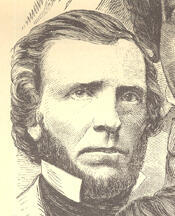
Martin Jenkins Crawford (March 17, 1820 – July 23, 1883) was an American lawyer, jurist, and legislator who served as a Democratic Representative from Georgia in the United States Congress from 1855 to 1861 and later as a representative to the Provisional Confederate Congress during the American Civil War. An antebellum U.S. Representative, he played a notable role in state and national politics in the turbulent years leading up to and during the secession crisis.
Crawford entered public life in Georgia state politics in the mid-1840s. From 1845 to 1847, he served in the Georgia House of Representatives, gaining early legislative experience and establishing himself within the Democratic Party. In 1849 he moved to Columbus, Georgia, which would remain his principal home and the base of his political and legal career. As sectional tensions increased, he participated in regional deliberations over Southern interests, serving as a delegate to the Southern convention at Nashville in May 1850, where Southern leaders met to discuss their response to national controversies over slavery and territorial expansion.
By the early 1850s, Crawford had also embarked on a judicial career. From February 1, 1854, to November 1854, he served as a judge of the superior courts of the Chattahoochee circuit. His judicial service in this period helped solidify his reputation as a capable lawyer and jurist and positioned him for higher office. That same year, in 1854, he was elected as a Democrat to the 34th United States Congress to represent Georgia’s 2nd congressional district.
Crawford’s service in the U.S. House of Representatives spanned three consecutive terms during a significant period in American history. First elected to the 34th Congress, he was reelected to the 35th and 36th Congresses, and his congressional tenure extended from March 4, 1855, until his resignation on January 23, 1861. As a member of the House of Representatives, he participated in the legislative process and represented the interests of his Georgia constituents at a time of mounting sectional conflict. A member of the Democratic Party, he contributed to debates over national policy in the years immediately preceding the Civil War. His resignation came one day after Georgia seceded from the Union on January 22, 1861, reflecting his alignment with his state’s decision to leave the United States.
Following his departure from the U.S. Congress, Crawford immediately entered the political structure of the nascent Confederacy. He was elected a representative to the Confederate Provisional Congress, serving from January 1861 to February 22, 1862, where he helped shape the early legislative framework of the Confederate States of America. During this period, Confederate President Jefferson Davis appointed him as a special commissioner to the United States in Washington, D.C., a diplomatic role intended to manage relations and negotiations in the brief interval between secession and full-scale war.
Crawford also took an active part in the Confederate military effort. In May 1862 he organized the 3rd Regiment, Georgia Cavalry, to support the Confederate States Army, and the regiment operated with the Army of Tennessee. Under his command, the 3rd Georgia Cavalry saw combat in Kentucky, fighting under Confederate cavalry leader General Joseph Wheeler. In a subsequent campaign near New Haven, most of the regiment was taken prisoner; the portion that successfully retreated participated in the Battle of Murfreesboro. After these engagements, the regiment was reconstituted under Colonel J. J. Morrison. The 3rd Georgia Cavalry ultimately surrendered on April 26, 1865, with the Army of Tennessee. Among the surrendering field officers were Colonels Martin J. Crawford, Richard E. Kennon, and Robert Thompson; Lieutenant Colonel James T. Thornton; and Majors Daniel F. Booton and Hiram H. Johnson.
In the postwar era, Crawford resumed his legal and judicial career in Georgia. On October 1, 1875, he became judge of the superior court of the Chattahoochee circuit to fill a vacancy, returning to the same circuit where he had briefly served as a superior court judge in 1854. He was reappointed in 1877 and continued on that bench until he resigned on February 9, 1880. The following day, February 10, 1880, he was appointed to a vacant position on the Supreme Court of Georgia. As a justice of the state’s highest court, he served until his death, contributing to the development of Georgia jurisprudence during the Reconstruction and post-Reconstruction periods.
Martin Jenkins Crawford died in Columbus, Georgia, on July 23, 1883, while still serving on the Supreme Court of Georgia. He was buried in Linwood Cemetery in Columbus. His career spanned state and national legislatures, Confederate political and military service, and significant judicial responsibilities in Georgia, marking him as a prominent figure in the political and legal history of his state in the nineteenth century.
Congressional Record