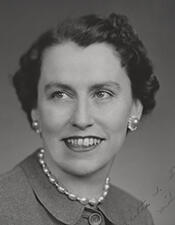
Martha Wright Griffiths (January 29, 1912 – April 22, 2003) was an American lawyer, judge, and legislator who became the first woman elected to the United States Congress from Michigan as a member of the Democratic Party and the first woman to serve on the House Committee on Ways and Means. Born Martha Edna Wright in Pierce City, Missouri, she attended public schools before enrolling at the University of Missouri, from which she graduated with a Bachelor of Arts degree in 1934. She then pursued legal studies at the University of Michigan Law School, earning her law degree in 1940. On July 9, 1940, she married Hicks George Griffiths, a fellow lawyer and judge who later served as chairman of the Michigan Democratic Party from 1949 to 1950; he died on March 4, 1996.
After law school, Griffiths began her professional career in private legal practice before joining the legal department of the American Automobile Insurance Company in Detroit, where she worked from 1941 to 1942. During World War II, she served as an ordnance district contract negotiator from 1942 to 1946, gaining experience in federal contracting and wartime production oversight. Her legal and administrative work during this period helped establish her reputation as a capable attorney with a strong command of complex regulatory and contractual issues, laying the groundwork for her subsequent entry into elective office.
Griffiths moved into state politics in the late 1940s. She was elected to the Michigan House of Representatives from the Wayne County 1st District and served there from 1949 to 1953. In 1953, she was appointed recorder and judge of the Recorder’s Court in Detroit, becoming the first woman to sit as a judge on that court. She held that judicial position from 1953 to 1954. Her tenure on the bench, combined with her legislative experience in Lansing, positioned her as a prominent figure in Michigan’s Democratic Party and a credible candidate for national office.
In 1954, Griffiths was elected as a Democrat from Michigan’s 17th congressional district to the 84th Congress and took office on January 3, 1955. She served ten consecutive terms in the United States House of Representatives, being re-elected to the nine succeeding Congresses and serving until December 31, 1974. Her service in Congress thus extended from 1955 to 1975, a period marked by major developments in civil rights, social policy, and federal economic legislation. During this time she became the first woman to serve on the powerful House Committee on Ways and Means, where she played a significant role in tax, Social Security, and economic policy deliberations. She also served as a delegate to the Democratic National Conventions in 1956 and 1968. In 1974, she chose not to be a candidate for re-election to the 94th Congress.
Griffiths’s congressional career was distinguished by her leadership on civil rights and gender equality. She was instrumental in securing the inclusion of the prohibition of sex discrimination under Title VII of the Civil Rights Act of 1964, helping to ensure that employment discrimination on the basis of sex was explicitly outlawed alongside discrimination based on race, color, religion, and national origin. She was a principal sponsor and leading advocate of the Equal Rights Amendment (ERA), one of 33 proposed constitutional amendments to pass Congress and be sent to the states for ratification, and among the six that ultimately were not ratified. Her persistent advocacy for the ERA led The Guardian to describe her as “the mother of the Equal Rights Amendment,” noting that the “weapons she deployed during her 10-term congressional career included implacable determination, a lawyer’s grasp of procedural niceties, and a tongue like a blacksmith’s rasp.” She also worked on animal welfare legislation, introducing in 1955, alongside Senator Hubert Humphrey, the first version of what became the federal Humane Slaughter Act, which sought to prohibit the shackling and hoisting of conscious animals and the use of sledgehammers for stunning; a version of this law sponsored by Griffiths and Representative William R. Poage was enacted in 1958.
Throughout her public life, Griffiths articulated a broad commitment to justice and equal treatment under the law. Reflecting on her motivations, she stated that she did not so much possess perseverance as a deep sense of indignation at the unjust treatment of women, and that she felt a similar concern for Black, Latino, and Asian Americans. She argued that if the United States was to live up to its ideals as “the land of the free and the brave,” it must provide genuine justice to all its people. She credited some of this outlook to her father, whom she adored and who, she recalled, believed that girls were smarter than boys—an attitude she noted was unusual in her youth.
After leaving Congress at the end of 1974, Griffiths returned to the practice of law before reentering public office at the state level. In 1982, she was elected the 59th lieutenant governor of Michigan on the ticket headed by Governor James Blanchard, becoming the first woman elected to that office in the state’s history. (Matilda Dodge Wilson had earlier been appointed, rather than elected, as Michigan’s first female lieutenant governor in 1939.) Griffiths served as lieutenant governor from 1983 to 1991, continuing her long record of public service and further solidifying her status as a trailblazer for women in government.
In recognition of her contributions, Griffiths was inducted into the Michigan Women’s Hall of Fame in 1983 and into the National Women’s Hall of Fame in 1993. She was a member of the American Association of University Women, and the AAUW of Michigan later established the “Martha Griffiths Equity Award” in her honor, reflecting her enduring legacy in the struggle for gender equity. After retiring from public life, she lived in Armada, Michigan, where she remained until her death on April 22, 2003, at the age of 91.
Congressional Record