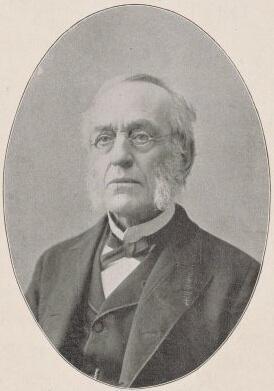
Marius Schoonmaker (April 24, 1811 – January 5, 1894) was a United States Representative from New York and a prominent lawyer and public official in Kingston, Ulster County. He was born in Kingston to Cornelia (née Groen) (1784–1874) and Zachariah Schoonmaker (1785–1818). His grandfather was Congressman Cornelius C. Schoonmaker (1745–1796), who had also served in the United States Congress, establishing a family tradition of public service. Schoonmaker’s father died when he was young, but despite this early loss he attended the local public schools in Kingston, receiving the education that would prepare him for a professional and political career.
Schoonmaker pursued higher education at Yale College, from which he graduated in 1830. After completing his studies, he read law and was admitted to the bar in 1833. He then commenced the practice of law in his native Kingston, where he quickly became an established member of the local bar. His legal practice formed the foundation of his later public life, providing both professional standing and connections within Ulster County and the broader region of upstate New York.
On December 13, 1837, in Montrose, New York, Schoonmaker married Elizabeth Van Wyck Westbrook (1810–1887), the daughter of Cornelius DePuy Westbrook (1782–1858) and his first wife, Hannah Van Wyck (1787–1817). Through his wife, he was connected to the prominent DuBois family, as she was a descendant of Louis DuBois, an early Huguenot settler in the Hudson Valley. The couple made their home in Kingston. Among their children was Captain Cornelius Marius Schoonmaker, born February 2, 1839, in Kingston, who graduated from the United States Naval Academy and served in the United States Navy. Captain Schoonmaker died on March 16, 1889, in the 1889 Apia cyclone in American Samoa, a notable event in naval history.
Schoonmaker’s political career began at the state level. A member of the Whig Party, he was elected to the New York State Senate, representing the 10th District, and served in 1850 and 1851. In this role he participated in state legislative affairs during a period of significant economic and infrastructural development in New York. His work in the State Senate helped establish his reputation as a capable legislator and prepared him for service in the national legislature.
As a member of the Whig Party representing New York, Marius Schoonmaker contributed to the legislative process during one term in the United States Congress. He was elected as a Whig to the Thirty-second Congress and served as a United States Representative from March 4, 1851, to March 3, 1853. His service in Congress occurred during a significant period in American history, marked by sectional tensions and debates over national policy. During this time he participated in the democratic process and represented the interests of his constituents from New York, contributing to the legislative work of the House of Representatives. At the conclusion of his term, he did not return to Congress and instead resumed the practice of law in Kingston.
Following his congressional service, Schoonmaker continued to hold important positions in New York State government and local affairs. He served as Auditor of the New York State Canal Department from 1854 to 1855, overseeing financial aspects of the state’s vital canal system at a time when canals were central to commerce and transportation. From 1855 to 1856 he was Superintendent of Banks for New York State, a position that placed him at the center of banking regulation and financial oversight during a period of expanding credit and economic growth. His expertise in law and finance made him a trusted figure in these administrative roles.
In addition to his state-level responsibilities, Schoonmaker was deeply involved in the civic life of Kingston. He served as President of the Kingston Board of Education for nine years, reflecting a sustained commitment to public education and local institutional development. He was also President of the Village of Kingston in 1866, 1869, and 1870, guiding municipal affairs during a time of post–Civil War adjustment and local growth. In 1867 he was chosen as a delegate to the New York State Constitutional Convention of 1867–68, where he participated in efforts to revise and modernize the state’s fundamental law, further underscoring his long-standing engagement with public policy and governance.
Marius Schoonmaker spent his later years in Kingston, remaining a respected figure in the community he had served in multiple capacities throughout his life. His legacy in the city is reflected in its geography: Marius Street in Kingston is named in his honor, and Elizabeth Street is named for his wife, commemorating the couple’s prominence in local history. Schoonmaker died in Kingston on January 5, 1894, and was interred in Wiltwyck Rural Cemetery, a resting place for many of the region’s notable citizens. His life and career, spanning law, state administration, education, and national and local politics, placed him among the leading public figures of nineteenth-century Ulster County and New York State.
Congressional Record