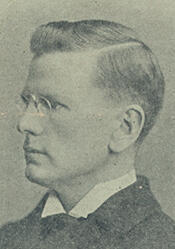
Marion De Vries (August 15, 1865 – September 11, 1939) was an American lawyer, politician, and jurist who served as a United States Representative from California, a Member and President of the Board of General Appraisers, and an Associate Judge and later Presiding Judge of the United States Court of Customs Appeals. A member of the Democratic Party, he contributed to the legislative process during two terms in the United States Congress and later played a significant role in the development of federal customs jurisprudence.
De Vries was born on August 15, 1865, on a ranch near Woodbridge in San Joaquin County, California. He attended local public schools before pursuing higher education at San Joaquin Valley College, from which he received a Bachelor of Philosophy degree in 1886. He then studied law at the University of Michigan Law School, earning a Bachelor of Laws degree in 1888. Following his graduation, he was admitted to the bar and entered private legal practice in Stockton, California, where he practiced from 1889 to 1900. In addition to his legal work, he served in the California National Guard from 1891 to 1893, rising to the rank of major and serving as signal officer on the staff of General James Budd, who later became governor of California.
Alongside his private practice, De Vries began his public career in local law enforcement. He served as assistant district attorney for San Joaquin County from January 1893 to February 1897. In this role he gained experience in public prosecution and legal administration at the county level, building a reputation that helped launch his subsequent political career. His combined experience in private practice, the National Guard, and the district attorney’s office positioned him as a prominent young Democrat in California at the close of the nineteenth century.
De Vries was elected as a Democrat to the United States House of Representatives, representing California in the 55th and 56th Congresses. He served from March 4, 1897, to August 20, 1900. During his two terms in office, he participated in the legislative process at a time of significant change in American history, including the aftermath of the Spanish–American War and the nation’s expanding role in international affairs. As a member of the House of Representatives, he represented the interests of his California constituents and took part in the broader democratic process of federal lawmaking. He resigned his seat in Congress on August 20, 1900, in order to accept appointment to a federal judicial position.
De Vries’s judicial career began with his appointment to the Board of General Appraisers, a federal body responsible for adjudicating customs disputes. He received a recess appointment from President William McKinley on June 9, 1900, to fill the seat vacated by Joseph Biddle Wilkinson Jr. McKinley formally nominated him to the same position on December 5, 1900, and the United States Senate confirmed his appointment on December 10, 1900. De Vries served as a Member of the Board and was later chosen as its President, holding the presidency from 1906 to 1910. His service on the Board of General Appraisers concluded on April 2, 1910, when he was elevated to a newly created federal appellate court specializing in customs matters.
On March 9, 1910, President William Howard Taft nominated De Vries to serve as an Associate Judge on the newly established United States Court of Customs Appeals (later known as the United States Court of Customs and Patent Appeals), to a new seat authorized by 36 Stat. 11. He was confirmed by the Senate and received his commission on March 30, 1910. As an Associate Judge, he helped shape early appellate jurisprudence in customs law during a period of expanding international trade and evolving tariff policy. His service in that capacity ended on June 28, 1921, when he was elevated to the position of Presiding Judge of the same court.
De Vries was nominated by President Warren G. Harding on June 23, 1921, to be Presiding Judge of the United States Court of Customs Appeals, filling the vacancy created by the death of Presiding Judge Robert Morris Montgomery. The Senate confirmed him on June 28, 1921, and he received his commission that same day. As Presiding Judge, he oversaw the court’s work in reviewing decisions related to customs duties and trade, guiding the institution during the early 1920s. His service as Presiding Judge terminated on October 31, 1922, when he resigned from the federal bench.
Following his resignation, De Vries returned to private legal practice, this time focusing his work in Washington, D.C., and New York City. From 1922 until his death in 1939, he practiced law in these major legal and governmental centers, drawing on his extensive experience in customs and federal law. Despite his professional activities on the East Coast, he maintained his connection to his native California. De Vries died on September 11, 1939, on his ranch near Woodbridge in San Joaquin County. He was interred in the family plot on the De Vries Ranch, returning in death to the place where his life had begun.
Congressional Record