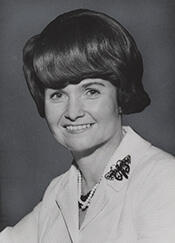
Margaret Mary Heckler (née O’Shaughnessy; June 21, 1931 – August 6, 2018) was an American politician and diplomat who served eight terms as a Republican Representative from Massachusetts in the United States Congress from 1967 to 1983, represented Massachusetts’s 10th congressional district, served as the 15th United States Secretary of Health and Human Services from 1983 to 1985, and was United States Ambassador to Ireland from 1986 to 1989. She was born Margaret Mary O’Shaughnessy in Flushing, New York, on June 21, 1931. Raised in a Catholic family of Irish heritage, she would later draw on that background in her diplomatic service to Ireland and in her political identity as a moderate Republican from the Northeast.
Heckler began her higher education at Albertus Magnus in New Haven, Connecticut, and in 1952 studied abroad at the University of Leiden in the Netherlands. She returned to Albertus Magnus College and completed her Bachelor of Arts degree in 1953. She then enrolled at Boston College Law School, where she was the only woman in her law school class, and received an LL.B. in 1956. Admitted to the Massachusetts bar, she practiced law and served as an editor of the Annual Survey of Massachusetts Law, gaining experience in legal analysis and public policy that would underpin her later legislative work. In recognition of her public service, she received an honorary doctorate from Johnson & Wales University in 1975.
Heckler’s formal political career began in Massachusetts state government. From 1963 to 1967 she served on the Governor’s Council for the Commonwealth of Massachusetts, becoming the first woman to hold that position. During this period she also emerged on the national Republican stage, serving as a delegate to the Republican National Conventions in 1964 and 1968. Her early service in state government and party politics helped establish her reputation as a capable and ambitious Republican officeholder at a time when relatively few women held high elective office.
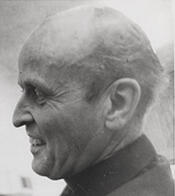
In 1966, Heckler sought a seat in the United States House of Representatives and won the Republican primary by defeating 42-year incumbent Joseph W. Martin Jr., a former Speaker of the House who was then 82 years old and 46 years her senior. In the general election she won with 51 percent of the vote, becoming the first woman representative to Congress from Massachusetts elected in her own right. She entered the 90th Congress on January 3, 1967, and was subsequently re-elected seven more times, serving continuously until January 3, 1983. When she was first elected, she was one of only 11 women in Congress. Representing Massachusetts’s 10th congressional district, she built an especially effective network of constituent services that enabled her to retain her seat in an overwhelmingly Democratic state, even as she became known in Washington as a social figure with a marked interest in high fashion.
During her congressional service, Heckler supported moderate to liberal policies favored by many Massachusetts voters while remaining a member of the Republican Party. She voted in favor of the Civil Rights Act of 1968 and in 1972 co-sponsored Title IX, which barred sex discrimination in any education program or activity receiving federal financial assistance. As a member of the House Banking and Currency Committee from 1968 to 1974, she authored the Equal Credit Opportunity Act of 1974, which for the first time in American history gave women the right to seek credit in their own names. She was also an outspoken advocate for, and co-sponsor of, the Equal Rights Amendment. In 1977 she launched and co-founded the Congresswoman’s Caucus, the first all-women’s caucus in Congress, a bipartisan group of 14 members focused on achieving equality for women in Social Security, tax laws, and related areas. At the 1980 Republican National Convention, she urged presidential nominee Ronald Reagan to appoint the first woman to the Supreme Court, reflecting her long-standing commitment to women’s equality.
Heckler’s committee assignments in the House were extensive and influential. In addition to her service on the Banking and Currency Committee, she served on the Agriculture Committee from 1975 to 1980 and on the Joint Economic Committee from 1975 to 1982. She was also a long-serving member of the Veterans’ Affairs Committee from 1967 to 1982, where she rose to become the ranking Republican member. Her legislative portfolio ranged from economic and banking issues to agriculture and veterans’ policy, and she participated actively in the broader democratic process during a significant period in American history marked by the Vietnam War, the civil rights movement, and shifting economic conditions.
Following the 1980 census, Massachusetts lost one of its congressional seats due to population changes. Heckler’s district, then the only one in the state large enough not to require redrawing, was combined with the district of freshman Democratic Representative Barney Frank. The new district was numbered as Frank’s 4th District but was geographically more similar to Heckler’s old district. In the 1982 election, both incumbents ran against each other. Although Heckler began the race as the frontrunner and had opposed President Reagan on approximately 43 percent of House votes, Frank successfully portrayed her as a Reagan ally by highlighting her early support for his tax cuts, which she later partially retracted. She lost the race by a larger-than-expected margin of about 20 percent. After her defeat, no woman would be elected to Congress from Massachusetts until Niki Tsongas won a special election in 2007.
After leaving Congress in January 1983, Heckler was considered for several high-profile positions in the Reagan administration. She reportedly turned down offers, including the post of Secretary of the Treasury, before President Reagan nominated her to serve as Secretary of Health and Human Services, replacing Richard Schweiker. She was confirmed by the Senate on March 3, 1983, by a vote of 82–3, and became the 15th Secretary of Health and Human Services. On January 21, 1985, during Reagan’s second inauguration, she became the first woman ever designated as the “designated survivor,” the Cabinet official kept at a secure location during major national events. As secretary, she supported the administration’s more conservative fiscal policies and presided over staffing cuts in the department as part of broader federal spending reductions, while also speaking frequently on a wide array of public health issues, including the emerging AIDS crisis.
One of Heckler’s most enduring contributions at HHS was her focus on racial and ethnic health disparities. Early in her tenure she commissioned the Secretarial Task Force on Black and Minority Health to investigate what she described as a “sad and significant fact: there was a continuing disparity in the burden of death and illness experienced by Blacks and other minority Americans as compared with our nation’s population as a whole.” The resulting document, The Secretary’s Report on Black and Minority Health—often called the “Heckler Report”—became a landmark in the study of health disparities and health equity and provided a historical foundation for many subsequent reports and initiatives. The work of the task force, on which Clarice Reid served, led to the establishment of the Office of Minority Health within HHS. Heckler also sought to elevate the federal response to AIDS, working to make AIDS the nation’s number one health priority despite difficulty in getting the topic placed on Cabinet meeting agendas. She attempted to calm public fears by assuring Americans that the nation’s blood supply was “100% safe… for both the hemophiliac who requires large transfusions and for the average citizen who might need it for surgery,” and she made a point of donating blood and publicly shaking hands with AIDS patients.
Heckler’s tenure at HHS was not without controversy. In 1984, her husband, John Heckler, filed for divorce, and the case became a subject of Washington press attention. The dispute, which involved questions over whether Massachusetts or Virginia—where she had moved—had jurisdiction, unfolded during an election year and raised concerns within the administration about its potential impact on conservative voters. Within the administration, some critics questioned her administrative management of the large department, and following President Reagan’s landslide re-election in 1984, White House Chief of Staff Donald Regan pressed for a Cabinet reshuffle. In November 1985, Reagan nominated Heckler to serve as United States Ambassador to Ireland, and she left HHS in 1985.
Heckler was confirmed as Ambassador to Ireland by a Senate voice vote in December 1985 and took up the post in 1986. During her tenure, she played a key role in securing a U.S. grant of approximately $120 million to the International Fund for Ireland, an economic development organization intended to promote peace and stability through investment and job creation. She became a frequent guest on Irish television programs and was widely regarded as an effective spokesperson for U.S. government policies on issues ranging from Central America to international trade. On May 31, 1987, she became the first woman to deliver the commencement address in the history of the University of Scranton. In February 1989, she announced her intention to resign as ambassador to pursue a private career, and her term concluded in August 1989.
In later years, Heckler remained associated with public affairs and her legacy as a pioneering woman in Republican politics and federal policymaking. Her papers were deposited in the John J. Burns Library at Boston College, providing a record of her congressional, Cabinet, and diplomatic careers, including her work on women’s rights, civil rights, health policy, and U.S.–Ireland relations. She lived in the Washington, D.C. area during her final years. Margaret Mary Heckler died at Virginia Hospital Center in Arlington, Virginia, on August 6, 2018, at the age of 87.
Congressional Record