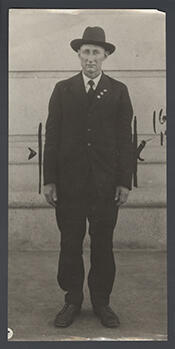
Manuel Herrick, nicknamed the “Okie Jesus Congressman” (September 20, 1876 – c. January 11, 1952), was a United States Representative from Oklahoma who served one term in the U.S. House of Representatives from March 4, 1921, to March 3, 1923. Born in the late nineteenth century, he came of age during a period of rapid expansion and change in the American West, an environment that shaped both his outlook and his later political career. His life spanned from the post-Reconstruction era through the First World War and into the early years of the Cold War, and his brief but notable tenure in Congress reflected the political and social currents of the early 1920s.
Details of Herrick’s early life and family background are relatively sparse in the historical record, but he was part of the generation that experienced the closing of the American frontier and the development of the Great Plains. Growing up in this context, he was exposed to the challenges of rural life, agricultural development, and the evolving relationship between local communities and the federal government. These experiences informed his understanding of the needs and concerns of ordinary citizens, particularly those living in newly settled or rapidly developing regions such as Oklahoma.
Herrick’s formal education, like that of many of his contemporaries in the region, was likely limited and practical in nature, oriented toward the demands of work and community life rather than advanced academic study. Nonetheless, he developed sufficient standing in his community to enter public life and ultimately seek national office. His background in a frontier and agricultural setting helped him to connect with voters in Oklahoma, a state that had only been admitted to the Union in 1907 and was still defining its political identity in the early twentieth century.
By the time Herrick entered national politics, Oklahoma was emerging as an important state in the context of World War I and the Roaring Twenties, with its economy tied to agriculture, natural resources, and the broader transformations sweeping the country. A member of the Republican Party, Herrick aligned himself with the national Republican ascendancy that followed the end of World War I. His decision to run for Congress reflected both the growing political competitiveness of Oklahoma and the appeal of Republican policies in the postwar period, including promises of stability, economic growth, and a return to “normalcy.”
Herrick was elected as a Republican to the Sixty-seventh Congress and served as a Representative from Oklahoma in the United States Congress from 1921 to 1923. His term in office, from March 4, 1921, to March 3, 1923, coincided with the administration of President Warren G. Harding and a significant period in American history marked by postwar adjustment, debates over Prohibition, immigration, and economic policy, and the early stirrings of the Roaring Twenties. As a member of the House of Representatives, Manuel Herrick participated in the democratic process, contributed to the legislative work of the chamber, and represented the interests of his Oklahoma constituents during a time of national transition.
During his single term, Herrick took part in the legislative deliberations of the Sixty-seventh Congress, which addressed issues ranging from veterans’ benefits and fiscal policy to regulation of emerging industries and the federal government’s role in a rapidly modernizing society. Although he did not become a major national figure in congressional leadership, his service reflected the broader participation of newer states like Oklahoma in shaping federal policy. His distinctive nickname, the “Okie Jesus Congressman,” underscored the unusual public persona and religiously inflected rhetoric that made him a memorable, if unconventional, figure in the political life of his era.
After leaving Congress at the conclusion of his term in March 1923, Herrick did not return to the House of Representatives and did not hold further national office. His later years unfolded against the backdrop of the Great Depression, World War II, and the early postwar period, though he remained outside the center of national political power. Manuel Herrick died around January 11, 1952, closing the life of a man whose brief congressional service captured a moment in Oklahoma’s and the nation’s political development during the World War I and Roaring Twenties era.
Congressional Record