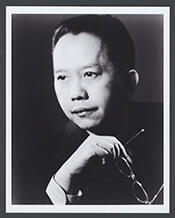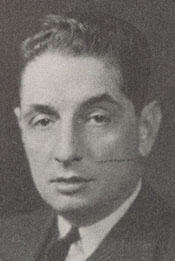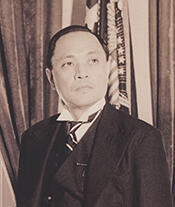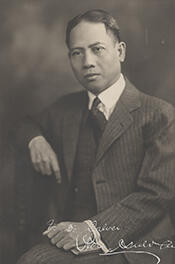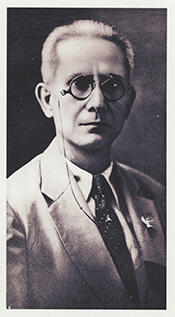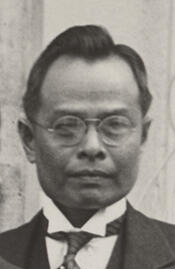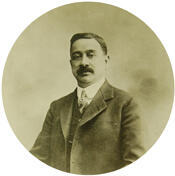
Manuel Noguera Earnshaw (November 19, 1862 – February 13, 1936) was a Filipino engineer, industrialist, and politician who served as a Resident Commissioner from the Philippine Islands in the United States Congress from 1913 to 1917. Born in Cavite, in the Captaincy General of the Philippines, on November 19, 1862, he was the eldest of three sons of British engineer Daniel Earnshaw and his Spanish-Filipina wife, Gavina Noguera. His younger brothers were Tomás Earnshaw, who would later become mayor of Manila, and Daniel Earnshaw. Growing up in a family that combined British engineering traditions with Spanish-Filipino heritage, he was exposed early to both technical pursuits and the evolving political and social environment of the late Spanish colonial period.
Earnshaw received his early education in Manila, where he attended the Ateneo Municipal de Manila, one of the leading educational institutions in the Philippines at the time. He later pursued nautical and technical studies at the Escuela Nautica de Manila. This combination of classical and technical training prepared him for a career that would bridge maritime, engineering, and industrial enterprises, and laid the groundwork for his later prominence in the drydocking and ship repair industry.
In 1884, Earnshaw became engaged in engineering and the drydocking business, entering a field that was vital to the maritime commerce of the archipelago. He founded the Earnshaw Slipways & Engineering Co., and served as its president and general manager. Under his leadership, the firm became a significant enterprise in Manila’s harbor and industrial sector, providing essential services to shipping and contributing to the modernization of the Philippines’ maritime infrastructure. His success as an engineer and businessman established him as a leading figure in the economic life of the islands and gave him the experience and public standing that would later support his entry into political life.
Earnshaw’s political career reached its peak with his election as a Resident Commissioner from the Philippine Islands to the United States House of Representatives. Elected as an Independent candidate, he began his service in Washington, D.C., on March 4, 1913. From 1913 to 1917 he served two terms as a Representative from the Philippine Islands in the United States Congress, during a significant period in American and Philippine history marked by debates over colonial policy, self-government, and evolving U.S.–Philippine relations. Although Resident Commissioners did not possess full voting rights on the House floor, Earnshaw, as a member of the House of Representatives in this capacity, participated in the democratic process, contributed to the legislative deliberations, and represented the interests of his Filipino constituents before the U.S. Congress. He was not a candidate for renomination in 1916, concluding his congressional service on March 3, 1917.
During his tenure in Congress, Earnshaw was identified with the Independent political designation rather than with a formal U.S. party organization, and in Philippine political terms he was effectively a member of an unknown or nonaligned party. From 1913 to 1917 he worked within the institutional framework of the House to advance Philippine concerns, drawing on his background in engineering and business to inform his perspective on economic development, infrastructure, and governance. His service coincided with broader movements toward increased Filipino participation in government and the gradual redefinition of the islands’ status under American sovereignty.
After leaving Congress, Earnshaw did not immediately return to his earlier business pursuits on a full-time basis, but he remained associated with the industrial and commercial life of the Philippines for several years. In 1921 he discontinued his former business activities and retired to Cavite, where he had been born. In retirement he lived away from the forefront of public affairs, as the Philippines moved through the final years of the American colonial period toward the establishment of the Commonwealth in 1935.
Manuel Noguera Earnshaw died in Manila, then part of the Commonwealth of the Philippines, on February 13, 1936. He was originally buried in Manila North Cemetery, one of the principal cemeteries of the capital. His remains were later transferred to San Agustin Church in Manila, a historic church in Intramuros. His legacy is commemorated in the city’s geography: M. Earnshaw Street in Sampaloc, Manila, is named in his honor, while T. Earnshaw Street in Tondo is named for his brother Tomás Earnshaw. His career as an engineer, industrialist, and Resident Commissioner places him among the early generation of Filipino leaders who represented the Philippine Islands in the United States Congress and helped shape the evolving relationship between the two countries.
Congressional Record