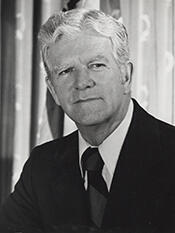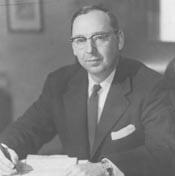
Magnus Tate (September 1, 1767 – March 30, 1823) was an American politician and lawyer who served in the Virginia House of Delegates, held local judicial and law-enforcement offices in Berkeley County, and represented Virginia as a Federalist in the United States House of Representatives. He lived and worked during a formative period in the early republic, participating in both state and national legislative processes and representing the interests of his constituents in what is now the Eastern Panhandle of West Virginia.
Tate was born on September 1, 1767, in Berkeley County in the Colony of Virginia, in the portion of the colony that is now part of West Virginia. He was initially raised in the Religious Society of Friends (Quakers) and was associated with the Hopewell Friends Meeting in Frederick County, Virginia, in 1776. His early religious affiliation placed him within a community that, soon after his youth, formally prohibited its members from owning enslaved persons. As a young man, Tate studied law, preparing for a professional career at the bar. Outside his legal and political pursuits, he was known to have a strong interest in horses, dogs, and the fox chase, reflecting the rural gentry culture of his region.
Tate married and established a large family in Berkeley County. Among his children was Magnus Tate Jr., who followed his father into public service and became a member of the Virginia House of Delegates in 1802 and was re-elected in 1803. By the time of the 1820 United States Census, Magnus Tate Sr. was recorded as owning 11 enslaved persons. His household also included 13 free white persons, 5 of them under age 16 and only 2 older than 25, illustrating both the size of his family and his participation in the system of slavery that underpinned much of the region’s agricultural economy despite his early Quaker background.
Professionally, Tate combined agriculture with the practice of law. He farmed on Dry Run Road about three miles outside Martinsburg, the seat of Berkeley County, and was admitted to the bar, practicing law in the area that would later become the Eastern Panhandle of West Virginia. His legal training and local prominence led naturally into public office. Berkeley County voters first elected him to the Virginia House of Delegates, a part-time legislative body, in 1797 and re-elected him in 1798. On May 19, 1798, he was appointed a justice of the Berkeley County Court, thereby serving as a county magistrate and playing a central role in local judicial and administrative affairs. He returned to the House of Delegates for additional terms in 1809 and 1810, maintaining an active presence in state politics over more than a decade.
Tate’s congressional service came at a critical moment in national history, in the aftermath of the War of 1812 and during the early stages of what would later be called the “Era of Good Feelings.” A member of the Federalist Party representing Virginia, he was elected to the Fourteenth Congress and served one term in the United States House of Representatives from March 4, 1815, to March 3, 1817. He won election with 63.35 percent of the vote, defeating fellow Federalist Francis White. During this single term in Congress, Tate contributed to the legislative process as a Federalist voice from a predominantly agrarian district, participating in the democratic process and representing the interests of his Berkeley County constituents in debates over postwar policy and national development.
After leaving Congress, Tate continued his involvement in local public service. He was elected sheriff of Berkeley County in 1819 and was re-elected to that office in 1820, assuming responsibility for law enforcement, the execution of court orders, and various administrative duties in the county. These roles, combined with his earlier service as a delegate and magistrate, reflected a long career in which he moved among legislative, judicial, and executive functions at the county and state levels while remaining rooted in his farming and legal pursuits near Martinsburg.
Magnus Tate died near Martinsburg, then in Virginia (now West Virginia), on March 30, 1823. His life and career spanned the transition from colonial Virginia to the early United States, and his family’s continued participation in the Virginia House of Delegates through his son, Magnus Tate Jr., underscored the enduring local political influence of the Tate family in Berkeley County and the surrounding region.
Congressional Record