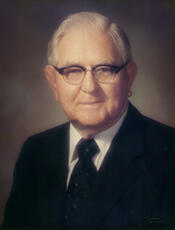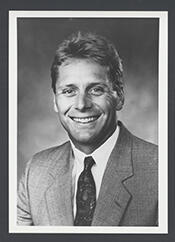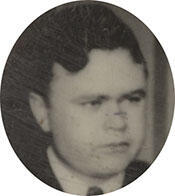
Lyle Hagler Boren (May 11, 1909 – July 2, 1992) was a Democratic politician and member of the United States House of Representatives from Oklahoma, serving five consecutive terms from 1937 to 1947. Born near Waxahachie, Texas, he was the son of Nannie May (née Weatherall) and Mark Latimer Boren. In 1917 his family moved to Lawton, Oklahoma, where he attended public schools. He later completed his secondary education in Choctaw, Oklahoma, graduating from Choctaw High School; for many years, the school’s activities center bore his name until it was renamed in 2021. Boren came from a family that would be influential in American culture and politics; his sister was Mae Axton, the songwriter best known for co-writing the hit song “Heartbreak Hotel.”
Boren pursued higher education at East Central College in Ada, Oklahoma, from which he graduated in 1930. Following his graduation, he embarked on a career in education, teaching school in Wolf, Oklahoma, from 1930 to 1935. During this period he also began to develop an interest in public affairs and administration. He later served as a deputy procurement officer for the United States Department of the Treasury, gaining experience in federal operations and finance. In addition to his public service roles, Boren became involved in agricultural and mercantile business interests, activities that helped root his political outlook in the concerns of rural communities and small enterprises.
In 1936 Boren married Christine McKown, an Oklahoma State University graduate and public school teacher. The couple had two children, David Boren and Susan Boren Dorman, and two grandchildren, including Dan Boren. His family would go on to form one of Oklahoma’s most prominent political dynasties: his son David Boren later served as Governor of Oklahoma and as a United States Senator, and his grandson Dan Boren represented Oklahoma’s 2nd congressional district in the U.S. House of Representatives from 2005 to 2013. The close-knit family and its multigenerational public service became a defining feature of Boren’s legacy.
Boren entered national politics at a remarkably young age. In November 1936, at the age of 26, he was elected as a Democrat to the United States House of Representatives, becoming one of the youngest individuals ever to serve in that body. He represented Oklahoma in Congress from January 3, 1937, to January 3, 1947, and was continuously re-elected until 1946, when he was defeated for renomination in the Democratic primary by Glen D. Johnson. His decade in the House coincided with a transformative era in American history, encompassing the later years of the New Deal, World War II, and the immediate postwar period. As a member of the House of Representatives, he participated actively in the legislative process and represented the interests of his Oklahoma constituents during these years of economic and global upheaval.
Throughout his congressional service, Boren was known for his independence within the Democratic Party. He frequently opposed efforts he viewed as expanding the federal government’s reach and worked against what he considered excessive federal spending. He angered labor unions by backing legislation to ban strikes at defense plants during a critical period for wartime production, a stance that hurt him politically but underscored his willingness to break with party orthodoxy. His legislative interests were wide-ranging and included support for cancer research, old-age pensions, regulation and oversight of the Civil Aeronautics Board, responses to newsprint and paper shortages, consumer product labeling, railroad freight rates, and the treatment of municipal bonds. In 1938 he articulated his philosophy of public service on the House floor, stating that “The greatest problem in America today is to erase the question in the minds of men, ‘What is the government going to do for me?’ and replace it with the question, ‘What can I do for my country.’”
Boren also became nationally known for his cultural and political commentary, most notably his criticism of John Steinbeck’s novel The Grapes of Wrath, which depicted the plight of Dust Bowl migrants, many from Oklahoma. He denounced the book as “a lie, a black, infernal creation of a twisted, distorted mind,” and publicly decried Steinbeck himself. His remarks reflected the resentment felt by some Oklahomans who believed the novel misrepresented their state and people, and they contributed to the broader national debate over the social and political meaning of Steinbeck’s work. His outspoken stance further solidified his reputation as an independent and sometimes controversial figure within his party and among his constituents.
After losing the Democratic renomination in 1946 and leaving Congress in January 1947, Boren resumed his business pursuits in agriculture and mercantile enterprises. He remained interested in public office and, in 1948, attempted unsuccessfully to regain his former House seat. In subsequent years he increasingly turned to roles that combined his political experience with private-sector interests. In 1957 he became a lobbyist for the railroad industry, a position that drew on his legislative background in transportation and freight regulation. He continued in that capacity until his retirement from lobbying in 1969, after which he devoted more time to ranching and other agricultural activities in Oklahoma.
Even after his formal political career ended, Boren remained active in state and party politics. He served as a spokesman and successful fund-raiser for the Oklahoma Democratic Party and worked energetically to help Democratic candidates win election to public office. His most notable efforts were on behalf of his son, David Boren, whose campaigns for Governor of Oklahoma in 1974 and for the U.S. Senate in 1978 benefited from the elder Boren’s experience, connections, and organizational skills. In this later phase of his life, he transitioned from officeholder to mentor and advocate, extending his influence through the success of others, particularly within his own family.
Boren gradually retired from public life in the mid-1980s due to failing health, bringing to a close approximately fifty years of involvement in public affairs, first as a member of Congress and later as a political adviser, lobbyist, and party leader. He moved to Oklahoma City, Oklahoma, where he lived quietly in retirement. Lyle H. Boren died there on July 2, 1992, leaving behind a legacy as an independent-minded New Deal–era congressman, a long-serving figure in Oklahoma Democratic politics, and the patriarch of a prominent political family whose impact on state and national government extended well beyond his own years in office.
Congressional Record