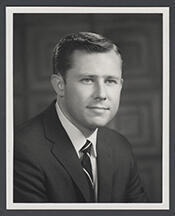
Lucien John Maciora (August 17, 1902 – October 19, 1993) was a U.S. Representative from Connecticut and a long-serving local public official in his native city of New Britain. Born in New Britain, Connecticut, to Polish immigrants, he grew up in a community with a substantial population of recent arrivals from Eastern Europe, an environment that shaped his later interest in local affairs and public service. He attended high school in New Britain, receiving the basic education that would support his subsequent work in business and politics.
After completing his schooling, Maciora entered private enterprise, working as a grocer and later expanding his activities as a business owner. His experience in small business, particularly in a growing industrial city, brought him into close contact with working-class residents and local concerns. In addition to his grocery and business interests, he later became an insurance agent, further broadening his engagement with the economic and personal needs of his community.
Maciora’s political career began at the municipal level. He served as a member of the New Britain common council from 1926 to 1934, participating in city governance during a period that spanned the late 1920s economic expansion and the onset of the Great Depression. While serving on the council, he was elected to the Connecticut House of Representatives, where he served from 1932 to 1937. In these overlapping roles, he gained experience in both local and state legislative processes. From 1934 to 1940 he also served as chairman of the New Britain police board, overseeing aspects of municipal law enforcement and public safety at a time of significant social and economic stress.
Building on his local and state service, Maciora was elected as a Democrat to the Seventy-seventh Congress, representing Connecticut in the U.S. House of Representatives from January 3, 1941, to January 3, 1943. His term in Congress coincided with the critical early years of World War II for the United States, including the period immediately following the attack on Pearl Harbor and the nation’s mobilization for war. As a member of the House during this time, he participated in the legislative response to national defense and wartime policy. He was an unsuccessful candidate for reelection to the Seventy-eighth Congress in 1942 and returned to private life and local public service after his single term.
Following his congressional service, Maciora remained active in New Britain’s civic affairs. He resumed his business and insurance activities and later took on a key fiscal role in city government. From 1950 to 1969 he served as city tax collector in New Britain, Connecticut, administering the collection of municipal revenues for nearly two decades. In this capacity he contributed to the financial management of the city during a period marked by postwar growth, suburbanization, and changing urban needs.
Lucien John Maciora lived his entire life in New Britain, maintaining close ties to the community from which he had risen to state and national office. He died on October 19, 1993, in New Britain, Connecticut. He was interred in Sacred Heart Cemetery in New Britain, reflecting both his lifelong connection to the city and his heritage within its Polish American community.
Congressional Record