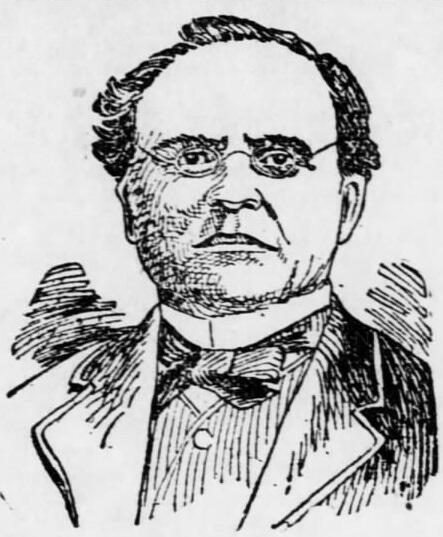
Lucas Miltiades Miller (September 15, 1824 – December 4, 1902) was a Greek American immigrant, lawyer, Democratic politician, and Wisconsin pioneer who became the first Greek American member of the U.S. House of Representatives. Born in Livadia, in the First Hellenic Republic, during the Greek War of Independence against the Ottoman Empire, he was left an orphan by that conflict before the age of four. His original birth name was lost amid the upheaval of war. He was found wandering the streets of an abandoned town shortly after fighting had occurred there and was adopted by American abolitionist Jonathan Peckham Miller, a veteran of the War of 1812 who had volunteered in the cause of Greek independence and served as a colonel in the Greek revolution. His adoptive father gave him the name “Lucas Miltiades Miller.” Lucas was one of three Greek orphans adopted by Jonathan Peckham Miller, the others being Anartes Nickolas Miller and Theseus Themistocles Miller; Jonathan Miller also had a biological daughter, Sarah, who later married Vermont politician Abijah Keith.
Miller accompanied his foster father to the United States and settled in Montpelier, Vermont, in 1828. He attended the common schools there until about age sixteen, when he was compelled to assume responsibility for his foster father’s affairs due to the latter’s medical incapacitation. During this period he studied law, obtained United States citizenship, and was admitted to the bar. His early legal training and exposure to New England political life helped shape his later career on the Wisconsin frontier. His name was often abbreviated as L. M. Miller in public and official usage, and some contemporary sources rendered his first name as “Lucius,” reflecting the fluidity with which his adopted classical name was Anglicized.
In 1846, Miller moved west to the Wisconsin Territory and purchased approximately 500 acres of land in the small settlement that would soon become Oshkosh, Wisconsin. Almost immediately he emerged as a leading figure in the community’s development. He advocated setting aside land along the Fox River for navigational improvements, recognizing the river’s importance to regional commerce. He played a central role in the successful effort to relocate the Winnebago County seat from Butte des Morts to Oshkosh, donating portions of his own land for the construction of county buildings. Over time, all of Miller’s original holdings were incorporated into the city of Oshkosh; his central homestead later became the site of what is now Menominee Park Zoo. He established a law practice in Oshkosh and, in partnership with fellow Vermonter Edward Eastman, operated a general store that served the growing population. In 1847, during the Mexican–American War, Governor Henry Dodge appointed him colonel of the Winnebago County militia, and Miller made frequent use of the honorific “Colonel” for the remainder of his life.
Miller became active in Democratic Party politics soon after settling in Wisconsin. In the political turmoil following the Mexican Cession, he affiliated with the short-lived “Union Democratic Party” and ran as its candidate for the Wisconsin Senate in what was then the 4th Senate district, but was defeated by John A. Eastman, the Regular Democrat or “Hunker” candidate. After the Compromise of 1850, he returned to the regular Democratic Party. In 1852, he was nominated for the Wisconsin State Assembly from Winnebago County’s 1st district, then comprising the southern half of the county plus Oshkosh, and he won election to the 6th Wisconsin Legislature. During his legislative term he advocated allowing the Menominee people to remain in Wisconsin and continued to press for improvements to navigation on the Fox River. That same term, the governor appointed him chairman of the state board of commissioners for public works, a post that aligned with his interest in internal improvements. He also invested in the Chicago and North Western Railway and was elected to its board of directors, further entrenching his role in the region’s economic development.
Miller’s ambitions extended to higher office. At the 1859 Democratic state convention he sought the party’s nomination for Governor of Wisconsin but received only 15 of 206 delegate votes on the first ballot and just 7 on the second before withdrawing. In 1860, he ran for the Wisconsin Senate in the 21st Senate district but lost the general election to Horace O. Crane. After the outbreak of the American Civil War, he sometimes cooperated politically with the National Union movement. In 1861 he sought the Union nomination for state bank comptroller but was defeated at the convention. Later that year, when Democratic nominee Hercules L. Dousman declined the party’s nomination for State Treasurer of Wisconsin, the Democrats turned to Miller, and he accepted. Dousman’s name, however, remained on some Democratic tickets and drew votes, and Miller lost the general election to the Union nominee, incumbent Samuel D. Hastings. Following this defeat, he withdrew from electoral politics for nearly a decade to concentrate on his legal and business interests.
Miller returned to local public life in 1871, winning election to the Winnebago County board of supervisors in the spring. That fall he ran again for the State Assembly from Winnebago County’s 1st Assembly district but was defeated by Republican Thomas Duncan Grimmer. He was reelected to the county board in 1872 and 1873 and, in November 1873, was chosen chairman of the board. With only brief interruptions, he remained on the Winnebago County board until his election to Congress in 1890. He was again elected chairman in 1878 and was reelected to that leadership position for thirteen terms, serving as chairman for the remainder of his tenure on the board. Over these years he became an instrumental figure in the civic and infrastructural development of Oshkosh and Winnebago County, reinforcing his reputation as a local leader and Wisconsin pioneer.
By 1890, Miller had developed a notable rivalry with fellow Oshkosh Democrat George White Pratt. That year he played a key role in the intra-party movement to deny Pratt the Democratic nomination for Governor of Wisconsin. At the Democratic convention for Wisconsin’s 6th congressional district, delegates were reluctant to challenge the incumbent Republican U.S. Representative Charles B. Clark. Several delegates first implored Pratt to accept the nomination, but he refused, and a subsequent offer to J. W. Hume was also declined. The convention then turned to L. M. Miller, who was away visiting family in New England. A few days later, Miller telegraphed from Vermont that he would accept the nomination, but he did not curtail his vacation to begin campaigning. Contemporary newspapers widely expected Clark to win reelection. Miller fell ill while traveling back to Wisconsin, further delaying his return, and once home he made it clear he did not intend to wage an especially vigorous campaign. Nonetheless, the political climate in Wisconsin had turned sharply against the Republicans because of the controversial Bennett Law, which had angered many of the state’s immigrants and inflamed Catholic opinion. Riding this wave of discontent, Miller defeated Clark by approximately 2,100 votes and was elected to the U.S. House of Representatives from Wisconsin’s 6th congressional district for the 52nd Congress (March 4, 1891 – March 3, 1893).
After his election to Congress, Miller briefly faced questions about his eligibility, specifically his citizenship status, but he produced documentation of his naturalization and was seated without further challenge. During his term he generally aligned with the Democratic majority but broke with his party on a major economic issue of the day, opposing efforts to eliminate the tariff on cotton. He was overruled by his colleagues, reflecting the internal divisions within the party over tariff policy. His most widely noted action in Congress was the introduction of a proposed constitutional amendment to change the name of the nation to “the United States of the Earth.” In advocating the measure, he argued that such a name would reflect the possibility that “it is possible for this republic to grow through the admission of new states…until every nation on earth has become part of it,” illustrating his expansive, if unconventional, vision of American federalism and international union.
Following the 1890 United States census, Wisconsin gained an additional congressional seat, prompting a redistricting that substantially altered Miller’s district. Outagamie, Adams, and Columbia counties were removed from the 6th district, while Manitowoc, Calumet, and Fond du Lac counties were added. Miller sought renomination in this new configuration but encountered strong resistance from Democratic leaders who favored replacing him with his rival, George White Pratt. The resulting struggle produced a backlash within the party, and after a protracted and contentious district convention, neither Miller nor Pratt secured the nomination; instead, Owen A. Wells was chosen as the Democratic candidate. Miller initially appeared likely to run as an independent but ultimately decided not to seek reelection, ending his brief congressional career.
In the years after leaving Congress, Miller largely retired from active politics, though he continued to take an interest in public affairs. His name was mentioned as a possible congressional candidate again in 1894, but he quickly disavowed any intention of running. In 1896, he publicly opposed the free silver platform of Democratic presidential nominee William Jennings Bryan, placing himself among the party’s more conservative, hard-money faction. Otherwise, he focused on local matters in Oshkosh and on managing his remaining business interests. In his personal life, Miller married twice. His first wife was Phedora Cady, the daughter of a prominent and successful Vermont tanner; she died in 1854. In 1860, he married Mary E. Reeve, the eldest daughter of Oshkosh pioneer banker Thomas Tusten Reeve. Miller had no biological children but, with his second wife, adopted a daughter.
Lucas Miltiades Miller died in Oshkosh, Wisconsin, on December 4, 1902, after suffering from kidney disease. He was interred in Riverside Cemetery in Oshkosh. Remembered as a pioneering settler, long-serving local official, and one-term congressman, he played a formative role in the establishment and growth of Oshkosh and Winnebago County and holds a distinctive place in American history as the first Greek American to serve in the U.S. House of Representatives.
Congressional Record