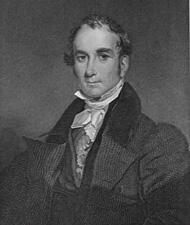
Louis McLane (May 28, 1786 – October 7, 1857) was an American lawyer, legislator, diplomat, and cabinet officer from Wilmington, in New Castle County, Delaware, and later Baltimore, Maryland. Over a long public career he served as a U.S. representative and U.S. senator from Delaware, the tenth United States Secretary of the Treasury, the twelfth United States Secretary of State, ambassador (Envoy Extraordinary and Minister Plenipotentiary) to Great Britain under two presidents, and president of the Baltimore and Ohio Railroad. A veteran of the War of 1812, he began his political life as a Federalist and later aligned with Andrew Jackson and the emerging Democratic Party. As a member of President Jackson’s Cabinet, he was a central figure in the Bank War and helped draft the Force Bill of 1833. He was elected to the American Philosophical Society in 1831.
McLane was born in Smyrna, Delaware, on May 28, 1786, the son of Allan McLane and Rebecca Wells McLane. His father, a Scots-Irish adventurer and Revolutionary War veteran, became a prominent Delaware Federalist and in 1797 was appointed by President George Washington as customs collector for the Port of Wilmington, a lucrative federal post he retained for more than thirty years under presidents of both parties. With the strong backing of Federalist leader James A. Bayard, Allan McLane survived the transition to the Jefferson administration and built a substantial fortune, much of it derived from the seizure of contraband. Louis McLane inherited a significant portion of this wealth, along with legal complications that extended well beyond his father’s death during the administration of Andrew Jackson. The younger McLane thus grew up in a politically engaged household that encouraged his “almost sinfully ambitious” nature, as one later biographer described it.
Educated in private schools, McLane briefly pursued a naval career, serving for about a year as a midshipman on the USS Philadelphia before he turned eighteen. He then attended Newark College, an institution that later became the University of Delaware. Deciding on the law, he read law in the Wilmington office of James A. Bayard, one of the most influential Federalist politicians of the era, and was admitted to the bar in 1807. McLane established a legal practice in Wilmington, quickly gaining a reputation for intelligence, clarity of mind, and efficiency. During the War of 1812, he joined the Wilmington Artillery Company, formed to defend the city. When Baltimore was threatened, the unit marched south, but was turned back for lack of provisions and saw no combat; McLane left the company with the rank of first lieutenant. In 1812 he married Catherine Mary (“Kitty”) Milligan, of a prominent Eastern Shore Maryland family. They had thirteen children, among them Robert Milligan McLane (1815–1898), later governor of Maryland and U.S. ambassador; Louis McLane (1819–1905), who became president of Wells Fargo & Co.; and Lydia Milligan Sims McLane (1822–1887), who married Confederate General Joseph E. Johnston.
Following the War of 1812, Delaware remained one of the few states where the Federalist Party continued to be viable, untainted by New England secessionist sentiment and supported by much of the Anglican and Methodist population downstate. Within this environment McLane entered politics. He first gained national office by winning the Federalist nomination for the U.S. House of Representatives over Thomas Clayton, whose support had been damaged by his vote for a controversial congressional pay raise. From that point, Clayton and his cousin John M. Clayton became McLane’s principal political rivals in Delaware. McLane was elected six times as a Federalist to the U.S. House of Representatives, serving five full terms from March 4, 1817, to March 3, 1827. During this decade in the House he had a distinguished career, rising to become chairman of the powerful Committee on Ways and Means. His Federalist affiliation, at a time when the party was dwindling nationally, was the principal obstacle to his election as Speaker. In a period when the Federalist caucus was small and partisan lines were blurred by personal alliances, McLane formed close friendships with William H. Crawford and Martin Van Buren and became an opponent of Henry Clay and John Quincy Adams. He was one of Crawford’s strongest supporters in the presidential election of 1824, and when Crawford retired from national politics, McLane and other Crawford men gravitated toward Andrew Jackson’s camp, a shift eased by McLane’s existing friendship with Van Buren.
McLane moved from the House to the United States Senate as a senator from Delaware, serving from March 4, 1827, to his resignation on April 29, 1829. His Senate tenure, which fell during the transition from the Adams to the Jackson administrations, coincided with the emergence of the Jacksonian movement. Although the existing summary of his service refers to “six terms in office,” his federal legislative career in fact comprised six consecutive elections to the House followed by this single Senate term. A member of the Jackson Party by the late 1820s, he worked strenuously, though unsuccessfully, to secure Delaware’s electoral votes for Jackson in the presidential election of 1828. Anticipating a major federal appointment from the incoming administration, and recognizing that his alliance with Jackson had severed his ties to the Claytons and the dominant Delaware political faction, McLane resigned his Senate seat in 1829. His decision effectively ended his prospects in Delaware politics, but he counted on Jackson to reward his loyalty with high office.
Initially passed over for a place in Jackson’s first cabinet, McLane accepted, with some reluctance, appointment as Envoy Extraordinary and Minister Plenipotentiary to the United Kingdom in October 1829, a post arranged by his friend, Secretary of State Martin Van Buren. He was instructed to signal a break with the policies of the John Quincy Adams administration and to resolve outstanding disputes, particularly over trade with the British West Indies. Well received by Foreign Secretary Lord Aberdeen, McLane successfully negotiated the reopening of West Indies trade on terms favorable to the United States. During this mission his personal secretary was the writer Washington Irving, who became a close and enduring friend of the McLane family. McLane’s effective performance in London enhanced his standing with Jackson and Van Buren and paved the way for his elevation to the cabinet.
In August 1831 Jackson appointed McLane the tenth United States Secretary of the Treasury, a position he held from August 8, 1831, to May 28, 1833. He entered the cabinet at a time when tariff policy and the future of the Second Bank of the United States were the central financial issues. Articulate and energetic, McLane quickly emerged as a leading figure in the administration, mastering complex fiscal questions and, in the view of contemporaries, acting almost as a prime minister. Although personally more moderate than Jackson on the Bank, he sought a compromise with Bank president Nicholas Biddle that would secure renewal of the Bank’s charter while achieving Jackson’s goal of retiring the national debt. On December 7, 1831, he presented a sweeping plan, praised for its Hamiltonian creativity, that he hoped would postpone a final decision on recharter until after the 1832 election. His efforts were undercut when Henry Clay, seeking a campaign issue against Jackson, urged Biddle to press for immediate recharter, hardening the President’s opposition. Attorney General Roger B. Taney also warned Jackson that McLane’s program resembled the old Federalist system. After Jackson vetoed the recharter bill in 1832 and interpreted his reelection as a popular mandate against the Bank, he removed the Bank question from McLane’s control. McLane refused to remove federal deposits from the Bank, and Jackson therefore reassigned him, offering the post of Secretary of State.
Appointed in a recess as the twelfth United States Secretary of State, McLane served from May 29, 1833, to June 30, 1834. Jackson hoped to retain McLane’s talents while freeing himself to pursue the destruction of the Bank through other subordinates. As Secretary of State, McLane undertook the first major reorganization of the department, establishing seven new bureaus to rationalize its operations. He also played a key role in the administration’s response to the Nullification Crisis, having earlier helped draft the Force Bill of 1833 to provide for enforcement of the federal tariff in South Carolina. In foreign affairs he managed a delicate dispute with France over “Spoliation Claims” for American shipping losses during the Napoleonic Wars. Although the French government had agreed in 1832 to indemnify the United States, successive ministries failed to appropriate the necessary funds. Jackson favored a hard line, and McLane initially worked with him to pressure France. Vice President Van Buren, however, intervened directly with Jackson without consulting McLane and persuaded the President to allow more time for French action. Feeling that his authority had been undermined and deeply offended by his former mentor’s maneuvering, McLane resigned as Secretary of State in 1834. The episode ended his friendship with Van Buren; the two men never spoke again.
After leaving the cabinet, McLane turned to private enterprise to support his large family. Although he had inherited wealth from his father, the needs of thirteen children required substantial earned income. In 1834 he became president of the Morris Canal and Banking Company, a New Jersey corporation based largely in New York City that operated a canal from Phillipsburg to Newark and conducted banking operations under its charter. During his year at the helm he instituted managerial reforms and oversaw one of the few profitable periods in the company’s history. The distance from his family homes in Wilmington and at “Bohemia” in Cecil County, Maryland, however, made the position unsatisfactory. When he was offered the presidency of the Baltimore and Ohio Railroad, he accepted quickly and moved his primary residence to Baltimore, aligning his personal and professional lives more closely with Maryland.
As president of the Baltimore and Ohio Railroad, McLane led one of the nation’s pioneering rail enterprises during a critical phase of its expansion. At the time of his appointment the line extended west only as far as Harpers Ferry, Virginia (now West Virginia), but the company aspired to reach the Ohio River and channel western commerce through Baltimore. McLane’s principal achievement was the extension of the railroad’s main line to Cumberland, Maryland, bringing it into proximity with coalfields that provided a more reliable revenue base. Profits remained modest, and much of his tenure was consumed by complex financial arrangements and negotiations with Pennsylvania and Virginia over possible western routes. Ultimately the company chose an all-Virginia route to Wheeling on the Ohio River, though the final realization of that goal fell to his successor. McLane, who never fully appreciated the long-term significance of his railroad work, retired from the presidency of the Baltimore and Ohio on September 13, 1848.
McLane’s ambition for high public office persisted despite his earlier political reverses. One of his few remaining close political associates from congressional days was James K. Polk, who became President in 1845. Hoping for a major diplomatic or cabinet post, McLane accepted a leave of absence from the railroad to serve again as Minister Plenipotentiary to the United Kingdom in 1845–1846, this time to assist in resolving the Oregon boundary dispute. Remembered favorably in London from his earlier mission, he renewed old friendships and helped maintain British flexibility while the Polk administration publicly adopted the hard-line slogan “54-40 or Fight.” McLane’s quiet diplomacy helped keep negotiations on track until the outbreak of the Mexican–American War and a shift in Washington’s priorities led to the eventual compromise settlement along the 49th parallel. He did not receive the higher office he desired and reluctantly returned to his railroad duties.
In his later years McLane increasingly identified with Maryland. Through his marriage into the Milligan family he had acquired Milligan Hall on the Bohemia River in Cecil County, Maryland, which the family called “Bohemia” and used as a favored retreat and gathering place. His resignation from the Senate in 1829 and adherence to Jacksonian Democracy had already signaled the end of his Delaware political career, and his move to Baltimore during his railroad presidency completed his transition to Maryland public life. In 1850 he took part in the Maryland constitutional convention, remaining an active voice in state affairs. He also owned the Zachariah Ferris House in Wilmington, later listed on the National Register of Historic Places in 1970, and his own Wilmington residence, the Louis McLane House, was similarly listed in 1973, reflecting his enduring architectural and historical footprint in Delaware.
Louis McLane died in Baltimore, Maryland, on October 7, 1857, and was buried in Green Mount Cemetery. His contemporaries and later scholars recognized both his talents and his personal difficulties. His biographer, Professor John A. Munroe, described him as intelligent, able, clear-minded, efficient, and immensely persuasive, yet “almost sinfully ambitious,” easily affronted, and inclined to hold grudges against those who crossed him. To many, including some of his children, he was more admirable than lovable—a stern, busy, handsome, and sensitive man whose deepest and most consistent loyalties were reserved for his wife Kitty and their children.
Congressional Record