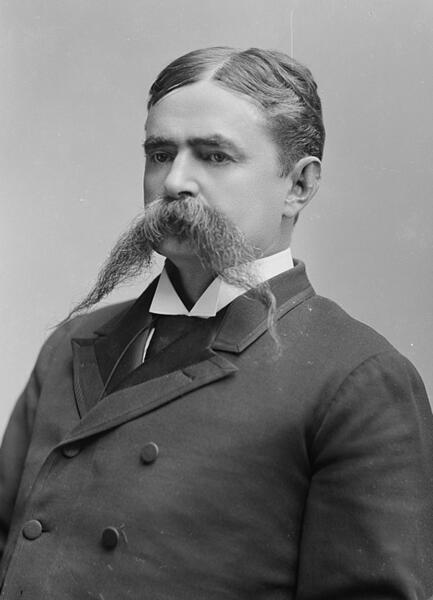
Louis Charles Latham (September 11, 1840, Plymouth, North Carolina – October 16, 1895, Baltimore, Maryland) was an American lawyer, Confederate Army officer, and Democratic politician who served as a Representative from North Carolina in the United States Congress from 1881 to 1883 and again from 1887 to 1889. Over the course of his public career he represented the interests of his constituents in eastern North Carolina during a significant period in American history marked by the aftermath of the Civil War and the consolidation of Reconstruction-era political realignments.
Latham was born in Plymouth, Washington County, North Carolina, where he spent his early years. He pursued higher education at the University of North Carolina at Chapel Hill, from which he graduated in 1859. Seeking further professional preparation, he later attended Harvard Law School. His legal studies were interrupted by the outbreak of the American Civil War, which profoundly shaped his early adulthood and subsequent public life.
With the secession crisis and the onset of the Civil War, Latham entered the Confederate Army in 1861. He was commissioned a captain and later promoted to major in the First Regiment of North Carolina State Troops. He served throughout the duration of the conflict, gaining military and leadership experience in one of the principal units raised by his state. His wartime service placed him among the generation of Southern veterans who would later play prominent roles in the political and legal reconstruction of the region.
During the latter part of the war, while still a young man, Latham began his political career. He was elected a member of the North Carolina House of Commons in 1864, participating in state governance during the closing phase of the Confederacy. After the war, he resumed the study of law, completing the professional training that had been interrupted by military service. He was admitted to the bar in 1868 and commenced the practice of law in Plymouth, North Carolina, building a legal career that underpinned his subsequent political activity. In 1870 he advanced in state politics when he was elected to the North Carolina State Senate, further establishing himself as a Democratic leader in the postwar period.
Latham’s congressional service began when he was elected as a Democrat to the Forty-seventh Congress, serving from March 4, 1881, to March 3, 1883. As a member of the United States House of Representatives, he participated in the legislative process and represented the interests of his North Carolina constituents during a time of industrial expansion and ongoing regional adjustment after Reconstruction. Although he contributed to the work of the House during this term, he was an unsuccessful candidate for renomination in 1882. Returning to private life for several years, he remained active in Democratic politics and the legal profession.
He reentered national office when he was elected to the Fiftieth Congress, serving from March 4, 1887, to March 3, 1889. During this second term in the House of Representatives, Latham again took part in the democratic process at the federal level, aligning with the Democratic Party on issues of the day and continuing to advocate for his district. At the conclusion of this term he was an unsuccessful candidate for reelection in 1888 to the Fifty-first Congress, which ended his service in the national legislature after two nonconsecutive terms in office.
Following his final departure from Congress, Latham resumed the practice of law, this time in Greenville, North Carolina. He continued his legal work there until his final illness. Louis Charles Latham died at Johns Hopkins University Hospital in Baltimore, Maryland, on October 16, 1895. His remains were returned to North Carolina, and he was interred in the City Cemetery in Greenville, closing the life of a lawyer, soldier, and legislator who had been closely identified with the political and legal affairs of his state in the latter half of the nineteenth century.
Congressional Record