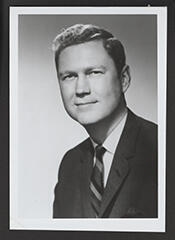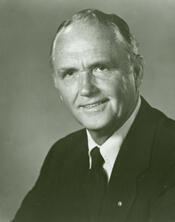
Louis Arthur “Skip” Bafalis (September 28, 1929 – March 10, 2023) was an American businessman and Republican politician who served as the U.S. representative for Florida’s 10th congressional district from 1973 to 1983. Over five terms in the United States House of Representatives, he represented a newly created district on Florida’s southeast and southwest coasts and contributed to the legislative process during a significant period in American political history. He was also the Republican nominee for governor of Florida in 1982 and earlier served in both the Florida House of Representatives and the Florida Senate.
Bafalis was born in Boston, Massachusetts, on September 28, 1929. His father was an immigrant from Greece, and his maternal grandparents were immigrants from Sweden, giving him a mixed Greek and Swedish heritage. He grew up in New England and graduated in 1948 from Manchester Central High School in Manchester, New Hampshire. He then attended Saint Anselm College in neighboring Goffstown, New Hampshire, from 1948 until 1952. His early years combined the experience of a first-generation American family with the educational opportunities of postwar New England.
Following college, Bafalis entered military service during the early Cold War era. He served in the United States Army from 1953 to 1956, rising to the rank of captain. During this period he developed leadership and organizational skills that would later inform his public career. While still in the midst of his military service, he moved to Florida in 1955, part of a broader postwar migration to the state. After leaving active duty, he settled there permanently and began work as an investment banker, launching a business career that preceded and paralleled his entry into politics.
Bafalis’s political career began at the state level in Florida during a time of rapid growth and partisan realignment. He was elected to the Florida House of Representatives in 1964. Two years later, in 1966, he won election to the Florida Senate from the 33rd district and was reelected in 1968, serving in the upper chamber until 1970. While in the state legislature, he was one of the leaders in the legislative work necessary to bring Walt Disney World to Florida, an initiative that would have a lasting impact on the state’s economy and tourism industry. In 1970 he sought higher office as a candidate for the Republican nomination for governor of Florida, but he was unsuccessful, losing the nomination to the incumbent Republican governor, Claude R. Kirk Jr. In the general election that followed, Kirk was defeated by Democrat Reubin Askew, and in the same election Republican U.S. Representative William C. Cramer lost a U.S. Senate race to Democrat Lawton Chiles. These setbacks, including Bafalis’s primary loss, contributed to intraparty divisions that slowed the projected growth of the Florida Republican Party in the early 1970s.
In 1972, Bafalis was elected to the Ninety-third United States Congress from a newly created district that became Florida’s 10th congressional district, stretching from the Palm Beaches on the Atlantic coast to Fort Myers on the Gulf coast. He took office on January 3, 1973, and was subsequently reelected to the four succeeding Congresses, serving continuously until January 3, 1983. During his decade in the House of Representatives, he resided in Fort Myers Beach and Palm Beach and represented the interests of a rapidly developing region of Florida. As a member of the U.S. House Committee on Transportation and Infrastructure, he played a key role in advancing several major road and highway projects in Florida, including work related to Interstate 95, new bridges to the Florida Keys, and improved connections from Fort Myers. His congressional tenure coincided with a period of national political change, and he participated in the democratic process on issues affecting both his district and the country at large.
Bafalis chose not to seek reelection to the Ninety-eighth Congress in 1982. Instead, he became the Republican Party’s nominee for governor of Florida that year, challenging the incumbent Democratic governor, Bob Graham of Miami. In the general election he was defeated by Graham. According to GovTrack, during his years of service in Congress Bafalis missed about 8 percent of roll call votes overall, but his rate of missed votes rose sharply to approximately 80 percent in the second quarter of 1982 while he was actively campaigning for governor. After leaving Congress in January 1983, he returned to the private sector as a lobbyist and governmental affairs consultant, drawing on his legislative experience and knowledge of federal and state government.
Bafalis attempted a political comeback in 1988, when he ran in the Republican primary for Florida’s 13th congressional district after incumbent Connie Mack III vacated the seat to run for the U.S. Senate. The district included much of the area Bafalis had previously represented, including Fort Myers. Despite his prior service and name recognition, he lost the primary runoff to Lee County Commissioner Porter Goss, who would later serve in Congress and as Director of Central Intelligence. Following this defeat, Bafalis did not return to elective office but remained active in governmental affairs.
In his later years, Bafalis lived in the Washington, D.C., metropolitan area. As of 2011, he resided in Fairfax, Virginia, and was a partner at Alcalde & Fay, an Arlington-based government affairs firm, where he continued to work in lobbying and consulting. He was married to Charlotte Maria Bafalis, and they had three children: Renee Louise Bafalis, Gregory Louis Bafalis, and Joshua Evan Bafalis. Louis Arthur “Skip” Bafalis died in Fairfax Station, Virginia, on March 10, 2023, at the age of 93.
Congressional Record