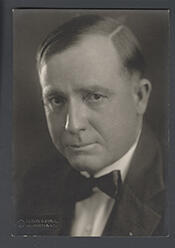
Lorraine Michael Gensman (August 26, 1878 – May 27, 1954) was a Republican U.S. Representative from Oklahoma who served one term in the United States Congress from 1921 to 1923. Born on a farm near Wichita, Sedgwick County, Kansas, he was the son of Nicholas and Kansas Osborne Gensman. He grew up in rural Kansas and attended local public schools, including the Garden Plains Grade School, before pursuing further education that prepared him for a career in teaching and law.
Gensman’s early education included study at Wichita Commercial College, Lewis Academy, and the Kansas State Normal School at Emporia, institutions that were central to training teachers and professionals in late nineteenth-century Kansas. By the mid-1890s he had entered the field of education, serving as principal of the public schools in Andale, Kansas, in 1896 and 1897. Seeking a legal career, he enrolled in the University of Kansas School of Law at Lawrence, from which he graduated in 1901. That same year he was admitted to the bar, launching a professional trajectory that would combine legal practice with public service. On April 6, 1904, he married Lucia Van Cleef, a fellow graduate of the University of Kansas.
After his admission to the bar, Gensman began the practice of law in Lawrence, Kansas, but soon moved to the growing frontier community of Lawton, in what would become Comanche County, Oklahoma, in 1901. There he resumed his legal practice and quickly became involved in the developing legal and commercial life of the region. From 1902 to 1907 he served as a Referee in Bankruptcy, a federal judicial position that placed him at the center of financial and commercial disputes during a period of rapid economic change in Oklahoma Territory and, after 1907, the new state of Oklahoma. He continued to build his reputation as a lawyer and civic leader in Lawton over the following decade.
Gensman’s public legal service expanded when he was elected prosecuting attorney of Comanche County, Oklahoma, serving in that capacity in 1918 and 1919. In this role he was responsible for enforcing state law and representing the county in criminal proceedings during the closing months of World War I and the immediate postwar period. His work as a county prosecutor, combined with his earlier federal bankruptcy experience, enhanced his standing within the Republican Party and among local voters, setting the stage for his entry into national politics.
Elected as a Republican to the Sixty-seventh Congress, Gensman represented Oklahoma in the U.S. House of Representatives from March 4, 1921, to March 4, 1923. His service in Congress occurred during a significant period in American history marked by post–World War I adjustment, debates over economic policy, and the early years of Prohibition. As a member of the House of Representatives, he participated in the legislative process, contributed to national policymaking, and represented the interests of his Oklahoma constituents within the broader framework of Republican Party priorities in the early 1920s. A member of the Republican Party, he served one full term in office, contributing to the democratic process and the work of the Sixty-seventh Congress.
Gensman was an unsuccessful candidate for reelection in 1922 to the Sixty-eighth Congress, ending his initial period of congressional service after a single term. He remained active in party affairs, however, serving as a delegate to the Republican National Convention in 1924, where the party nominated Calvin Coolidge for the presidency. He later sought a return to Congress as a candidate for election in 1936 to the Seventy-fifth Congress but was again unsuccessful, reflecting the broader challenges faced by Republicans in Oklahoma during the New Deal era.
Following his departure from Congress, Gensman resumed the practice of law in Lawton and also engaged in the oil business, participating in one of the key industries that shaped Oklahoma’s economy in the first half of the twentieth century. He continued his legal and business activities for several decades, remaining a prominent figure in the civic and professional life of Lawton until his retirement in 1953. His long career reflected a combination of legal expertise, public service, and entrepreneurial activity characteristic of many early Oklahoma leaders.
Lorraine Michael Gensman died in Lawton, Comanche County, Oklahoma, on May 27, 1954, at the age of 75. He was interred at Highland Cemetery in Lawton. His life and career, spanning from rural Kansas in the late nineteenth century to the political and economic development of Oklahoma in the mid-twentieth century, encompassed service as an educator, attorney, local prosecutor, federal bankruptcy referee, and member of the United States House of Representatives.
Congressional Record