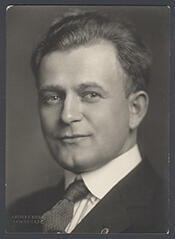
Lon Allen Scott (September 25, 1888 – February 11, 1931) was an American politician, lawyer, and businessman who served as a Republican United States Representative from Tennessee from 1921 to 1923. Over the course of his career, he was active in state and national politics, participated in World War I military service, and engaged in mercantile, real estate, and lumber enterprises.
Scott was born on a farm near Cypress Inn in Wayne County, Tennessee, on September 25, 1888, to Daniel Egan Scott and Mattie G. Cash Scott. During his childhood, his family moved to Savannah in Hardin County, Tennessee. There he attended the local public schools and later the Savannah Tennessee Institute, receiving the education that prepared him for both business and public life. Seeking professional training in the law, he enrolled in the law department of Cumberland University in Lebanon, Tennessee, and graduated in 1915.
Before and alongside his legal training, Scott engaged in various business pursuits. He entered mercantile enterprises and became involved in the real estate and lumber business, activities that tied him closely to the economic life of his region. His business experience complemented his emerging political career and provided him with practical knowledge of the commercial and agricultural interests of his constituents.
Scott’s formal political career began at the state level. He was elected to the Tennessee House of Representatives and served from 1913 to 1917. During this period, he rose to a position of leadership as the Republican minority floor leader from 1915 to 1917. While in the state legislature, he also played a notable role in a high-profile legal and political matter, representing the State of Tennessee in the prosecution of Attorney General Estes in an impeachment proceeding before the Tennessee Senate. His service in the state house established him as a prominent Republican figure in Tennessee politics.
With the onset of American involvement in World War I, Scott resigned his seat in the Tennessee House of Representatives to enter military service. He enlisted as a private and later received a promotion to the rank of lieutenant. His wartime service added a military dimension to his public career and reflected the broader national mobilization of the period.
Scott was elected as a Republican to the Sixty-seventh Congress and served as a United States Representative from Tennessee from March 4, 1921, to March 3, 1923. His single term in the House of Representatives occurred during a significant period in American history, in the early 1920s, when the nation was adjusting to the post–World War I era and addressing issues of economic transition and international engagement. As a member of the House, he participated in the legislative process, represented the interests of his Tennessee constituents, and contributed to the work of the Republican majority. Among his official acts, he nominated Willis S. Matthews to the United States Military Academy at West Point; Matthews went on to serve in the United States Army from 1927 to 1962 and retired with the rank of major general. Scott was an unsuccessful candidate for re-election in 1922 to the Sixty-eighth Congress, bringing his federal legislative service to a close after one term.
After leaving Congress, Scott returned to Savannah, Tennessee, where he resumed his earlier business pursuits in mercantile trade, real estate, and the lumber industry. He remained a resident of Savannah and continued to be identified with the civic and economic life of his community. Following an illness of three months, Lon Allen Scott died in Savannah on February 11, 1931. He was interred in Savannah Cemetery, closing a career that had encompassed state legislative leadership, wartime military service, and a term in the United States House of Representatives.
Congressional Record