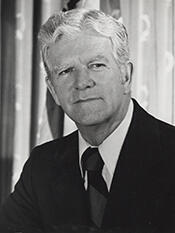
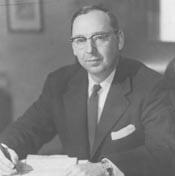
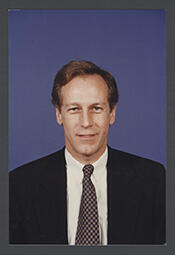
Lewis Steenrod (May 27, 1810 – October 3, 1862) was a nineteenth-century politician and lawyer from Virginia, who helped secure congressional authorization of the Wheeling Suspension Bridge but who later opposed secession of what became West Virginia months before his death. A member of the Democratic Party representing Virginia, he served three terms in the United States House of Representatives during a significant period in American history, participating in the legislative process and representing the interests of his constituents in the trans-Appalachian region.
Steenrod was born near Wheeling, Virginia (now Wheeling, West Virginia) on May 27, 1810, to Daniel Steenrod of New York and his second wife, Nancy Ann Gater, who had married in 1806. He was one of eight children, with an older brother, Edward Gater Steenrod, and elder sisters Catherine and Emma among his siblings. His sister Mary married Wheeling postmaster General Feeney, and their daughter Ann Elizabeth married Congressman and judge George W. Thompson, with whom Lewis Steenrod would later work professionally. The Steenrod family was closely tied to the early development of transportation infrastructure in the Ohio Valley. His father, Daniel Steenrod, together with Colonel Moses Shepherd, was responsible for building and repairing bridges on the National Road, which had been authorized by Congress in 1806 and was completed through Ohio County in 1817–1818. Daniel Steenrod also operated a tavern on the south side of the road and, after Virginia assumed responsibility for toll collection and upkeep, continued contracting to repair and maintain the road and its bridges. In the mid-1830s he laid out the village of Fulton and platted an area known as “Steenrod’s Island” around a paper mill constructed by Alexander Armstrong in 1836, further entrenching the family’s prominence in the region.
As a boy, Lewis Steenrod attended private schools near Wheeling before pursuing legal training. He read law in the traditional manner of the time and was admitted to the Virginia bar in 1835. He began his legal practice in Wheeling, the county seat of Ohio County, where his family’s longstanding involvement in transportation and commerce provided a natural base for a law career focused on local and regional interests. On September 5, 1843, he married Mary Neldon in Athens, Ohio, but the marriage was short-lived; she died soon afterward at age 23, and their infant son died after only six weeks. By 1850, Steenrod was residing with his parents and his 21-year-old nephew, Daniel Steenrod, in the family mansion near Wheeling. On the eve of the Civil War, he had become a substantial property holder: in 1860 he owned $8,000 in real property and $23,000 in personal property, including enslaved persons. His father at that time owned $150,000 in real estate and $10,000 in personal property, while his deaf younger brother George, living in nearby Triadelphia, held $600 in real estate and $5,500 in personal property and had married and started a family with two sons, Lewis and Daniel, and two daughters, Margaret and Elizabeth.
Steenrod entered national politics as a Democrat in the late 1830s. In 1838, running as the Democratic candidate, he defeated incumbent Whig Richard W. Barton and was elected to the United States House of Representatives. He served three consecutive terms in Congress from March 4, 1839, to March 3, 1845, representing a Virginia district that included Wheeling and the surrounding counties. During his tenure, he served on the Committee on Roads and Canals and the Committee on Revolutionary Pensions, reflecting both his regional interest in internal improvements and the broader national concern with veterans’ claims. In Congress, he introduced legislation to authorize a bridge across the Ohio River at Wheeling, intended to replace a partial bridge and ferry service that linked two major sections of the National Road. Although the Wheeling Suspension Bridge was completed before that particular bill passed, his efforts helped secure federal recognition and, ultimately, congressional authorization for the structure, which became a critical transportation link in the region.
The Wheeling Suspension Bridge soon became the focus of intense legal and political controversy. Pittsburgh interests, concerned that the bridge interfered with increasingly tall steamboat smokestacks navigating the Ohio River, challenged it in litigation that twice reached the United States Supreme Court. An initial unfavorable Supreme Court decision threatened the bridge’s future and the commercial position of Wheeling. In part to counteract this decision and to protect the bridge and the National Road’s prominence, voters elected Steenrod to the Virginia Senate, where he represented Ohio, Brooke, and Hancock Counties from 1853 to 1856. In the state senate he supported and helped secure passage of legislation favorable to the bridge, reinforcing Wheeling’s status as a transportation hub. After his term in the Virginia Senate, Steenrod resumed the practice of law in Wheeling, continuing to be identified with the defense of local infrastructure and commercial interests.
The coming of the Civil War placed Steenrod and his family in a difficult political position. Although he had long been associated with efforts to promote transportation improvements such as the National Road and the Wheeling Suspension Bridge, he was hostile to the growing influence of the Baltimore and Ohio Railroad, which diverted traffic and economic activity away from the road system that had underpinned his family’s fortunes. His political stance in the 1860s reflected the complex loyalties of the border region. While he opposed the secession of the northwestern counties from Virginia to form the new state of West Virginia, he also held outspoken secessionist views with respect to the Union, a position that may have been shaped in part by his opposition to the railroad and his alignment with traditional Virginia interests. During the Civil War, these views led authorities to place Lewis Steenrod and his brothers under house arrest, underscoring the deep divisions within the Wheeling area as it became the political center of Unionist West Virginia.
Steenrod died of tuberculosis at his home near Wheeling, then part of Virginia but soon to be incorporated into the new state of West Virginia, on October 3, 1862. His father, Daniel Steenrod, died two years later. Lewis Steenrod was interred in Stone Church Cemetery in Elm Grove, West Virginia. His nephew and namesake, Lewis Steenrod, later served as sheriff of Ohio County, continuing the family’s public role in local affairs.
The legacy of Lewis Steenrod and his family remained visible in Wheeling long after his death. Steenrod Avenue in Wheeling commemorates the family’s contributions to the development of the region’s transportation network and civic life. Steenrod Elementary School, completed in 1919 on land owned by his father at the time of his death—when Daniel’s estate was valued at approximately $200,000—was named in honor of the elder Steenrod; the school has since been supplanted by Triadelphia Middle School. The former family home near Wheeling, known as Woodridge, passed to his brother George W. Steenrod and his wife, but was sold in 1874, after the Panic of 1873, to his brother-in-law Judge George W. Thompson and Thompson’s wife to satisfy debts. By 1880, George Steenrod’s daughter Maggie and her husband, Platoff Zane, owned the property and were known for fostering many children, though they had none of their own. Sheriff Lewis Steenrod later sold a large portion of the surrounding land to the city of Wheeling for a 150-house subdivision, while selling the house itself to his son, Dr. Lewis Steenrod, and his wife. They in turn sold Woodridge to John and Annie McGinnis, who resided there for decades and developed its gardens into a local showplace during the 1930s. The property was listed on the National Register of Historic Places in 2005 and now serves as housing for married and graduate students of Wheeling Jesuit University, preserving the Steenrod family’s historic association with the Wheeling area.
Congressional Record