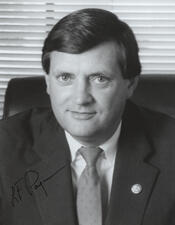
Lewis Franklin “L. F.” Payne Jr. (born July 9, 1945) is an American businessman, politician, and lobbyist who served as a Representative from Virginia in the United States Congress from 1988 to 1997. A member of the Democratic Party, he represented Virginia’s 5th Congressional District, which covers much of Southside Virginia, and contributed to the legislative process during five terms in office. His service in Congress occurred during a significant period in American history, as he participated in the democratic process and represented the interests of his constituents in a district with a mix of rural communities, small towns, and evolving economic needs.
Payne was born in Amherst, Virginia, where he was raised before pursuing higher education in the Commonwealth. He attended the Virginia Military Institute (VMI), from which he graduated, and subsequently served as an officer in the United States Army, gaining leadership and organizational experience as a veteran. After his military service, he continued his education at the University of Virginia, earning a Master of Business Administration degree, which prepared him for a career in business and later informed his work on economic and fiscal issues in public office.
Before entering Congress, Payne established himself in the private sector as the founder and president of Wintergreen Resort, a major four-season resort development in the Blue Ridge Mountains of Virginia. In this role, he oversaw significant business operations, including tourism, real estate, and recreational services, and became closely involved with regional economic development. His leadership at Wintergreen Resort helped enhance the local economy and provided him with practical experience in business management, job creation, and long-term planning that would later shape his legislative priorities.
Payne entered national politics as a Democrat when he was elected to the 100th United States Congress in a special election held on June 14, 1988, to fill the vacancy caused by the death of Representative Dan Daniel. In that special election, he won the seat with 59.3 percent of the vote, defeating Republican Linda L. Arey. Later that year, in the regular general election, he was re-elected with 54.19 percent of the vote, defeating Republican Charles Robert Hawkins and Independent J. F. Cole. He legislated as a conservative Democrat, reflecting the centrist and often moderate-to-conservative political orientation of his Southside Virginia district, and he worked to balance party priorities with the economic and social concerns of his largely rural constituency.
During his subsequent terms, Payne consolidated his position in the House of Representatives. In 1990, he was re-elected without opposition, underscoring his political strength and popularity at that point in his career. In the 1992 election, he again secured re-election with 68.9 percent of the vote, defeating Republican W. A. Hurlburt by a wide margin. In 1994, amid a national Republican surge and a challenging political climate for Democrats, his share of the vote fell sharply, but he was nonetheless re-elected with 53.28 percent of the vote, defeating Republican George C. Landrith. Over the course of his service from June 14, 1988, to January 3, 1997, Payne participated in the work of the House during a period marked by debates over budget policy, economic restructuring, and changes in federal programs, consistently representing the interests of his district within the broader legislative process.
Payne chose not to seek re-election to the House in 1996 and instead retired from Congress at the conclusion of his fifth term on January 3, 1997. That same year, he sought statewide office as the Democratic nominee for lieutenant governor of Virginia. In the 1997 general election, he ran a competitive race but lost a close contest to Republican John H. Hager, a defeat that occurred in the context of a strong Republican showing at the statewide level, including Jim Gilmore’s gubernatorial victory over Democrat Don Beyer. His decision to pursue the lieutenant governorship marked the culmination of his congressional career and his effort to continue in public service at the state executive level.
Following his departure from elective office, Payne transitioned fully into the private sector and the field of government relations. He joined McGuireWoods Consulting, a Washington, D.C.–based government relations and lobbying firm associated with the Richmond-based law firm McGuireWoods LLP. In this capacity, he drew on his experience as a businessman, former resort executive, and five-term member of Congress to advise clients on public policy, regulatory matters, and legislative strategy. His post-congressional work, along with his earlier appearances on national platforms such as C-SPAN, has maintained his involvement in public affairs while shifting his role from elected representative to consultant and advocate in the public policy arena.
Congressional Record