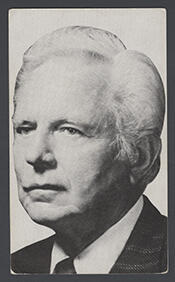
Lewis B. Gunckel (October 15, 1826 – October 3, 1903) was an attorney, politician, advocate for Civil War disabled soldiers and their families, commissioner, and a member of the United States House of Representatives from Ohio. As a member of the Republican Party representing Ohio, he contributed to the legislative process during one term in Congress, serving at a significant moment in American history and participating in the democratic process on behalf of his constituents.
Gunckel was born in Germantown, Montgomery County, Ohio, a village originally laid out and founded by his paternal grandfather, Philip Gunckel, in 1805. He was the son of Michael and Barbara (Shuey) Gunckel. His father, Michael Gunckel, served in active duty during the War of 1812, rising to the rank of colonel, and later represented his county in the Ohio legislature. His grandfather, Philip Gunckel, was elected in 1806 to represent Montgomery County in the Ohio General Assembly and again in 1808 to represent both Montgomery and Preble counties. In 1816, Philip was appointed associate judge of the Circuit Court for Montgomery County, a position he held for fifteen years. On his mother’s side, Gunckel’s maternal great-grandfather, the father of John Martin Shuey, was elected to represent Lancaster County, Pennsylvania, on the Committee of Inspection organized to cooperate with the Continental Congress in the years leading up to the American Revolution, though he died before the Declaration of Independence was signed. This family background placed Gunckel in a lineage of public service and civic leadership from an early age.
Gunckel pursued his early education in local schools in Ohio before attending Miami University and later Farmer’s College at College Hill in Cincinnati, Ohio, from which he was graduated in 1848. Deciding to prepare for the legal profession, he read law in Dayton following his graduation and subsequently entered the Cincinnati Law School. He completed his formal legal education there and was graduated in 1851. That same year he was admitted to the Ohio bar and commenced the practice of law in Dayton, beginning a legal career that would span more than half a century and become closely intertwined with his political and public service endeavors.
In 1853, Gunckel formed a law partnership in Dayton with Hiram Strong, who remained his partner until Strong was killed in the Civil War nine years later. The practice grew steadily, and in 1869 Edward L. Rowe joined the firm, which then became known as Gunckel & Rowe. Over subsequent years, as additional partners entered and others retired, the firm practiced under various names, including Gunckel, Rowe & Gunckel and Gunckel, Rowe & Shuey. Among his notable associates was John A. McMahon, with whom Gunckel would later spar politically despite their professional association. The firm that originated with Gunckel and Strong in 1853 continued under successor names and became recognized as one of the oldest continuously operating law firms in Ohio. In 1860, Gunckel married Catharine Winters, daughter of Valentine Winters, a prominent capitalist and banker of Dayton. The couple had four children—Winters, Katharine, Lewis W., and Percy—of whom Katharine and Lewis W. survived to adulthood.
Upon attaining his majority in 1847, Gunckel affiliated with the Whig Party. When the Whig Party disintegrated, he refused to join the nativist Know-Nothing movement. Instead, upon the organization of the Republican Party in the 1850s, he promptly transferred his allegiance and became one of its earliest adherents in his locality. He presided over and spoke at the first Republican meeting held in Montgomery County and served as a delegate to the first Republican National Convention in 1856, which nominated John C. Frémont for the presidency. In the presidential election of 1864, he was chosen as a Republican presidential elector from Ohio and actively canvassed the state on behalf of Abraham Lincoln, underscoring his firm Unionist stance during the Civil War.
Gunckel’s formal political career began in 1862 when he was elected to the Ohio Senate. He served there for four years and quickly emerged as one of its leaders, acting as chairman of the judiciary committee. A stalwart Union man during the Civil War, he strongly supported Lincoln’s policies and took a leading role in enacting measures to aid the prosecution of the war and to protect the families of soldiers in the field. He authored and championed a bill providing relief for soldiers’ families, defending it vigorously when its constitutionality was questioned and when opponents urged economy, insisting that Ohio must be willing both to “fight and pay” in support of its soldiers. He also authored the bill granting Ohio soldiers in the field the right to vote, a right that many thousands of them exercised during the conflict. In addition, he introduced legislation establishing a State of Ohio soldiers’ home for returning veterans, and after his service in the Senate he was appointed by the governor as manager of that institution, further cementing his reputation as an advocate for disabled soldiers and their families.
Gunckel’s work on behalf of veterans extended to the national level. The gradual disappearance of state hospitals and soldiers’ retreats after the Civil War led to the creation of more substantial national institutions. An act of Congress approved on March 31, 1865, created a Board of Managers of the National Homes for Disabled Volunteer Soldiers. Under this act, the board elected General Benjamin F. Butler as president and Lewis B. Gunckel as secretary. The law authorized the establishment of one or more homes, and under its provisions four such homes were created. Gunckel was particularly influential in the measures that led to the establishment of the Central National Soldiers’ Home in Dayton, Ohio. The organization of this Central Home dates from March 26, 1867, when Gunckel, as resident manager, formally took charge of the disabled soldiers then at the facility, a responsibility he would continue to discharge for the next decade. In selecting a site, the Board of Managers chose the fertile Miami Valley and negotiated the purchase of 540 acres of land approximately three miles west of Dayton at a cost of $46,800, of which $20,000 was donated by the citizens of Dayton under Gunckel’s leadership. Congress provided lumber from temporary buildings at Camp Chase, and under Gunckel’s direction the buildings of the Home were rapidly and economically constructed and filled with disabled soldiers as soon as they were ready. The people of Dayton came to regard this work as his greatest and most enduring public achievement.
In 1871, Gunckel was appointed by President Ulysses S. Grant’s Secretary of the Interior as special commissioner to investigate frauds committed upon the Cherokee, Creek, and Chickasaw Indians. His exhaustive report led to the detection and punishment of the guilty parties and prompted important reforms in the administration of the Indian service. The following year, in 1872, he was elected as a Republican to the Forty-third Congress from Ohio’s 4th congressional district. During his single term in the U.S. House of Representatives, he served on the Committee on Military Affairs and became conspicuous for his relentless opposition to public corruption and organized raids on the national treasury. He voted to repeal the controversial “salary grab” law, which had increased congressional pay retroactively, and he refused to accept the additional salary due him under its retroactive provisions. He was an active participant in debate on the House floor and a frequent public speaker on economic issues, especially the need for cheap transportation to facilitate commerce and relieve economic distress.
In 1874, Gunckel was unanimously renominated by the Republican Party for re-election to Congress. However, the nation was then suffering from the effects of the Panic of 1873 and was deeply divided by the temperance movement. These conditions contributed to a political upheaval in Ohio that resulted in the election of Democrat John A. McMahon, Gunckel’s own law partner, to succeed him in the House. Gunckel remained a respected figure in Republican politics and was again nominated for Congress in 1884, but he declined to run, choosing instead to concentrate on his legal and civic work in Dayton.
After leaving Congress, Gunckel returned to Dayton and resumed the full-time practice of law. He gained a reputation not only for his courage and persistence in fighting for principle but also for his skill in avoiding unnecessary litigation. Contemporaries observed that he believed compromise was often preferable to courtroom conflict and that higher courage could be shown by conciliation than by combat. His ability to protect his clients’ interests through negotiation and diplomacy earned him the informal title of “the peacemaker of the Dayton bar.” Beyond his local practice, he was active in professional legal organizations, serving as a delegate from the Ohio state bar to the newly formed National Bar Association from 1888 to 1890, during which time he also served as treasurer and as a member of its executive committee. In his later years he expanded his civic involvement into the financial sector, serving as president of the Dayton Public Savings Bank.
Lewis B. Gunckel died of pneumonia and heart trouble in Dayton, Ohio, on October 3, 1903. He was interred in Woodland Cemetery and Arboretum in Dayton, where his career as an attorney, state legislator, congressman, and tireless advocate for Civil War veterans and their families remains part of the region’s historical legacy.
Congressional Record