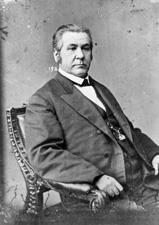
Lewis Vital Bogy (April 9, 1813 – September 20, 1877) was a Democratic politician, lawyer, and businessman who represented Missouri in the United States Senate from 1873 until his death in 1877. His single term in the Senate coincided with the later years of Reconstruction, during which he participated in the legislative process and represented the interests of his Missouri constituents in a period of significant national political and economic change.
Bogy was born in Ste. Geneviève, Missouri, then a small but important river town on the Mississippi River. He attended local public schools and, as a young man, was employed as a clerk in a mercantile establishment, gaining early experience in commerce and business. He served in the Black Hawk War in the early 1830s, an experience that introduced him to public service and frontier affairs. Seeking a professional career, he studied law in Illinois and then enrolled at Transylvania University in Lexington, Kentucky, one of the leading legal and educational institutions in the West at the time. He graduated in 1835 and was admitted to the bar, after which he commenced the practice of law in St. Louis, Missouri.
Settling in St. Louis, Bogy quickly became involved in local politics and municipal affairs. In 1838 he served as a member of the board of aldermen of St. Louis, participating in the governance of a city that was emerging as a major commercial center of the Mississippi Valley. His political career advanced to the state level when he was elected to the Missouri House of Representatives, serving first from 1840 to 1841 and again from 1854 to 1855. These legislative terms helped establish him as a prominent Democratic figure in Missouri politics and gave him experience in shaping state policy during a period of expansion and sectional tension.
In addition to his legal and political work, Bogy was active in business and infrastructure development. He was one of the founders of the St. Louis Iron Mountain Railway, a key line intended to connect St. Louis with the mineral-rich regions to the south. He served as president of the railroad for two years, reflecting his role in promoting transportation and economic growth in Missouri. Within St. Louis municipal government, his influence continued to grow; by 1872 he was president of the city council of St. Louis, a position that placed him at the center of local legislative and administrative decision-making.
Bogy’s experience with western affairs and Native American policy led to his appointment as Commissioner of Indian Affairs in 1866, a post he held through 1867. In this federal role he was involved in the administration of Indian policy during a critical period of westward expansion, treaty-making, and conflict on the Great Plains. His tenure as Commissioner coincided with broader national debates over the treatment of Native American nations and the management of Indian lands, and it further enhanced his profile in national politics.
In 1873, Bogy was elected as a Democrat to the United States Senate from Missouri. He took his seat on March 4, 1873, entering the Senate at a time when the country was grappling with the aftermath of the Civil War, Reconstruction policies, and the economic turmoil surrounding the Panic of 1873. During his term, he contributed to the legislative process and participated in the democratic governance of the nation, representing Missouri’s interests on issues of finance, infrastructure, and federal policy. His service in Congress occurred during a significant period in American history, and he was recognized as an active member of the Senate until his death. His career in Washington also drew public attention, as reflected in later memorial addresses delivered in the Senate on January 16, 1878, and in the House of Representatives on January 23, 1878, commemorating his life and character.
Lewis Vital Bogy died in office in St. Louis on September 20, 1877, before completing his first term in the Senate. His death placed him among the members of the United States Congress who died while serving between 1790 and 1899. He was interred in Calvary Cemetery, section 1, in St. Louis, a burial ground for many of the city’s prominent citizens. His public career—spanning local office, state legislation, federal administration, railroad development, and service in the United States Senate—left a record documented in contemporary government publications and later historical collections, including family papers and memorial tributes that preserve his role in Missouri and national political life.
Congressional Record