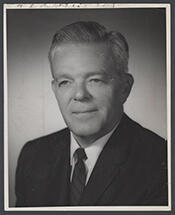
Leo William O’Brien (September 21, 1900 – May 4, 1982) was an American journalist, radio and television commentator, and Democratic politician who represented New York in the United States House of Representatives during a significant period in mid-twentieth-century American history. Nicknamed “Obie,” he was most notable for his service in Congress from April 1, 1952, to December 30, 1966, during which he was elected to multiple terms and contributed to the legislative process as a member of the House of Representatives. Over the course of his congressional career, he participated actively in the democratic process and represented the interests of his New York constituents.
O’Brien was born in Buffalo, New York, on September 21, 1900, the son of Patrick O’Brien and Agnes O’Brien. His father was a building contractor in the Buffalo area who later became responsible for construction at Niagara University, an association that helped shape the family’s ties to that institution. Leo O’Brien was educated in Buffalo, graduating in 1918 from St. Joseph’s Collegiate Institute. He then attended Niagara University, from which he graduated in 1922, laying the academic foundation for his later work in journalism and public service.
Following his graduation, O’Brien embarked on a career in journalism. He worked as a newspaper reporter for the International News Service and for the Albany Knickerbocker Press and Times-Union, becoming a well-known figure in the Albany press corps. He was active in the Legislative Correspondents’ Association, where he served on the board of directors and held the offices of secretary, vice president, and president, reflecting his prominence among reporters covering state government. In April 1951, his excellence in reporting was recognized nationally when he was named one of 20 journalists in the United States to receive the Sigma Delta Chi Award. O’Brien later expanded his communications career into broadcasting, working as a radio and television commentator, which further increased his public profile and familiarity with political issues.
In addition to his journalistic work, O’Brien held an important local administrative position as a member of the Port of Albany District Commission from 1935 to 1952. In this role, he participated in the oversight and development of the port facilities that were central to Albany’s economic life. His long tenure on the commission, combined with his experience in journalism and broadcasting, positioned him as a knowledgeable observer and participant in public affairs and helped pave the way for his transition into elective office.
O’Brien entered Congress as a Democrat in 1952, when he was the successful nominee in a special election to fill the United States House of Representatives seat left vacant by the death of Representative William T. Byrne. He took office on April 1, 1952. He was subsequently reelected seven times, serving continuously until he resigned on December 30, 1966, a few days before the end of his final term. Across this period—spanning the early Cold War, the Eisenhower and Kennedy administrations, and the beginning of the Johnson era—he served approximately eight terms in office, from 1951 to 1967 as reflected in congressional records, and was a member of the Democratic Party throughout. He did not seek reelection in 1966, choosing instead to conclude his congressional career at the end of that year.
During his tenure in the House of Representatives, O’Brien served on the Committee on Interior and Insular Affairs, where he became a leading advocate for the admission of Alaska and Hawaii as states. His efforts on behalf of Alaska statehood were particularly noted and later formally recognized by institutions in Alaska. He also played a significant role in environmental and conservation-related legislation. O’Brien helped to create the Fire Island National Seashore in New York and was a strong proponent of cleaning up the Hudson River and protecting it as a scenic waterway, reflecting an early congressional concern for environmental quality and preservation of natural resources.
After leaving Congress, O’Brien remained active in public affairs in New York. He served as chairman of the Albany County Planning Board, where he contributed to regional planning and development initiatives. He also chaired the Adirondack Study Commission, a body concerned with the future of the Adirondack region, its resources, and its communities. These roles underscored his continuing interest in land use, conservation, and regional planning after his federal legislative service had ended.
O’Brien’s contributions were recognized by several academic institutions through the conferral of honorary degrees. In 1959, the University of Alaska Fairbanks awarded him an honorary LL.D. in recognition of his efforts to promote Alaska statehood. His alma mater, Niagara University, conferred upon him an honorary Doctor of Letters degree in 1960. Siena College awarded him an honorary LL.D. in 1961, and in May 1966 the Albany College of Pharmacy honored him with an honorary Doctor of Humane Letters degree. In 1964, as an additional tribute to his work on Alaska statehood, the state government of Alaska named Mount Terrance, a mountain near Haines, after his 10-year-old grandson, further cementing the O’Brien family’s symbolic connection to the forty-ninth state.
In his personal life, O’Brien married Mabel C. Jean in 1925. The couple had one son, Robert. His longstanding ties to Albany were reflected not only in his professional activities but also in the decision to honor him locally: the United States federal building in Albany, New York, located at the corner of Clinton Avenue and North Pearl Street, was named for Leo W. O’Brien. The building houses, among other facilities, a Military Entrance Processing Station (MEPS), ensuring that his name remains associated with federal service in the city where he spent much of his career.
Leo William O’Brien died at St. Peter’s Hospital in Albany, New York, on May 4, 1982. He was interred at St. Agnes Cemetery in Menands, New York. His life encompassed journalism, broadcasting, local administration, and more than a decade of congressional service, during which he played a notable role in the admission of new states to the Union and in the protection of important natural and scenic resources.
Congressional Record