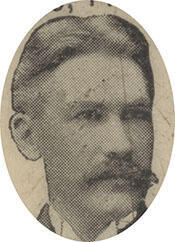
Lemuel Ely Quigg (February 12, 1863 – July 1, 1919) was a United States Representative from New York and a prominent Republican journalist, party leader, and attorney in the late nineteenth and early twentieth centuries. He was born near Chestertown, Kent County, Maryland, the son of a Methodist minister, and spent his early years in a household shaped by religious and educational values. During his youth he attended the public schools of Wilmington, Delaware, receiving a basic formal education that prepared him for a career in letters and public life.
In 1880 Quigg moved to New York City, where he began a career in journalism that would establish his public reputation and introduce him to the political currents of his era. He first became editor of the Flushing (New York) Times in 1883 and 1884, a position that brought him into close contact with local issues and the concerns of Queens County residents. In 1884 he joined the editorial staff of the New York Tribune, one of the leading Republican newspapers in the country, and remained there for a decade, from 1884 to 1894. His work at the Tribune coincided with a period of intense national debate over tariffs, monetary policy, and civil service reform. In 1895 he advanced to the post of editor-in-chief of the New York Press, further solidifying his influence in New York’s political and journalistic circles.
Quigg’s prominence as a Republican journalist helped propel him into elective office. A member of the Republican Party, he was elected to the Fifty-third Congress to fill the vacancy caused by the resignation of Representative John R. Fellows, thus beginning his service as a Representative from New York in the United States Congress. He took his seat on January 30, 1894, and was subsequently re-elected to the Fifty-fourth and Fifty-fifth Congresses, serving continuously from January 30, 1894, to March 3, 1899. Over these three terms in office, Quigg contributed to the legislative process during a significant period in American history marked by the aftermath of the Panic of 1893, debates over the gold standard, and the nation’s growing international role. As a member of the House of Representatives, he participated in the democratic process and represented the interests of his New York constituents.
During his congressional service, Quigg held a notable leadership role as chairman of the Committee on Expenditures in the Department of State in both the Fifty-fourth and Fifty-fifth Congresses. In that capacity, he was involved in overseeing and reviewing the financial administration of the State Department at a time when the United States was expanding its diplomatic and consular presence abroad. His tenure in Congress ended after he was an unsuccessful candidate for re-election in 1898 to the Fifty-sixth Congress, losing to New York millionaire William A. Chanler. His defeat marked the close of his formal legislative career, but he remained deeply engaged in Republican politics and public affairs.
After leaving Congress, Quigg turned to the study of law, reflecting a broader professional shift from journalism and elective office to legal practice. He studied law in New York and was admitted to the bar in 1903. Thereafter he engaged in the practice of law in New York City, building a career as an attorney while maintaining his connections to political life. His legal practice extended through the first decades of the twentieth century, during which he continued to be recognized as a figure of influence in both legal and political circles.
Parallel to his legal career, Quigg remained an active and influential Republican Party leader in New York State. He served as chairman of the Republican State conventions in 1896 and 1902, playing a central role in shaping party platforms and candidate slates during years of intense national political realignment. He was president of the Queens Republican county committee from 1896 to 1900, helping to organize and strengthen the party’s local structure in a rapidly growing borough. On the national stage, he was a delegate to the Republican National Conventions in 1896, 1900, and 1904, participating in the nomination of presidential candidates and the formulation of national party policies. Later, in 1915, he served as a delegate to the New York State constitutional convention, contributing to deliberations on proposed changes to the state’s fundamental law.
Lemuel Ely Quigg continued his legal and political activities until his final illness. He died in New York City on July 1, 1919, after a three-month bout with Bright’s disease. At the time of his death he was 56 years old. He was survived by his wife, Ethel G. (Murray), his son, Murray Townsend Quigg, his brothers, the Rev. Howard Quigg and A. W. Quigg, and two sisters. He was buried in Flushing Cemetery in Flushing, Queens County, New York, a resting place that reflected his long association with Queens and the wider New York community he had served as journalist, legislator, party leader, and attorney.
Congressional Record