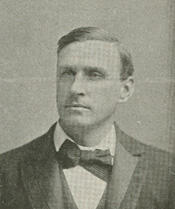
Lawrence Edward McGann (February 2, 1852 – July 22, 1928) was an Irish-born American public official and U.S. Representative from Illinois who served in Congress during the 1890s. A Chicago Democrat, he represented an Illinois district in the United States House of Representatives from 1891 to 1895, and, after a contested election, from March 4, 1895, until December 27, 1895. Over three terms in office, he contributed to the legislative process during a significant period in American history, participating in the democratic process and representing the interests of his constituents.
McGann was born in Dooghcloon, near Attymon, County Galway, Ireland, on February 2, 1852. His early childhood in Ireland was marked by family loss; his father died when he was still very young. In 1855, a year after his father’s death, he immigrated to the United States with his mother. They settled in Milford, Massachusetts, where he attended the local public schools. This New England upbringing provided his basic education and introduced him to American civic life at a time when many Irish immigrants were establishing new communities and political networks in the United States.
In 1865 McGann and his mother moved west to Chicago, Illinois, a rapidly growing city that would remain the center of his personal and professional life. As a young man he entered the boot and shoe trade, working in that line until 1879. His experience in the trades acquainted him with the concerns of working people in an industrializing city and helped shape the labor-oriented perspective he later brought to public office. In 1879 he entered municipal service as a clerk in the service of the city of Chicago, beginning a long career in local government and administration.
McGann’s rise in Chicago’s municipal structure continued through the 1880s. On January 1, 1885, he was appointed superintendent of streets for the city, a position of considerable responsibility in an era when urban infrastructure and street maintenance were central to public health, commerce, and daily life. He served as superintendent of streets until May 1891, when he resigned in connection with his election to national office. His work in this role, managing public works in a rapidly expanding metropolis, established his reputation as an effective administrator and aligned him closely with Chicago’s Democratic political organization.
A member of the Democratic Party, McGann was elected to the Fifty-second and Fifty-third Congresses and served as a Representative from Illinois in the United States Congress from March 4, 1891, to March 3, 1895. During these two consecutive terms he participated actively in the legislative process at a time of significant economic and social change in the United States. In the Fifty-third Congress he served as chairman of the Committee on Labor, a role that placed him at the center of debates over labor conditions, industrial regulation, and the rights of workers during the turbulent 1890s. As a member of the House of Representatives, he represented the interests of his Chicago constituents and contributed to national discussions on labor and urban issues.
McGann’s congressional service extended into a third term under contested circumstances. In the 1894 election he was initially declared the victor by a margin of 31 votes and was seated in the Fifty-fourth Congress, serving from March 4, 1895, until December 27, 1895. His Republican opponent, Hugh R. Belknap, contested the result. After a recount showed that Belknap had in fact won the election, McGann conceded the race without demanding further investigation, bringing his service in the House to a close. Although his continuous tenure is often dated from 1891 to 1895, this contested term meant that he held office in three successive Congresses during the decade.
After leaving Congress, McGann returned to Chicago and embarked on a long career in local service and business. In 1896 and 1897 he served as president of the Chicago General Railways, becoming a significant figure in the city’s transportation sector and a large investor in local streetcar enterprises. His leadership in urban transit reflected both his earlier experience in public works and his interest in the infrastructure that underpinned Chicago’s growth. He subsequently served as commissioner of public works of Chicago from 1898 to 1901 and again from 1911 to 1915, overseeing major aspects of the city’s physical development. Between these terms, from 1901 to 1907, he held the office of city controller, managing important elements of Chicago’s municipal finances.
In his later years McGann continued to reside in the Chicago area, making his home in Oak Park, Illinois. He remained identified with the city’s Democratic political tradition and with the civic improvements that had marked his long public career. Lawrence Edward McGann died in Oak Park on July 22, 1928. He was interred in Mount Olivet Cemetery in Chicago, closing a life that spanned immigration from Ireland, advancement through local government, service in the United States Congress, and decades of leadership in the public and business affairs of one of the nation’s largest cities.
Congressional Record