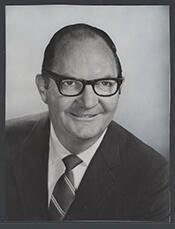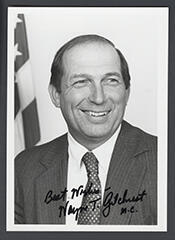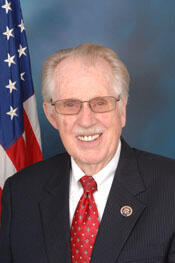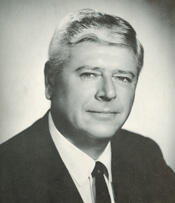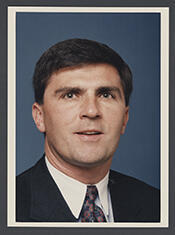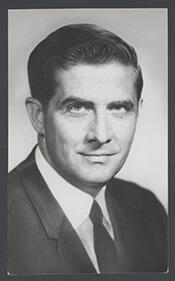
Lawrence Joseph Hogan Sr. (September 30, 1928 – April 20, 2017) was an American lawyer and politician who served as a Republican U.S. Representative from Maryland’s 5th congressional district from January 3, 1969, to January 3, 1975. A member of the Republican Party, he served three terms in the House of Representatives during a significant period in American history, contributing to the legislative process and representing the interests of his constituents. In 1974, he gained national attention as the only Republican representative on the House Judiciary Committee to vote to recommend all three House articles of impeachment against President Richard Nixon. He was the father of Lawrence J. “Larry” Hogan Jr., the 62nd governor of Maryland.
Hogan was born in Boston, Massachusetts, on September 30, 1928, and was raised in Washington, D.C. He attended Gonzaga College High School in the District of Columbia and went on to study at Georgetown University, where he received his bachelor’s degree in 1949. While a college student, he worked for the Washington Times-Herald. He joined the Federal Bureau of Investigation in 1948 and became a full-time FBI agent while attending Georgetown University Law Center. Hogan earned his J.D. from Georgetown in 1954, was admitted to the bar that same year, and later pursued additional graduate studies. He studied at San Francisco State College from 1956 to 1957, received a master’s degree from American University in 1965, and continued his education at the University of Maryland from 1966 to 1967.
Before entering elective office, Hogan built a career in law, public relations, and business. He practiced law and engaged in public relations work, eventually founding Larry Hogan Associates, a public relations and consulting business that was reportedly generating about $1 million a year before he sold it to enter politics. His background as an FBI agent, attorney, and businessman provided him with a combination of legal, investigative, and managerial experience that would inform his later public service at both the federal and local levels.
Hogan entered electoral politics in 1968, running as a Republican for Maryland’s 5th congressional district. That year he defeated incumbent Democrat Hervey Machen and took office in the 91st Congress on January 3, 1969. He was re-elected in 1970 and 1972, serving in the 92nd and 93rd Congresses. During his tenure in the House of Representatives from 1969 to 1975, he participated actively in the democratic process and represented a district that included much of southern Maryland and Prince George’s County. His service coincided with the Vietnam War, the civil rights era, and the unfolding of the Watergate scandal, placing him at the center of several of the most consequential debates of his time. To date, he remains the last Republican to have served as representative from Maryland’s 5th congressional district.
Hogan’s most prominent moment in Congress came during the impeachment proceedings against President Richard Nixon. As a member of the House Judiciary Committee, he was the only Republican to vote in favor of all three articles of impeachment when they were adopted in committee in 1974. In nationally televised hearings, he explained his decision in stark terms, stating that what appalled him was that the President, when confronted with the idea of blackmail, bribery, and silencing witnesses, did not respond with “righteous indignation” and reject such conduct as unworthy of the office. Instead, Hogan said, Nixon “worked and worked to try to cover this thing up so it wouldn’t come to light.” His vote, which broke with most of his party, was widely noted and became a defining act of his congressional career.
In 1974, Hogan chose not to run for re-election to the House and instead sought the Republican nomination for governor of Maryland. Early polling suggested he would be a strong challenger to incumbent Democratic Governor Marvin Mandel. However, his highly publicized break with Nixon was controversial among some Republican voters and contributed to his defeat in the Republican primary by Louise Gore, whose more “genteel, low-key nature” was also cited by political observers as a factor in her victory. Gore went on to lose to Mandel in the general election, and Democrat Gladys Spellman was elected to succeed Hogan in Congress. After his unsuccessful gubernatorial bid, Hogan and his wife Ilona opened the law firm Hogan and Hogan, with offices in Forestville, Maryland, and Washington, D.C. In 1976, he was elected a Maryland National Republican Committeeman, and in January 1977 he became executive vice president of the Associated Builders and Contractors trade association, a position in which he earned between $70,000 and $100,000 a year, a substantial salary in that period.
Hogan returned to elective office at the local level in 1978, when he ran for Prince George’s County Executive amid a “tax revolt” climate in the county. He challenged incumbent County Executive Winfield “Win” Kelly and won the office with about 60 percent of the vote. That same year, county voters approved a tax reform measure known as “TRIM,” which limited property tax increases and became a defining feature of county fiscal policy. Hogan served as county executive from 1978 to 1982, focusing on issues of taxation, growth, and county administration. In 1982, he sought higher office again, running as the Republican challenger to first-term Democratic U.S. Senator Paul Sarbanes, who had been his colleague on the House Judiciary Committee during the Nixon impeachment. Hogan lost the Senate race by a wide margin, and Parris Glendening was elected to succeed him as Prince George’s County Executive. After this defeat, Hogan’s active political career effectively came to an end.
In his later years, Hogan returned to practicing law, taught, and wrote on legal subjects. Among his publications was “Legal Aspects of the Fire Service,” a work that, as of 2014, was used at fire service training academies across the United States. He remained connected to public life through his family’s political involvement. Hogan married Nora Maguire in the mid-1940s; the marriage lasted 27 years and ended in divorce in 1972. In 1974 he married Ilona Maria Modly. After they moved to Frederick County, Maryland, Ilona Hogan was elected to the Board of County Commissioners, serving from 1994 to 2001. Of Hogan’s six children, at least two became active in Maryland politics. His son Patrick N. Hogan served as a Republican member of the Maryland House of Delegates representing District 3A. His eldest son, Larry Hogan, was elected governor of Maryland in 2014, defeating Lieutenant Governor Anthony Brown by 3.78 percent, and was re-elected in 2018 over former NAACP executive director Ben Jealous by 11.5 percent, becoming the first Republican since 1954 to win a second consecutive term as governor. Larry Hogan later became the Republican nominee for the 2024 U.S. Senate election in Maryland, running against Prince George’s County Executive Angela Alsobrooks.
On April 15, 2017, Hogan suffered a severe stroke and was hospitalized in Annapolis, Maryland. He died five days later, on April 20, 2017, at the age of 88. His long career in law enforcement, law, business, and politics—spanning service in the FBI, three terms in Congress, a pivotal role in the Nixon impeachment proceedings, and leadership as Prince George’s County Executive—left a lasting imprint on Maryland and on national political history.
Congressional Record