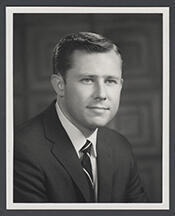
Lawrence Joseph “Larry” DeNardis (March 18, 1938 – August 24, 2018) was an American politician and academic who served as a Republican Representative from Connecticut in the United States Congress from 1981 to 1983 and later as president of the University of New Haven. Over the course of a varied public career, he was active in state and national politics, higher education administration, and civic affairs, and he became known as a moderate Republican voice during a period of significant political and economic change in the United States.
DeNardis became active in Republican Party politics in Connecticut during the 1960s. Beginning in 1966, he served as a delegate to the state Republican conventions, establishing himself within the party’s organizational structure and gaining experience in legislative and policy matters. His early political work coincided with a period of social and political transformation in the state and the nation, and it laid the groundwork for his subsequent election to public office.
In 1970, DeNardis was elected to the Connecticut State Senate, marking the start of nearly a decade of service in the state legislature. As a state senator, he represented his constituents through the 1970s, participating in the development of state policy during a time of economic adjustment and evolving public priorities. He served in the Connecticut State Senate until 1979, when he resigned his seat to become president of the Connecticut Conference of Independent Colleges. In that role, he shifted from direct legislative work to higher education leadership, representing and coordinating the interests of independent colleges across the state and engaging with issues of educational access, finance, and institutional governance.
In 1980, DeNardis sought federal office as a candidate for the United States House of Representatives from Connecticut’s 3rd congressional district. The seat had been held for 22 years by Democrat Robert Giaimo, who was retiring. Although the Democratic Party enjoyed a substantial registration advantage in the district, the 1980 election took place in the context of Ronald Reagan’s successful presidential campaign, and the district supported Reagan by 25,769 votes. Running as a Republican, DeNardis defeated Democratic State Senator Joe Lieberman by 13,121 votes, securing election to the Ninety-seventh Congress and beginning his single term in the U.S. House of Representatives.
DeNardis served in the House of Representatives from 1981 to 1983, representing Connecticut as a member of the Republican Party and contributing to the legislative process during a significant period in American history. In Congress, he emerged as a leader among the so‑called “gypsy moths,” a group of moderate Republicans from the Northeast and other regions who opposed some of President Reagan’s proposed budget cuts. While he ultimately supported certain elements of the administration’s fiscal program, he worked to temper its impact on his district and on key public projects. Notably, he was instrumental in retaining a $16 million federal grant to renovate the train station in New Haven, reflecting his attention to local infrastructure and economic development. Throughout his term, he participated in the democratic process by representing the interests and concerns of his constituents in the 3rd district.
In the 1982 election, DeNardis sought a second term and faced Democratic challenger Bruce Morrison, the executive director of the New Haven Legal Assistance Association. Morrison, who had been a classmate of Bill Clinton at Yale Law School, ran in a district where Democrats held a substantial registration advantage of approximately 110,000 to 55,000. Although DeNardis emphasized his opposition to some of Reagan’s initiatives and highlighted his record as a moderate, Morrison narrowly prevailed in the general election by 1,687 votes, ending DeNardis’s congressional service after one term. DeNardis attempted to regain the seat in 1984, a year that was broadly favorable to Republicans nationally and in Connecticut. Despite Reagan’s margin of more than 20 percent in the state and the Republican capture of both houses of the Connecticut General Assembly, DeNardis again lost to Morrison, concluding his bids for that congressional district.
Following his congressional career, DeNardis continued his involvement in public life and higher education. Building on his earlier experience with the Connecticut Conference of Independent Colleges, he became president of the University of New Haven, where he oversaw the institution’s academic and administrative affairs and furthered its development as a regional center of higher learning. His leadership in academia complemented his legislative background, and he remained engaged in public policy discussions, civic initiatives, and educational advocacy. Lawrence Joseph DeNardis died on August 24, 2018, leaving a record of service that spanned state government, the United States Congress, and the administration of higher education in Connecticut.
Congressional Record