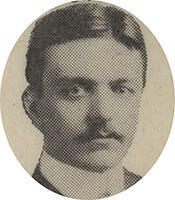
Lathrop Brown (February 26, 1883 – November 28, 1959) was a United States Representative from New York and a member of the Democratic Party who served one term in Congress from 1913 to 1915. He was born in New York City on February 26, 1883. His family included his brother, the architect Archibald Brown. Brown was educated at Groton School, from which he graduated in 1900, and he went on to Harvard University, graduating in 1903. At Harvard he was a roommate and close friend of Franklin D. Roosevelt; the two men remained lifelong associates and served as each other’s best man when they married. Early in his adult life Brown engaged in the real estate business and served for five years in Squadron A of the National Guard of New York. He was also keenly interested in the then‑fashionable but now discredited field of eugenics.
After establishing himself in business and public life in New York, Brown entered national politics as a Democrat. He was elected to the Sixty-third Congress and served as a Representative from New York from March 4, 1913, to March 3, 1915. During this single term in the U.S. House of Representatives, he participated in the legislative process during a significant period in American history, representing the interests of his New York constituents as the Wilson administration and a Democratic Congress undertook major reforms in banking, tariffs, and regulation. Following his term, he unsuccessfully contested the election of Frederick C. Hicks to the Sixty-fourth Congress, attempting to return to the House but failing to overturn the result.
Brown continued in public service after leaving Congress. From March 1917 to October 1918, during the First World War, he served as special assistant to the Secretary of the Interior. He also enlisted in the United States Army and served as a private in the Tank Corps during the war. In 1919 he was joint secretary of President Woodrow Wilson’s Industrial Conference, which sought to address postwar labor and industrial tensions. Remaining active in Democratic Party affairs, Brown was a delegate to the Democratic National Conventions in 1920, 1924, and 1936. He further pursued his longstanding interest in economic and financial questions by studying monetary theory at the Graduate School of Harvard University from 1928 to 1932. In the mid‑1950s he was a member of a committee to supervise what became the Harvard Kennedy School, serving in that capacity in 1954 and 1955.
Brown’s personal and family life reflected both substantial means and a strong interest in architecture and landscape. On Long Island he bought a 100‑acre estate on St. James Harbor, where the family raised and raced horses. There they commissioned his brother, architect Archibald Manning Brown, to design a large, modern country house, now known as the Knox School, although the Browns themselves never lived in it. While Brown served in Congress and later as special assistant to the Secretary of the Interior, the family lived near the White House in Washington, D.C. They subsequently resided in Manhattan, then at The Windmill on Montauk Point, and later in Boston. His Long Island home at Nissequogue, New York, known as Land of Clover, was later recognized for its historical and architectural significance and was added to the National Register of Historic Places in 1993.
In 1924 Brown and his wife, Hélène Hooper Brown—who had inherited $10,000,000 and been orphaned at age fifteen in 1910—traveled to Big Sur, California, in search of wild coastal land on which to build a house. They purchased the 1,600‑acre Saddle Rock Ranch from pioneer homesteader Christopher McWay. Rancher Julia Pfeiffer Burns leased some of the land for cattle, and Hélène Brown became a close friend of Julia until the latter’s death in 1928. The Browns first built a redwood cabin on the cliffs opposite McWay Falls, at the site of what is now the Waterfall Overlook, at a time when the waterfall still fell directly into the ocean. The location, however, was frequently enveloped in a cold marine fog. After the Carmel–San Simeon Highway was completed in 1937, the Browns replaced the cabin in 1940 with an elaborate multi‑story residence known as “Waterfall House,” sited halfway down the cliff below the new highway.
Waterfall House was notable for its dramatic design and luxurious appointments. Visitors reached the house via a short funicular railway descending from the highway. The residence featured a sixteen‑foot‑wide marble staircase at its base, fine furnishings, and large windows overlooking the Pacific Ocean. The entryway was inlaid with an ornamental brass fish, a large gold octopus with long tentacles, and a compass rose. The Browns decorated the home with artworks by Edgar Degas, Raoul Dufy, and Paul Gauguin. Hélène Brown’s small bedroom, the only room with a direct view of McWay Falls, was painted entirely black with gold stars on the ceiling and contained a large window framing the waterfall. The adjoining bathroom was finished in deep blue tile inlaid with gold, with mirrors arranged to create endless reflections. Behind the house lay terraced gardens and a caretaker’s cottage. Despite its beauty, the house remained subject to the same foggy conditions that had affected the earlier cabin, and the Browns continued to seek a residence above the marine layer.
In 1932, Saddle Rock Ranch foreman Hans Ewoldsen constructed a Pelton wheel on McWay Creek, using hand‑split redwood from the canyon and materials obtained through his work in the highway construction crew’s machine shop. The undershot wheel powered a 32‑volt generator and provided the first electric power in the Big Sur area, supplying electricity to three residences, a blacksmith shop, and the funicular railway serving Waterfall House. During World War II, in 1944, the Browns decided to build yet another residence, this time three miles inland on a ridge 1,960 feet (597 m) above the coast, beyond the reach of the fog. Because wartime rationing made building materials scarce and even forced some gasoline stations out of business, they purchased two abandoned gas station buildings, had a road built to the ridge, and hired a crew to haul the dismantled tin structures up the steep grade. An architect then assembled a distinctive modern house from the salvaged materials.
The resulting residence, which the family called the “Gas Station” house and which later became known as “Tin House,” had bold modern lines, a kitchen, living room, and maid’s quarters, and spectacular views up and down the coast. A west‑facing wall was constructed to block the intense afternoon sun, and the large living room was richly painted in blue. Legend later suggested that Tin House was built as a vacation retreat for President Franklin D. Roosevelt, but in fact, although Brown and Roosevelt had been childhood friends and close companions, FDR never visited the property. According to local accounts, the Browns spent only a single night in Tin House; they had not anticipated the loud popping and creaking caused by the metal siding and roof expanding in daytime heat and contracting in the cool night air. Disturbed by the noise and unable to sleep, they never returned to live there. Brown remained active in local affairs and was elected to the sheriff’s posse of Monterey County in 1947.
In 1956 Lathrop and Hélène Brown left Big Sur and moved to Florida. Lathrop Brown died in Fort Myers, Florida, on November 28, 1959, at the age of seventy‑six. He was cremated, and his ashes were interred in the Abbey of the Light at Manasota Memorial Park in Sarasota, Florida. In 1961, in fulfillment of the couple’s long association with Big Sur and in memory of her friend, Hélène Hooper Brown donated the entire Saddle Rock Ranch property to the State of California, stipulating that it be used as a park and named for Julia Pfeiffer Burns, whom she described as a “true pioneer.” She further required that Waterfall House be converted within five years into a museum of Big Sur history or else be demolished. The museum plan was never realized, and the mansion was razed in 1966. The Waterfall Overlook of McWay Falls was built on its site, where visitors can still see remnants of the original landscaping, including palm trees, and view the preserved Pelton wheel.
Congressional Record