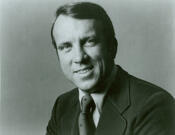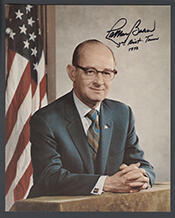
LaMar Baker (December 29, 1915 – June 20, 2003) was a Tennessee businessman and Republican political figure who served two terms in the United States House of Representatives from 1971 to 1975. Born in Chattanooga, Tennessee, he attended the public schools there before pursuing higher education at David Lipscomb College, now Lipscomb University, in Nashville from 1936 to 1938. He then enrolled at Harding College in Searcy, Arkansas, another institution affiliated with the Churches of Christ, and received a Bachelor of Science degree in 1940. These early academic experiences in religiously affiliated institutions helped shape his outlook and prepared him for a career that combined business, public service, and politics.
During World War II, Baker served in the United States Army Air Forces, now the United States Air Force, from 1942 to 1946. His wartime service coincided with the global conflict that engaged millions of Americans in uniform and contributed to the Allied victory. After returning from military duty, he established himself as a successful businessman in the Chattanooga area. His business career in the postwar years provided him with local prominence and practical experience that would later inform his approach to legislative and constituent matters.
Baker’s formal political career began at the state level in Tennessee. Drawing on his business background and community standing, he was elected in 1966 to the Tennessee House of Representatives. Two years later, in 1968, he advanced to the Tennessee State Senate, thus becoming a member of both houses of the Tennessee State Legislature. His service in the General Assembly gave him experience in state policymaking and positioned him as a rising figure within the Tennessee Republican Party at a time when the party was gaining strength in what had traditionally been a Democratic stronghold.
In 1970, Baker sought federal office when he received the Republican nomination for the Chattanooga-based congressional district then represented by Bill Brock, who was running successfully for the United States Senate. In the November 1970 general election, Baker won a very close race to the U.S. House of Representatives, a victory widely regarded as having been aided by the coattails of Brock’s Senate campaign and the concurrent election of Republican Winfield Dunn as governor of Tennessee. He took his seat in Congress in January 1971, representing his constituents as a member of the Republican Party during a significant period in American history marked by the Vietnam War, social change, and growing public distrust of government.
Baker served two terms in Congress, from 1971 to 1975, contributing to the legislative process and participating in the democratic governance of the nation. He was reelected in 1972, a Republican landslide year in which President Richard M. Nixon carried all but five of Tennessee’s ninety-five counties. That same year, Baker also served as a delegate to the 1972 Republican National Convention, reflecting his growing stature within the party. During his tenure in the House of Representatives, he worked to represent the interests of his Chattanooga-area constituents while aligning with the broader Republican agenda of the era.
His congressional career came to an end in the aftermath of the Watergate scandal. In 1974, Baker was defeated for reelection by Democrat Marilyn Lloyd. Two principal factors were widely cited in his defeat. One was the general unpopularity of Republicans nationwide following the Watergate revelations and President Nixon’s resignation earlier that year, which contributed to Democratic gains in many competitive and marginally Republican districts. The other was the unusual and sympathetic circumstance surrounding his opponent: Marilyn Lloyd was the widow of Mort Lloyd, a well-known anchorman at CBS affiliate WDEF-TV in Chattanooga, who had won the Democratic nomination to face Baker but was killed in a light-airplane accident on his way to celebrate his primary victory. After Mort Lloyd’s death, the Democratic Party selected his wife, Marilyn Lloyd, to replace him as the congressional nominee, and she went on to defeat Baker in the general election. Baker attempted a comeback in 1976 but lost badly in a rematch against Lloyd, a year in which Democrat Jimmy Carter of neighboring Georgia carried Tennessee’s electoral votes.
Following his departure from Congress, Baker continued to serve in public roles. During the administration of President Ronald W. Reagan, from 1981 to 1985, he was appointed regional representative to United States Secretary of Transportation Drew Lewis. In this capacity, he acted as a liaison between the Department of Transportation and regional interests, drawing on his legislative experience and knowledge of transportation and infrastructure issues. This position extended his public service beyond elective office and kept him engaged in federal policymaking during the early 1980s.
In his later years, Baker resided in Nashville, Tennessee. He remained a respected figure within Tennessee Republican circles and among those who had observed his career in state and national politics. LaMar Baker died on June 20, 2003. He is interred in Woodlawn Cemetery in Nashville, closing a life that spanned service in World War II, success in business, and a notable career in both the Tennessee State Legislature and the United States Congress.
Congressional Record