Kenneth Farrand Simpson (May 4, 1895 – January 25, 1941) was a Republican member of the United States House of Representatives from New York, serving for the last 22 days of his life. His brief tenure in Congress, from January 3, 1941, until his death on January 25, 1941, occurred during a significant period in American history on the eve of the nation’s entry into World War II. A member of the Republican Party, he participated in the legislative process and represented the interests of his New York constituents during his short service in the House of Representatives.
Simpson was born in New York City on May 4, 1895, the son of William Kelly Simpson, an ear, nose, and throat specialist and professor at Columbia University. He was educated at The Hill School in Pottstown, Pennsylvania, where his leadership and initiative were evident early; during his senior year he successfully persuaded former President Theodore Roosevelt to address the student body. He went on to Yale University, graduating in 1917. At Yale he was elected to Phi Beta Kappa and was initiated into the Skull and Bones society, receiving the distinction of being the “last man tapped,” a traditional honor within that organization.
Upon graduation from Yale, Simpson entered military service during World War I. He served in the United States Army as a member of the 302nd Field Artillery Regiment, part of the 76th Division, and attained the rank of captain. During the postwar period he remained in Europe for a time and served as Commandant of the American School Detachment at the University of Aix-Marseilles in France, contributing to the education and orientation of American personnel in a European academic setting.
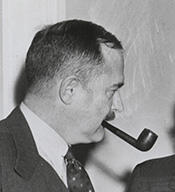
After returning to the United States, Simpson pursued legal training and graduated from Harvard Law School in 1922. He was admitted to the bar and began practice as an attorney. Maintaining strong ties to Europe, he was active in the art world of postwar France and worked with the French government to recover artworks stolen by the Germans during World War I. In his legal and personal capacities he represented and befriended a number of prominent artists and intellectuals, including Pablo Picasso, former Russian prime minister Alexander Kerensky, literary critic Edmund Wilson, and writer Gertrude Stein. His association with Stein was highlighted in his later political life; his congressional campaign materials depicted him in his living room, leaning near a statue of Stein and smoking a pipe beneath a painting by the French artist Jean Lurçat. From 1925 to 1927 he served as an Assistant United States Attorney for the Southern District of New York, gaining experience in federal prosecution and public service.
Simpson became increasingly active in Republican politics in New York during the 1930s. He chaired the New York County Republican Committee from 1935 to 1940, a position from which he helped shape party strategy and candidate selection in one of the nation’s most important political jurisdictions. He was elected to represent New York on the Republican National Committee and served as a delegate to the Republican National Conventions in 1936 and 1940. Within the party, he aligned himself with the Fusion Republicans, a reform-oriented and more liberal faction that opposed the conservative leadership in New York. In this capacity he formed alliances with Mayor Fiorello H. La Guardia and other liberal Republicans, advocating for a more progressive and internationalist Republican agenda. An early and outspoken critic of Adolf Hitler, Simpson condemned both Nazi aggression and those U.S. business interests that were perceived as sympathetic to or accommodating of the Nazi regime in the 1930s.
In the 1940 elections, Simpson was chosen as the Republican candidate for the United States House of Representatives from New York. He was elected in November 1940 and took his seat in the Seventy-seventh Congress on January 3, 1941. His service in Congress, from 1941 to 1943 as recorded for the term to which he was elected, in fact lasted only 22 days in person, as he died early in that term. During this brief period, he participated in the opening proceedings of a Congress that would soon confront the global crisis of World War II and the question of American involvement. His role as a Representative from New York placed him at the center of national debates over foreign policy, defense preparedness, and the evolving responsibilities of the federal government, although his early death curtailed his ability to leave a substantial legislative record.
In his personal life, Simpson married Helen Louise Knickerbacker Porter of Montclair, New Jersey, in 1925. The couple had four children: William Kelly Simpson, who became a noted Egyptologist; Helen-Louise Simpson Seggerman; Elizabeth Carroll Simpson Bennett; and Sally Simpson French. His family life and his connections to the artistic and intellectual communities in both the United States and Europe formed an important backdrop to his public career, reflecting a cosmopolitan outlook that informed his political internationalism and cultural interests.
Kenneth Farrand Simpson died of a heart attack in New York City on January 25, 1941, less than a month after taking office in the House of Representatives. His death placed him among the members of the United States Congress who died in office during the first half of the twentieth century. He was interred at Hudson City Cemetery in Hudson, New York.
Congressional Record