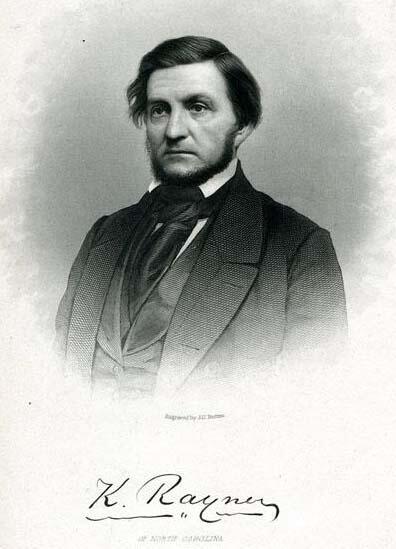
Kenneth Rayner (June 20, 1808 – March 5, 1884) was an American lawyer and politician who served three terms as a Whig U.S. Congressman from North Carolina between 1839 and 1845. He was born in Bertie County, North Carolina, on June 20, 1808. Raised in eastern North Carolina, he attended Tarborough Academy, a leading preparatory school in the region, where he received a classical education that prepared him for the study of law and public life in the early nineteenth century.
After completing his preparatory studies, Rayner read law and was admitted to the bar in 1829. He subsequently moved to Hertford County, North Carolina, where he established a legal practice. His work as an attorney in Hertford County brought him into contact with local political and economic leaders and helped lay the foundation for his entry into state politics. Through his legal career, he gained a reputation as a capable advocate and developed the skills in argument and debate that would later characterize his legislative service.
Rayner’s formal political career began in the mid-1830s. In 1835, he was chosen as a delegate to the North Carolina Constitutional Convention, which undertook significant revisions to the state’s governing framework. That same year he was elected to the North Carolina House of Commons, in which he served in 1835 and 1836. His participation in the convention and the House of Commons placed him among the more prominent young Whig leaders in the state and positioned him for national office.
In 1838, Rayner was elected as a Whig to the U.S. House of Representatives. He served three consecutive terms in Congress, representing North Carolina in the 26th, 27th, and 28th Congresses from March 4, 1839, to March 3, 1845. As a member of the Whig Party during a significant period in American history, he contributed to the legislative process and participated in the national debates of the antebellum era, representing the interests of his North Carolina constituents. His service in Congress coincided with major issues such as economic policy, the role of the federal government, and sectional tensions, and he took part in the democratic process at a time of growing political realignment.
Rayner did not run for a fourth term in 1844 and left Congress at the close of his third term in 1845. He returned to North Carolina and resumed his involvement in state politics. He again served in the North Carolina House of Commons in 1846, 1848, and 1850, remaining an influential Whig voice in state affairs. In 1854, he was elected to the North Carolina Senate, further extending his legislative career and reinforcing his status as a prominent figure in the state’s political life.
As national tensions intensified in the 1850s and 1860s, Rayner aligned himself with efforts to preserve the Union. In the 1860 United States presidential election, he supported and campaigned for the Constitutional Union Party ticket of John Bell and Edward Everett, which sought to avert sectional conflict by emphasizing adherence to the Constitution and the Union. Although the Bell–Everett ticket ultimately lost to Abraham Lincoln, Rayner’s support reflected his moderate, unionist inclinations within the broader Southern political context.
Following the Civil War, Rayner continued his public service at the federal level. In 1871, President Ulysses S. Grant appointed him as one of the court commissioners to help settle the Alabama Claims, an important international dispute arising from British-built Confederate commerce raiders that had damaged U.S. shipping during the war. His role in this process placed him within the broader framework of Reconstruction-era diplomacy and postwar reconciliation. Later, from 1877 to 1884, he served as Solicitor of the United States Treasury, acting as a senior legal officer for the department and contributing to the federal government’s financial and legal administration during the late Reconstruction and post-Reconstruction years.
Kenneth Rayner died in Washington, D.C., on March 5, 1884, while still serving as Solicitor of the Treasury. He was buried in Raleigh, North Carolina, reflecting his enduring connection to the state he had represented and served in various capacities throughout his life.
Congressional Record