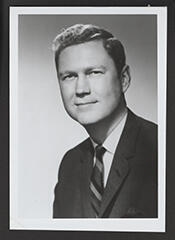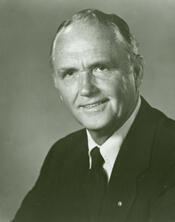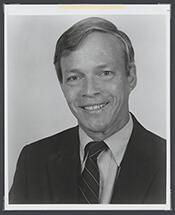
Kenneth Hood “Buddy” MacKay Jr. (March 22, 1933 – December 31, 2024) was an American politician and diplomat who served as the 42nd governor of Florida from December 12, 1998, to January 5, 1999, and as a member of the United States House of Representatives from Florida from 1983 to 1989. A lifelong Democrat, he also served as the 14th lieutenant governor of Florida from 1991 to 1998, was a state legislator, and later a special envoy for the Americas. MacKay was the most recent Democratic governor of Florida and, until his death in 2024, the last living Democrat to have held that office.
MacKay was born on March 22, 1933, in Ocala, Florida, into a family with deep roots in the state. He grew up in central Florida and came of age during the Great Depression and World War II, experiences that helped shape his views on public service and economic opportunity. His early years in Marion County exposed him to the concerns of small-town Floridians and the agricultural and rural communities that would later form an important part of his political base.
After completing his primary and secondary education in Florida, MacKay pursued higher education and legal training, preparing for a career in law and public life. He established himself professionally as an attorney before entering elective office, gaining experience that would inform his later work on legislative and policy matters. His legal background contributed to his reputation as a careful, detail-oriented policymaker once he began serving in the Florida Legislature and, later, in Congress.
MacKay’s formal political career began in state government, where he served as a member of the Florida Legislature and rose to the Florida Senate. In the 1974 election for the Florida Senate from the 6th district, he was elected with 26,418 votes (75.32 percent) to 8,655 votes (24.68 percent) for his Republican opponent, Charles E. Curtis. He consolidated his position in state politics when he was re-elected to the Florida Senate from the 6th district in 1978 without opposition. Seeking to extend his influence to the federal level, MacKay entered the 1980 Democratic primary for the United States Senate from Florida. In that primary he finished third, receiving 272,538 votes (24.61 percent), behind incumbent Senator Richard Stone, who received 355,287 votes (32.08 percent), and Bill Gunter, who received 335,859 votes (30.33 percent), but ahead of Richard A. Pettigrew, James L. Miller, and John B. Coffey. Although unsuccessful, this race elevated his statewide profile and set the stage for his subsequent election to Congress.
Kenneth Hood MacKay served as a Representative from Florida in the United States Congress from 1983 to 1989. A member of the Democratic Party, he contributed to the legislative process during three terms in office. In the 1982 election for Florida’s 6th congressional district, he was elected to the U.S. House of Representatives with 85,825 votes (61.35 percent) to 54,059 votes (38.65 percent) for Republican Ed Havill. He was overwhelmingly re-elected in 1984, receiving 167,409 votes (99.30 percent) against 1,174 write-in votes (0.70 percent) for Eric Tarnley, and again in 1986 with 143,598 votes (70.16 percent) to 61,069 votes (29.84 percent) for Republican Larry Gallagher. MacKay’s service in Congress occurred during a significant period in American history, encompassing the later years of the Cold War and major debates over fiscal policy, social programs, and foreign affairs. As a member of the House of Representatives, he participated in the democratic process and represented the interests of his Florida constituents, bringing to Washington the concerns of a rapidly growing Sun Belt state. In 1988 he again sought a seat in the United States Senate from Florida. In the Democratic primary that year, he finished second with 263,946 votes (26.14 percent), behind Bill Gunter, who received 383,721 votes (38.00 percent), and ahead of Dan Mica, Pat Frank, Claude Roy Kirk Jr., and Fred Rader, but he did not advance to the Senate.
After leaving Congress, MacKay returned to statewide politics. In 1990 he joined the Democratic ticket as the candidate for lieutenant governor alongside former U.S. Senator Lawton Chiles, who had previously held the Senate seat MacKay had unsuccessfully sought in 1988. MacKay won the 1990 Democratic primary for lieutenant governor on Chiles’s ticket, and the Chiles–MacKay team was elected in the general election. They were re-elected in 1994 in a closely contested race against the Republican ticket headed by Jeb Bush. As the 14th lieutenant governor of Florida from 1991 to 1998, MacKay was widely regarded as the most significant and powerful lieutenant governor in the state’s history. He served as co-chair of the Florida Commission on Education, Reform and Accountability, reflecting his long-standing interest in education policy and government accountability. During this period he also took positions on criminal justice issues, including capital punishment. A strong supporter of the use of the death penalty, as was Governor Chiles, MacKay stated during the 1998 gubernatorial campaign that he supported the death penalty and the use of the electric chair “so long as it operates in a reliable fashion,” while also suggesting that Florida should consider changing its mode of execution after the botched execution of Pedro Medina, remarking that “the last thing we want to do is generate sympathy for these killers.”
In 1998 MacKay ran for governor in his own right but was defeated by Republican Jeb Bush. Despite this electoral loss, he became governor when Lawton Chiles died unexpectedly on December 12, 1998. At the time of Chiles’s death, MacKay was in Boston with his wife. Returning to their hotel room, they found a message informing him of the governor’s death and directing him to travel immediately. He flew to Atlanta, where a state crew met him and flew him through thick fog to Tallahassee. At 12:30 a.m. on December 13, 1998, the 65-year-old MacKay was sworn in as Florida’s 42nd governor in his Capitol office for the 24 days remaining in Chiles’s term. Reflecting on assuming the office under such circumstances, he remarked, “There’s no great pleasure in this,” noting his sorrow that, because of the short time and lack of an electoral mandate, he would be unable to fully address issues he had long prioritized, such as education and health care. Although he kept a relatively low public profile during his brief tenure, MacKay made at least 56 appointments to various boards and offices, including two judgeships. He granted six pardons to female prisoners and engaged in policy matters such as negotiations over an Everglades restoration plan and the moderation of other state disputes. Perhaps his most visible act as governor was signing the nomination of Peggy Quince to the Florida Supreme Court. Quince had been Chiles’s final choice for the bench, and it fell to MacKay, and then to Governor-elect Bush, to sustain her appointment. Having been defeated in the 1998 election, MacKay was succeeded by Bush on January 5, 1999.
After his governorship ended, MacKay retired from active electoral politics but remained publicly engaged in national and hemispheric affairs. He was appointed by President Bill Clinton as a special envoy for the Americas, becoming the second person to hold that position. In this diplomatic role he traveled to 26 countries throughout the Western Hemisphere, working on issues including the proposed Free Trade Area of the Americas (FTAA), the implementation and impact of the North American Free Trade Agreement (NAFTA), the Caribbean Basin Initiative (CBI), hemispheric security, the strengthening of the rule of law, labor standards, environmental policies, and human rights. His work as special envoy reflected a broadening of his public service from state and national concerns to regional and international policy, drawing on his legislative, executive, and legal experience.
Kenneth Hood “Buddy” MacKay Jr. died on December 31, 2024. At the time of his death he was recognized as the most recent Democrat to have served as governor of Florida and, until that date, the last living Democratic former governor of the state. His long career in public service—spanning the Florida Legislature, the U.S. House of Representatives, the lieutenant governorship, a brief but consequential governorship, and diplomatic service as special envoy for the Americas—left a lasting imprint on Florida’s political history and on U.S. engagement with the nations of the Americas.
Congressional Record