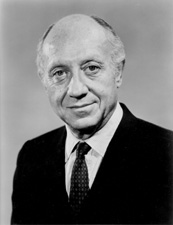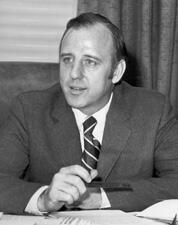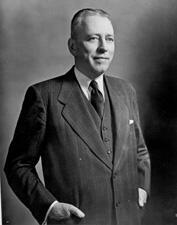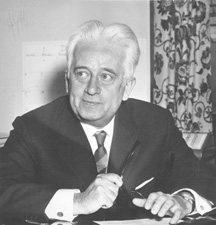
Kenneth Barnard Keating (May 18, 1900 – May 5, 1975) was an American politician, diplomat, soldier, and judge who served in both houses of the United States Congress and later as a United States ambassador. A member of the Republican Party, he represented New York in the United States House of Representatives from 1947 to 1959 and in the United States Senate from 1959 to 1965. He subsequently served as a judge of the New York State Court of Appeals from 1966 to 1969 and as U.S. ambassador to India from 1969 to 1972 and to Israel from 1973 until his death in 1975.
Keating was born in Lima, Livingston County, New York, and was educated in the local schools before attending Genesee Wesleyan Seminary, from which he graduated in 1915. He then enrolled at the University of Rochester, where he completed his undergraduate studies in 1919. During World War I, while a student at Rochester, he served in the Student Army Training Corps (SATC), reflecting an early commitment to public service and national defense. After receiving his degree, he briefly taught at East High School in Rochester before deciding to pursue a legal career.
In 1920 Keating entered Harvard Law School, from which he graduated with a law degree in 1923. He returned to Rochester to practice law and quickly became active in Republican Party politics in upstate New York. Over the following two decades he built a successful legal practice while emerging as a prominent figure in local and state Republican circles. His legal and political work was interrupted by World War II, during which he joined the United States Army. Commissioned as a major, he was assigned to the China Burma India Theater and served in India as head of the U.S. office that managed the Lend-Lease Program for that theater. He was promoted to colonel before the end of the war. After the war, Keating continued his military involvement in the Organized Reserve Corps, in which he was promoted to brigadier general in 1948 and served until his retirement from the reserves in 1963.
Keating’s national political career began with his election to the United States House of Representatives in 1946. He took office on January 3, 1947, representing New York’s 40th congressional district, centered on Rochester. Following redistricting, he represented New York’s 38th district beginning in 1953. He was re-elected five times and served in the House until January 3, 1959, completing six consecutive terms. During his House service, which spanned a significant period in American postwar history, he developed a reputation as a moderate Republican on many domestic issues, while adopting firm conservative positions on the Cold War, anti-communism, and the fight against organized crime. His legislative work and public profile during these years included appearances on national programs such as the “Longines Chronoscope,” where he discussed contemporary political and foreign policy issues.
In 1958 Keating successfully ran for the United States Senate from New York. He took office on January 3, 1959, and served one term, leaving the Senate on January 3, 1965. His service in Congress thus extended from 1947 to 1965, encompassing seven terms in office in the House and Senate combined, during a transformative era marked by the Cold War, the early civil rights movement, and significant changes in American domestic policy. In the Senate, Keating was known for his advocacy of civil rights and desegregation. He played a key role in helping to break the filibuster that enabled passage of the Civil Rights Act of 1964, aligning himself with bipartisan efforts to secure federal civil rights protections. During the 1964 presidential election, he notably refused to endorse the Republican Party’s conservative nominee, Senator Barry Goldwater of Arizona, reflecting his more moderate stance within the party. In the same year, he sought re-election to the Senate but was defeated by Democrat Robert F. Kennedy in a closely watched contest.
After leaving the Senate in January 1965, Keating briefly returned to the practice of law. He also received numerous honorary degrees in recognition of his public service and legal and legislative accomplishments. These included honorary Doctor of Laws (LL.D.) degrees from the University of Rochester in 1954; Hobart and William Smith Colleges, Hamilton College, Le Moyne College, Albany Law School of Union University, and Long Island University in 1959; Adelphi University and Iona University in 1962; and Rhode Island College in 1965. He was awarded honorary Doctor of Humane Letters (DHL) degrees from Alfred University in 1960, Yeshiva University in 1962, New York Medical College in 1965, and Clarkson University in 1964; an honorary Doctor of Letters (D.Litt.) from Elmira College in 1964; and a Doctor of Civil Law (DCL) from Pace University in 1965. These academic honors underscored his stature as a national legislator and public figure.
In 1965 Keating was elected to the New York State Court of Appeals, the state’s highest court, and he took his seat in 1966. He served on the Court of Appeals until 1969, bringing to the bench his extensive experience in federal legislation, constitutional issues, and public policy. In 1969 he resigned from the court when President Richard M. Nixon appointed him United States ambassador to India. As ambassador in New Delhi from 1969 to 1972, Keating served during a period of considerable regional tension and shifting U.S.–South Asia relations, including the run-up to and aftermath of the 1971 Indo–Pakistani War. He resigned the ambassadorship in 1972 to participate in the campaign for Nixon’s re-election.
In 1973 President Nixon appointed Keating United States ambassador to Israel. He assumed this post at a critical moment in Middle Eastern affairs and served through the October 1973 Yom Kippur War and its aftermath, working to manage U.S.–Israeli relations during a period of intense diplomatic and military crisis. Keating remained in this position until his death on May 5, 1975. He was buried at Arlington National Cemetery, reflecting both his long record of military service and his distinguished career in public life as a legislator, judge, and diplomat.
Congressional Record