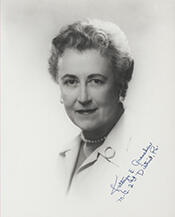
Kathryn Elizabeth Granahan (December 7, 1894 – July 10, 1979) was an American politician who served as a Democratic member of the United States House of Representatives from Pennsylvania from 1955 to 1963 and later as Treasurer of the United States, to which office she was appointed by President John F. Kennedy. A pioneering figure in Pennsylvania politics, she was the first woman to be elected to the United States Congress from Philadelphia and contributed to the legislative process during four terms in office at a significant period in American history.
Granahan was born Kathryn Elizabeth O’Hay on December 7, 1894, in Easton, Pennsylvania, in the Lehigh Valley region of eastern Pennsylvania. All four of her grandparents were Irish immigrants, and she grew up in a family and community shaped by Irish American heritage. She attended local schools and graduated from Easton Area High School. Seeking further education, she moved to Philadelphia and enrolled at Mount St. Joseph Collegiate Institute, a Catholic women’s institution that was later renamed Chestnut Hill College, from which she graduated.
Before entering elective office, Granahan built a career in public service and civic affairs in Pennsylvania. From 1940 to 1943, she served as supervisor of public assistance in the State Auditor General’s Department, where she was responsible for oversight of relief and assistance programs during the later years of the Great Depression and the early years of World War II. In that capacity she also acted as liaison officer between the Auditor General’s Department and the Pennsylvania Department of Public Assistance, coordinating policy and administration between the two agencies. Beyond her governmental duties, she was active in educational and medical causes and served as a member of the national board of the Woman’s Medical College of Pennsylvania in Philadelphia, one of the nation’s pioneering institutions for the training of women physicians.
Granahan’s path to Congress was closely intertwined with that of her husband, Representative William T. Granahan, a Democrat who represented a Philadelphia-area district in the U.S. House of Representatives from 1945 to 1947 and again from 1949 until his death in 1956. His death occurred shortly after the 1956 primary election. In the ensuing vacancy, the Democratic Party organization in Philadelphia selected Kathryn Granahan to succeed her husband as the party’s nominee in both the special election to complete his unexpired term and the general election for the next full term. She won both contests and was simultaneously elected to serve out her husband’s term in the 84th Congress and to a full term in the 85th Congress in her own right, formally beginning her congressional service in 1955 and continuing through 1963.
During her tenure in the House of Representatives, Granahan represented the interests of her Pennsylvania constituents through a period marked by the Cold War, the early civil rights movement, and postwar economic change. She became particularly noted for her work on postal issues and served as chair of the House Subcommittee on Postal Operations. In that role, she worked closely with Postmaster General Arthur Summerfield to advance legislation aimed at curbing the distribution of obscene materials through the mails. The resulting measure, commonly known as the Granahan bill, authorized federal authorities to seize and detain the mail of anyone suspected of trafficking in obscenity, reflecting contemporary concerns about morality, censorship, and the regulation of communications. A loyal Democrat, she also participated in national party affairs and served as a delegate to the 1960 Democratic National Convention in Los Angeles.
Following the 1960 census, Pennsylvania was slated to lose three seats in the U.S. House of Representatives due to reapportionment. In the ensuing redistricting negotiations, Democratic Party leaders determined that Granahan’s district would be among those eliminated. Representative William J. “Bill” Green, a powerful figure in Philadelphia’s Democratic organization, secured Granahan’s agreement not to seek reelection in 1962. In return, Green obtained a commitment from President John F. Kennedy to appoint her Treasurer of the United States. Kennedy fulfilled this promise, and Granahan began her term as Treasurer on January 9, 1963, immediately after her service in Congress concluded.
As Treasurer of the United States, Granahan oversaw key functions of the Treasury Department related to currency issuance and the nation’s financial operations, and her signature appeared on U.S. paper currency printed during her tenure. Her time in that office, however, was affected by health difficulties. In 1965 she suffered a blood clot following a fall, an injury that significantly limited her ability to maintain a full work schedule. She continued to serve on a reduced basis, but by 1966 concerns about her health and capacity led to an unsuccessful effort to have her declared incompetent. Although that effort failed, she resigned from the post approximately four months later, bringing her federal executive service to a close. During this period of national prominence, she also appeared as a guest on popular television panel shows, including “What’s My Line?” on March 3, 1963, and “To Tell the Truth” in November 1963, reflecting the public interest in her role as a woman holding high federal office.
In her later years, Granahan lived in the Philadelphia region, remaining a notable figure in Pennsylvania’s political history as both a trailblazing congresswoman and a former Treasurer of the United States. She died in Norristown, Pennsylvania, on July 10, 1979, at the age of 84. Kathryn Elizabeth Granahan was interred at Gethsemane Cemetery in her native Easton, Pennsylvania, closing a life that spanned from the late nineteenth century through the modern era and that was marked by sustained service in state and national government.
Congressional Record