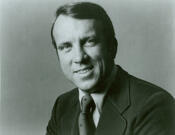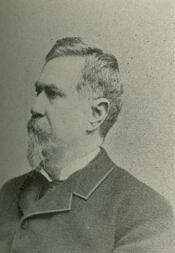
Josiah Patterson (April 14, 1837 – February 10, 1904) was a Confederate soldier, attorney, political figure, and a member of the United States House of Representatives for the 10th District of Tennessee. A Democrat, he served three consecutive terms in Congress from 1891 to 1897, representing his Memphis-area constituency during a significant period in American political and economic history.
Patterson was born on April 14, 1837, in Morgan County, Alabama. He attended local schools and pursued further studies at Somerville Academy in Somerville, Alabama. After completing his preparatory education, he read law and was admitted to the bar in 1859. That same year he began the practice of law in Morgan County. On December 22, 1859, he married Josephine Rice in Morgan County, Alabama. The couple had three children: Malcolm Rice Patterson, who would later become governor of Tennessee; Mary Louisa; and Ann Eliza.
With the outbreak of the American Civil War, Patterson entered military service for the Confederacy. In September 1861 he enlisted in the Confederate Army, and in 1862 he was commissioned a first lieutenant in the 1st Alabama Cavalry Regiment. Over the course of the war he was promoted through the ranks until he attained the rank of colonel and was assigned command of the 5th Alabama Cavalry Regiment. Serving in General Philip Dale Roddey’s brigade, he spent most of the conflict operating in North Alabama. He surrendered with his regiment at the end of the war in May 1865 and then returned home to resume his legal practice.
In January 1867 Patterson relocated to Florence, Alabama, where he continued his work as an attorney during the early years of Reconstruction. In 1872 he moved to Memphis, Tennessee, a growing commercial center on the Mississippi River, and established himself in the city’s legal and political life. His prominence in Tennessee politics increased during the 1880s, and he served in the Tennessee House of Representatives from 1883 to 1885, participating in state legislative affairs as the region adjusted to postwar economic and social changes.
Patterson’s state-level experience led to his election to the United States House of Representatives as a Democrat from Tennessee’s 10th Congressional District. He was elected to the Fifty-second, Fifty-third, and Fifty-fourth Congresses and served from March 4, 1891, to March 3, 1897. During these three terms in office, he contributed to the legislative process and represented the interests of his constituents in Memphis and the surrounding area. His service in Congress coincided with a period marked by debates over monetary policy, tariffs, and economic reform in the wake of the Panic of 1893. Identified with the Gold Democrat faction of his party, he was an unsuccessful candidate for re-election to the Fifty-fifth Congress, running as a Gold Democrat in the 1896 election.
After leaving Congress in 1897, Patterson returned to Memphis and resumed the practice of law, remaining active in his profession until the end of his life. He continued to be a figure of some influence in Tennessee’s legal and political circles, even as younger leaders, including members of his own family, came to the fore.
Josiah Patterson died on February 10, 1904, in Memphis, Tennessee. He was interred at Forest Hill Cemetery in Memphis. His family continued his public legacy: his son, Malcolm Rice Patterson (June 7, 1861 – March 8, 1935), served as governor of Tennessee from 1907 to 1911, and his granddaughter, Virginia Foster Durr (August 6, 1903 – February 24, 1999), became a prominent civil rights advocate and friend of Rosa Parks, active in the Civil Rights Movement in the mid-twentieth century.
Congressional Record