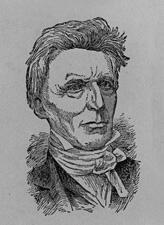
Dr. Joshua Clayton (July 20, 1744 – August 11, 1798) was an American physician, Revolutionary War officer, and Federalist politician from Mount Pleasant in Pencader Hundred, New Castle County, Delaware. He was born near Wyoming, Delaware, the son of John Clayton, a miller, and Eleanor Edinfield. His family had deep roots in the region; his grandfather, also named Joshua Clayton, was a Quaker who emigrated from Lincolnshire, England, in the late seventeenth century. These family connections placed him within an established local community that would later support his medical and political careers.
Clayton received a formal medical education at what is now the University of Pennsylvania in Philadelphia, then one of the leading medical schools in the colonies. He studied there from 1757 until 1762, after which he returned to Delaware and began a medical practice in Middletown. In the course of his early professional life he became a close friend of Richard Bassett, a prominent Delaware lawyer and statesman. In 1765 he married Bassett’s adopted daughter, Rachael McCleary, thereby strengthening his ties to one of the colony’s influential families. Clayton later acquired a portion of Bassett’s Bohemia Manor estate, and in 1773 he built a home there called Locust Grove. The property, now known as the Dickey Farm, is located on the Choptank Road, about two miles west of Mount Pleasant in Pencader Hundred, northwest of Middletown. Joshua and Rachael Clayton had three children who survived to adulthood—Richard, James Lawson, and Thomas—and, although their precise religious affiliation is not fully documented, they were almost certainly members of the Bethel Methodist Church by the time of their deaths.
During the American Revolution, Clayton served as an officer in the Continental Army, combining his medical training and leadership skills in support of the patriot cause. His wartime service helped establish his reputation for public duty and contributed to his emergence as a political figure in the new state of Delaware. After the war he entered public life more fully, becoming active in the Delaware General Assembly. As a member of the Federalist Party, he aligned himself with those who favored a strong national government and close cooperation with the emerging federal institutions. His legislative work in the General Assembly formed the foundation of a broader political career that would eventually include executive and federal office.
Clayton rose to statewide prominence when he was elected Governor of Delaware. In that capacity he presided over the state during the formative years of the federal republic, participating in the implementation of the new constitutional order and the consolidation of state institutions. His tenure as governor coincided with ongoing efforts to organize and regularize the operations of Delaware’s government, including the use of public buildings and the relationship between county authorities and the state legislature. Within this broader context, his family was connected to a notable incident on May 3, 1792, when Sheriff John Clayton, acting by order of the Levy Court, entered the Assembly rooms in Dover with a drawn sword and demanded their use for workmen completing the courthouse. The General Assembly thereupon adjourned to the tavern of Thomas Hale at Duck Creek Cross-Roads and continued its session there. The following day, the State House adopted a resolution condemning the notion that the legislature should be subject to the “caprice of any individual in the State” and declaring that it would not be proper to hold sessions in Dover until the Levy Court or another authority explicitly appropriated chambers for legislative use. Although the State Senate failed to concur in this resolution, the dispute was subsequently reconciled, and beginning with the next session in November 1792, the General Assembly occupied the State House in Dover and continued to do so thereafter.
Following his service as governor, Joshua Clayton entered national office as a member of the United States Senate. A committed Federalist, he served as a Senator from Delaware in the United States Congress from 1797 to 1799. His term placed him in the Senate during a significant period in American history, marked by the presidencies of George Washington and John Adams and by intense debates over foreign policy, domestic stability, and the scope of federal authority. As a member of the Senate, Clayton participated in the legislative process at the highest level of the federal government and represented the interests of his Delaware constituents in the emerging national political arena. His service in Congress, though limited to one term, reflected the trust placed in him by his state and his continued engagement with the central issues of the early republic.
Clayton’s later years were spent balancing his responsibilities as a national legislator with his longstanding identity as a physician and landowner in Delaware. He remained associated with his home at Locust Grove and with the community around Mount Pleasant in Pencader Hundred. Dr. Joshua Clayton died on August 11, 1798, while still in the prime of the nation’s early federal period. His life encompassed the transition from colonial society through revolution to the establishment of the United States, and his career—spanning medical practice, military service, state governance, and federal office—made him a significant figure in Delaware’s political history and in the early development of the American republic.
Congressional Record