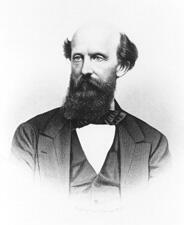
Joseph Rodman West (September 19, 1822 – October 31, 1898), also known as J. Rodman West, was a United States senator from Louisiana, a Union general in the United States Army during and after the American Civil War, and later the chief executive of the District of Columbia. Over the course of his public life he held military and civil positions that linked the era of the Mexican–American War, the Civil War, Reconstruction, and the late nineteenth-century governance of the nation’s capital. As a commander of militia, he gave the order to torture and murder Apache chief Mangas Coloradas, who had come to meet with him under a flag of truce to discuss terms of peace, an episode that has remained one of the most controversial aspects of his career.
West was born on September 19, 1822, in New Orleans, Louisiana. He spent his early years in that city before moving with his family to Philadelphia, Pennsylvania, where he was educated. As a young man he engaged in mercantile pursuits and developed an early familiarity with both Southern and Northern commercial life, an experience that later informed his political and military outlook. His upbringing in two major American cities during a period of sectional tension exposed him to differing regional perspectives in the decades leading up to the Civil War.
West’s formal education was supplemented by early military experience. During the Mexican–American War he volunteered for service and was commissioned as a first lieutenant in the 2nd Regiment of Pennsylvania Volunteers. He served in Mexico from 1847 to 1848, participating in the campaign that brought United States forces into the Mexican interior. After the war he returned to civilian life and resumed business activities, but his wartime service established his credentials as a capable officer and laid the groundwork for his later return to arms during the Civil War.
In the 1850s West moved westward to California, where he became involved in business and local affairs. He engaged in mercantile and mining-related enterprises and took part in the civic life of the growing state. When the American Civil War began in 1861, he offered his services to the Union cause from California. He was commissioned as a lieutenant colonel of the 1st California Infantry and soon came to wider prominence in the Union Army. A contemporary photograph from around 1861 depicts him as a lieutenant colonel, reflecting his early role in organizing and leading volunteer forces from the Pacific Coast.
West’s Civil War service extended beyond California. He rose in rank to brigadier general of volunteers and later to major general of volunteers, serving in the Union Army during and after the conflict. He commanded troops in the Southwest and along key lines of communication, and he was involved in military operations against Native American groups as well as in the broader Union war effort. It was in this context, as a commander of militia forces in the West, that he gave the order leading to the torture and killing of the Apache leader Mangas Coloradas, who had come under a flag of truce to negotiate peace. This act, carried out while he held military authority, has been widely condemned by historians and remains a significant and troubling part of his legacy.
Following the Civil War, West settled in New Orleans and entered political life in Louisiana as a member of the Republican Party during the Reconstruction era. He became active in state and regional politics at a time when federal authority and Republican leadership were central to the reorganization of Southern governments and the protection of newly freed African Americans. His military background and loyalty to the Union made him a natural figure in the Reconstruction Republican coalition that sought to reshape Louisiana’s political institutions.
West was elected as a Republican to the United States Senate from Louisiana and served one term from March 4, 1871, to March 3, 1877. His tenure in the Senate coincided with a significant period in American history, as Congress grappled with the final phases of Reconstruction, civil rights enforcement, and the contested presidential election of 1876. As a member of the Senate, Joseph Rodman West contributed to the legislative process, participated in the democratic deliberations of the era, and represented the interests of his Louisiana constituents. He served on committees and took part in debates over national policy during a time when the balance between federal authority and state governments was being intensely contested.
After leaving the Senate in 1877, West continued his public service in the nation’s capital. He was appointed to the Board of Commissioners of the District of Columbia, the three-member body that functioned as the chief executive authority for Washington, D.C. In this capacity he served as one of the chief executives of the District, overseeing municipal administration, public works, and local governance during a period of modernization and growth in the capital city. His role on the commission placed him at the center of decisions affecting the infrastructure and daily life of Washington residents in the late nineteenth century.
In his later years, West remained associated with public affairs and with the veteran community, his name appearing in lists and photographic collections of Union generals from the Civil War era. He lived out his final years in Washington, D.C., where he died on October 31, 1898. His long career, spanning service in two major American wars, a term in the United States Senate from Louisiana from 1871 to 1877, and executive authority in the District of Columbia, left a complex legacy that reflected both the ambitions and the moral conflicts of the United States in the nineteenth century.
Congressional Record