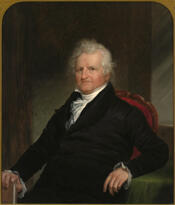
Joseph Bradley Varnum (January 29, 1750/1751 – September 21, 1821) was an American politician and militia officer from Dracut, in Middlesex County, in the Province of Massachusetts Bay, who served as both a United States representative and United States senator from Massachusetts and held leadership positions in each chamber. A member of the Democratic-Republican Party—often referred to in later sources as the Democratic Party—he contributed to the legislative process during a long national career that spanned from the early years of the federal government through the aftermath of the War of 1812. He served nine consecutive terms in Congress, first in the U.S. House of Representatives from 1795 to 1811 and then in the U.S. Senate from 1811 to 1817, and he was Speaker of the House and later president pro tempore of the Senate.
Varnum was born in Dracut, Massachusetts, on January 29, 1750 or 1751, the son of Samuel Varnum, a farmer, militia officer, and local official, and his wife Mary Prime. He received only a limited formal education but became largely self-taught, developing the learning and practical skills that would support his later public career. He followed his family’s agricultural pursuits and became a farmer in Dracut. His family was prominent in New England military and civic affairs; his brother, James Mitchell Varnum, later became a major general who commanded the 1st Rhode Island Regiment from 1775 to 1777, served as a brigade commander at the Battle of Rhode Island, and subsequently commanded the Rhode Island Militia.
At the age of eighteen, Varnum received a commission as a captain in the Massachusetts militia from the authorities of the Massachusetts Bay Colony. During the American Revolutionary War he commanded Dracut’s militia company, participating in the defense of the new nation. He continued his militia service after the Revolution and played a role in suppressing Shays’ Rebellion in 1786–1787, when western Massachusetts farmers rose in armed protest against state fiscal policies. His steady advancement in the militia reflected both his experience and local standing: he was commissioned a colonel by the Commonwealth of Massachusetts in 1787, promoted to brigadier general in 1802, and in 1805 attained the rank of major general of the state militia, a position he held until his death in 1821.
Following independence, Varnum entered civil government in Massachusetts. He served as a member of the Massachusetts House of Representatives from 1780 to 1785, participating in the formative legislative work of the new state. He then served in the Massachusetts State Senate from 1786 to 1795, representing his region during a period marked by economic dislocation and political realignment in the post-Revolutionary era. Although he was not trained as an attorney, Varnum also held judicial office, serving as a Justice of the Massachusetts Court of Common Pleas and as Chief Justice of the Massachusetts Court of General Sessions, reflecting the confidence placed in his judgment and character by his contemporaries.
Varnum sought national office several times before securing a seat in Congress. He ran unsuccessfully in 1788 to represent Massachusetts’s 3rd congressional district in the First Congress, and again in 1792 for the Middlesex County seat in the 1st congressional district. In 1794 he was elected to the United States House of Representatives as a Democratic-Republican, beginning his service on March 4, 1795. He remained in the House until his resignation on June 29, 1811, serving nine consecutive terms. During his tenure he represented Massachusetts through the administrations of George Washington, John Adams, Thomas Jefferson, and James Madison, a period that encompassed the rise of party politics, the debates over the Alien and Sedition Acts, and the tensions leading to the War of 1812. Varnum was one of six Democratic-Republican representatives to oppose the Twelfth Amendment to the United States Constitution, which reformed the process for electing the president and vice president. From 1807 to 1811 he served as Speaker of the House, presiding over the chamber during the Tenth and Eleventh Congresses and guiding its proceedings at a time of growing sectional and partisan conflict.
In 1811 Varnum was elected to the United States Senate from Massachusetts to fill a vacancy, and he served there from 1811 to 1817. His service in the Senate occurred during a significant period in American history, including the War of 1812 and its aftermath. As a member of the Senate, he participated in the democratic process and represented the interests of his Massachusetts constituents. He was the only United States senator from Massachusetts to belong to the Democratic-Republican Party, a notable distinction in a state that was otherwise a stronghold of Federalist sentiment during this era. Within the Senate he held important leadership roles: he served as president pro tempore from December 6, 1813, to February 3, 1814, during the Thirteenth Congress, placing him in the line of succession to the presidency in the absence of a vice president, and he later chaired the Senate Committee on Militia during the Fourteenth Congress, drawing on his long experience in the Massachusetts militia.
After leaving the U.S. Senate in 1817, Varnum returned to Massachusetts and resumed service in the Massachusetts State Senate, continuing his involvement in state affairs until his death. He remained a figure of local and state prominence, combining his agricultural pursuits with legislative and militia responsibilities. Varnum died in Dracut on September 21, 1821. He was buried in Varnum Cemetery in Dracut, where his grave marks the resting place of a Revolutionary-era militia officer and long-serving national legislator whose career bridged the colonial, revolutionary, and early republican periods of American history.
Congressional Record