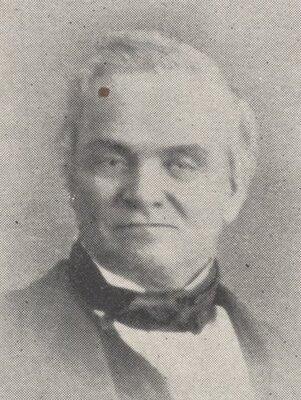
Joseph Mosley Root (October 7, 1807 – April 7, 1879) was a U.S. Representative from Ohio who served three terms in Congress during a pivotal era in American political and sectional conflict. The son of Joseph Root III and Tryphena Mosley, he was born on October 7, 1807, in Brutus, Cayuga County, New York. Root pursued classical studies in his youth and later undertook the study of law in Auburn, New York, preparing for a professional career at a time when legal training was largely conducted through apprenticeship and self-directed study.
In 1829, Root moved west to Ohio, part of a broader migration into the Old Northwest during the early nineteenth century. He settled first in Norwalk, where he was admitted to the bar in 1830 and commenced the practice of law. Establishing himself quickly in his new community, Root became active in local affairs. In 1832–1833 he served as mayor of Sandusky, Ohio, reflecting his early prominence in municipal government. In 1835 he married Mary S. Buckingham in Norwalk; the couple had five daughters. Root’s legal and political standing continued to grow, and in 1837 he was elected prosecuting attorney of Huron County, a position that placed him at the center of county legal administration. He advanced to state-level office as a member of the Ohio State Senate, serving in 1840 and 1841.
Root’s national career began with his election to the United States House of Representatives as a member of the Whig Party. He was elected to the Twenty-ninth Congress and reelected to the Thirtieth Congress as a Whig, then reelected as a Free Soil Party candidate to the Thirty-first Congress, serving continuously from March 4, 1845, to March 3, 1851. As a member of the Free Soil Party representing Ohio during part of his tenure, Root contributed to the legislative process over three terms in office, participating in the democratic process and representing the interests of his constituents during a significant period in American history marked by debates over slavery and territorial expansion. In the Thirtieth Congress he served as chairman of the Committee on Expenditures in the Department of the Treasury, overseeing aspects of federal fiscal administration.
Root’s congressional service coincided with the intensifying national struggle over the expansion of slavery into the territories. In 1848 he introduced a resolution recommending that New Mexico and California be organized with territorial governments that excluded slavery, aligning himself with the Free Soil principle of preventing the extension of slavery into newly acquired western lands. His stance placed him among the antislavery voices in Congress who sought to shape the status of the territories following the Mexican–American War, and it reflected the broader realignment of political parties in the years leading up to the Civil War.
After leaving Congress in 1851, Root remained active in public life and in the evolving party system. He later affiliated with the Republican Party and served as a presidential elector on the Republican ticket in 1860, participating in the election that brought Abraham Lincoln to the presidency. In 1861 he was appointed United States Attorney for the Northern District of Ohio, a federal post he held during the opening phase of the Civil War, when issues of loyalty, civil liberties, and wartime administration were prominent in federal legal affairs.
Root continued to engage in Ohio politics in the postwar period. He returned to the Ohio Senate in 1869, again serving as a state legislator during Reconstruction. By the early 1870s he had aligned with the Democratic Party in state matters, serving as a Democratic delegate to the Ohio constitutional convention in 1873, which addressed questions of state governance and legal structure. In 1875 he was an unsuccessful Democratic candidate for probate judge of Erie County, demonstrating his continued interest in judicial and public service roles even late in his career.
Joseph Mosley Root spent his later years in Sandusky, Ohio, where he had long been a prominent figure. He died there on April 7, 1879, and was interred in Oakland Cemetery in Sandusky. The Joseph Root House in Sandusky, associated with his life, is listed on the National Register of Historic Places and is believed to have served as a “safe house” on the Underground Railroad, suggesting that Root’s household may have played a role in assisting enslaved people seeking freedom.
Congressional Record