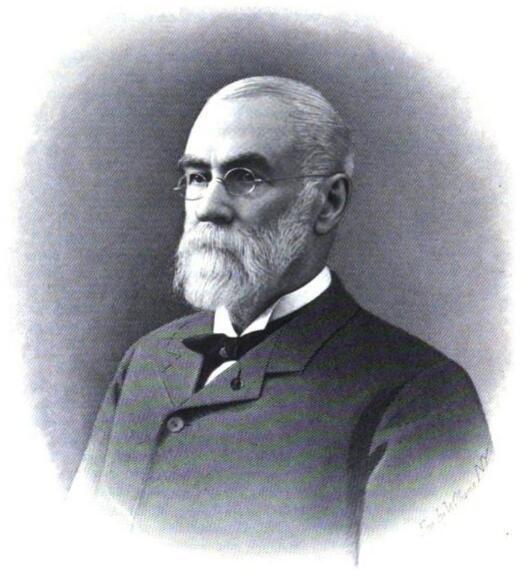
Joseph Rea Reed (March 12, 1835 – April 2, 1925) was an Iowa Supreme Court justice (including a brief tenure as chief justice), a one-term Republican U.S. Representative from Iowa’s 9th congressional district in southwestern Iowa, and chief justice of a specialized federal court, the United States Court of Private Land Claims. As a member of the Republican Party representing Iowa, he contributed to the legislative process during one term in office, serving during a significant period in American history and participating in the democratic process on behalf of his constituents.
Reed was born on March 12, 1835, in Ashland County, Ohio. He was educated in the common schools of the area and pursued further studies at the Vermillion Institution in Hayesville, Ohio, which he attended from 1854 to 1857. Seeking opportunities in the developing Midwest, he moved to Adel, Iowa, in 1857. There he studied law, was admitted to the bar in 1859, and began the practice of law in Adel, establishing himself professionally in the years immediately preceding the Civil War.
With the outbreak of the American Civil War, Reed entered military service in the Union Army. In July 1861 he enlisted as first lieutenant in the 2nd Iowa Independent Battery Light Artillery. Over the course of the war he rose in rank, being promoted to captain in October 1864. He served in that capacity until June 10, 1865, when he was mustered out of service. After the war, Reed returned to Adel and resumed the practice of law, building on his prewar legal experience and wartime leadership.
Reed soon entered public life in Iowa. He served as a member of the Iowa Senate from 1866 to 1870, participating in state legislative affairs during the Reconstruction era. In 1869 he moved from Adel to Council Bluffs, Iowa, a growing community in the southwestern part of the state that would remain his principal home for much of his later life. His legislative service and legal reputation led to his appointment in 1872 by Governor Cyrus C. Carpenter as judge of the Iowa 13th district court. Reed held that district judgeship from 1872 until 1884, presiding over a wide range of civil and criminal matters during a period of rapid development in Iowa.
On January 1, 1884, Reed was elevated to the Iowa Supreme Court. He served as a justice of that court until his resignation on February 28, 1889. At the beginning of 1889 he became chief justice of the Iowa Supreme Court, holding that position from January 1, 1889, until his resignation two months later. His tenure on the state’s highest court, including his brief service as chief justice, placed him among the leading judicial figures in Iowa during the late nineteenth century.
Reed’s judicial career in Iowa was followed by service in the national legislature. In 1888 he received the Republican nomination for the U.S. House of Representatives from Iowa’s 9th congressional district after incumbent Republican Joseph Lyman declined to seek a third term. Reed won the general election and served in the Fifty-first Congress, representing the largely agricultural southwestern region of Iowa. As a Republican member of Congress, he contributed to the legislative process during a period marked by debates over tariffs, economic policy, and veterans’ issues. He sought reelection in 1890 but was defeated by Democrat Thomas Bowman, who benefited from the broader Democratic landslide that year.
In June 1891, President Benjamin Harrison appointed Reed as chief justice of the newly created United States Court of Private Land Claims. This specialized federal court was established to adjudicate land claims arising under the Treaty of Guadalupe Hidalgo and related agreements, particularly in the territories of New Mexico, Arizona, and Utah, and in the states of Nevada, Colorado, and Wyoming. As chief justice, Reed presided over complex litigation involving Spanish and Mexican land grants, helping to define property rights in large portions of the American Southwest during a critical period of settlement and development. He served on that court from 1891 until its work concluded in 1904.
After the termination of the Court of Private Land Claims, Reed returned to Council Bluffs, Iowa, where he resumed the practice of law. He continued to reside there in his later years, remaining a respected figure in the legal and civic life of the community. Joseph Rea Reed died in Council Bluffs on April 2, 1925. He was interred in Walnut Hill Cemetery, leaving a legacy that encompassed military service in the Civil War, legislative work in the Iowa Senate and the U.S. House of Representatives, and significant judicial service at both the state and federal levels.
Congressional Record