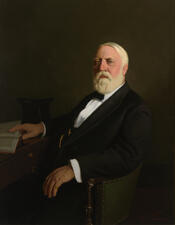
Joseph Warren Keifer (January 30, 1836 – April 22, 1932) was an American soldier, lawyer, and Republican politician from Ohio who served multiple terms in the United States House of Representatives and rose to the rank of major general during the Spanish–American War. Over the course of a long public career, he represented Ohio in Congress from 1877 to 1885 and again from 1905 to 1911, and served as Speaker of the House of Representatives from 1881 to 1883. His congressional service occurred during a significant period in American history, and he participated actively in the legislative process while representing the interests of his constituents.
Keifer was born near Springfield, Clark County, Ohio, on January 30, 1836, into a farming family of modest means. He worked on the family farm in his youth and attended local common schools. Demonstrating early ambition and intellectual ability, he pursued further study at Antioch College in Yellow Springs, Ohio, although he did not complete a degree. His early life in rural Ohio and exposure to the issues of a growing western state helped shape his political outlook and later public service.
After his studies, Keifer read law in Springfield and was admitted to the bar in 1858, beginning the practice of law there. His legal career was interrupted by the outbreak of the American Civil War. Enlisting in the Union Army, he rose through the ranks, serving with distinction in numerous campaigns. He was commissioned as an officer in the 3rd Ohio Volunteer Infantry and later in the 110th Ohio Volunteer Infantry, eventually attaining the rank of brevet brigadier general and then brevet major general of volunteers by the close of the war. His Civil War service, marked by participation in major engagements and repeated responsibilities in command, established his public reputation and provided the military background that later supported his appointment as a major general during the Spanish–American War.
Following the Civil War, Keifer returned to Springfield and resumed the practice of law, becoming a prominent attorney and active participant in Republican Party politics in Ohio. He served in the Ohio State Senate, where he gained legislative experience and visibility within the party. Building on his wartime record and state-level service, he was elected as a Republican to the United States House of Representatives, beginning his first period of congressional service on March 4, 1877. He served continuously in the House from 1877 to 1885, during which time he contributed to the legislative process over four consecutive terms and took part in debates on Reconstruction-era policies, economic issues, and veterans’ affairs.
Keifer reached the height of his congressional influence when he was elected Speaker of the House of Representatives, serving from December 5, 1881, to March 3, 1883, during the Forty-seventh Congress. As Speaker, he presided over a closely divided and often contentious House at a time of factionalism within the Republican Party. He pledged, in his own words, to act “with my best ability, guided by a sincere and honest purpose, to discharge the duties belonging to the office with which you have clothed me.” Nevertheless, his tenure drew criticism from contemporaries; observers questioned his command of parliamentary procedure and his handling of party divisions. The Nation remarked that he was “more successful than any of his predecessors in displeasing the majority of the House,” reflecting the difficulties he faced in managing the chamber during a turbulent period.
After leaving Congress in 1885, Keifer returned once more to his legal practice in Springfield and remained active in Republican politics and veterans’ organizations. With the outbreak of the Spanish–American War in 1898, his Civil War record and continued involvement in military affairs led to his appointment as a major general of United States Volunteers. In that capacity he commanded troops in the Puerto Rican campaign, further cementing his reputation as a military leader. His dual identity as both soldier and statesman became a defining feature of his public image.
Keifer reentered national politics at the turn of the twentieth century. He again ran for and was elected to Congress, beginning his second period of service in the House of Representatives on March 4, 1905. He served from March 4, 1905, to March 3, 1911, adding three more terms to his earlier four, for a total of seven terms in office. During this later service, he represented Ohio in an era marked by the rise of progressivism, industrial regulation, and debates over America’s expanding international role. As a member of the Republican Party, he continued to participate in the democratic process and to represent the interests of his Ohio constituents until his retirement from Congress in 1911.
In his later years, Keifer remained a respected elder statesman in Springfield, where he continued to practice law, write, and speak on public affairs and military history. He authored works reflecting on the Civil War and his experiences in public life, contributing to the historical record of the periods in which he served. Joseph Warren Keifer died in Springfield, Ohio, on April 22, 1932, at the age of ninety-six, closing a life that spanned from the antebellum era through the First World War and into the Great Depression, and that combined long service as a lawyer, soldier, and legislator.
Congressional Record