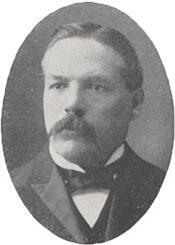
Joseph Howell (February 17, 1857 – July 18, 1918) was an American businessman and Republican politician who served seven consecutive terms as a U.S. Representative from Utah from 1903 to 1917. His service in Congress occurred during a significant period in American history, and he played an active role in the legislative process while representing the interests of his constituents in Utah.
Howell was born in Brigham City, Utah Territory, on February 17, 1857. In 1863 he moved with his parents to Wellsville, Utah, where he was raised in a growing Latter-day Saint agricultural community. He attended the common schools of the area and later pursued higher education at the University of Utah in Salt Lake City, reflecting an early commitment to learning that would later be evident in his public service and his role in educational governance.
Before entering higher elective office, Howell worked as a schoolteacher and engaged in mercantile pursuits, establishing himself in local business and community affairs. His first major public office came when he was elected mayor of Wellsville, serving from 1882 to 1884. He then advanced to territorial politics, serving in the Utah Territorial House of Representatives from 1886 to 1892, a period in which Utah was still working toward statehood and developing its political institutions. After Utah was admitted as a state in 1896, Howell became a member of the Utah State Senate, serving from 1896 to 1900. During the same period, from 1896 to 1900, he also served as a regent of the University of Utah, helping oversee the development of the state’s principal institution of higher education. In 1901 he moved to Logan, Utah, which became his home base for the remainder of his life.
Howell married Mary Maughan, and the couple’s family was active in the religious and civic life of the region. Their daughter, Barbara Howell Richards, later served as a member of the Relief Society General Board of The Church of Jesus Christ of Latter-day Saints, extending the family’s influence into churchwide women’s leadership.
In national politics, Howell was elected as a Republican to the U.S. House of Representatives for the Fifty-eighth Congress and to the six succeeding Congresses, serving from March 4, 1903, to March 3, 1917. Over these seven terms, he participated in the democratic process during an era marked by the Progressive movement, expanding federal authority, and growing U.S. involvement in international affairs. He represented Utah both when its House seats were district-based and during the 1912 election, which consisted of an all-party, statewide election for two at-large seats; in that contest Howell was elected to the first at-large seat, while his fellow Republican, William H. M. Johnson, was elected to the second at-large seat. As a member of the House of Representatives, Howell worked to secure federal support for his state, including involvement in obtaining appropriations for Latter-day Saint colonists who had fled Mexico in 1912 during the turmoil of the Mexican Revolution. His political career also drew opposition from figures such as Parley Parker Christensen, a Utah and later California politician who challenged the Republican establishment in the state.
Alongside his political career, Howell was active in business, particularly in banking and real estate. His business interests extended into Box Elder County, where land associated with one of his enterprises became the site of a new community founded around 1910. The town was named Howell, Utah, in his honor, reflecting both his prominence in the region and the interconnection between his commercial ventures and the development of northern Utah.
Joseph Howell died in Logan, Utah, on July 18, 1918, a little more than a year after leaving Congress. He was interred in Logan City Cemetery. His career spanned the transition from territorial governance to statehood and from local office to long service in the national legislature, and he is remembered as a key Republican figure in Utah’s early statehood era who combined business activity with extensive public service at the municipal, territorial, state, and federal levels.
Congressional Record