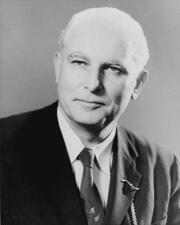
Joseph Roswell Hawley (October 31, 1826 – March 18, 1905) was the 42nd Governor of Connecticut, a U.S. politician in the Republican and Free Soil parties, a Civil War general, and a journalist and newspaper editor. He served two terms in the United States House of Representatives and was a four-term United States Senator from Connecticut, holding his Senate seat from 1871 to 1905. A member of the Republican Party, he contributed to the legislative process during seven terms in Congress and emerged as one of the key Republican leaders in both the House and the Senate.
Hawley was born in Stewartsville, near Laurinburg, North Carolina, at the Stewart-Hawley-Malloy House on October 31, 1826. A direct descendant of Joseph Hawley, the first of the name in America, through Ebenezer, Joseph, and Samuel, he was the son of a Connecticut-born Baptist minister who was then serving a church in North Carolina. The Stewart-Hawley-Malloy House, his birthplace, was later added to the National Register of Historic Places in 1975. In 1837 his father returned with the family to Connecticut, where Hawley grew up in the New England environment that would shape his political and professional life.
Hawley pursued higher education at Hamilton College in Clinton, New York, where he distinguished himself as a student and graduated in 1847. After college he studied law and was admitted to the bar in 1850. He then practiced law in Hartford, Connecticut, for six years. During this period he became increasingly involved in public affairs and journalism, laying the groundwork for his later prominence as both a political leader and newspaper editor.
An ardent opponent of slavery, Hawley became a Free Soiler in the early 1850s. He served as a delegate to the National Convention of the Free Soil Party that nominated John Parker Hale for the presidency in 1852 and subsequently became chairman of the party’s state committee in Connecticut. He also edited the party’s newspaper, the Charter Oak, using the press to advocate antislavery principles. In 1856 he took a leading role in organizing the Republican Party in Connecticut, and in 1857 he became editor of the Hartford Evening Press, a newly established Republican newspaper. His work as an editor and party organizer made him a prominent figure in the emerging Republican movement on the eve of the Civil War.
When the Civil War began, Hawley entered the Federal army and served with distinction throughout the conflict, rising from captain to brevet major general of volunteers. In April 1861 he helped recruit and organize an infantry company and was mustered into the three‑month 1st Connecticut Infantry as captain of Company A on April 22, 1861. He first saw combat at the First Battle of Bull Run in July 1861, where he received praise from his brigade commander, General Erasmus D. Keyes. After mustering out with the regiment, he assisted Colonel Alfred H. Terry in raising the 7th Connecticut Infantry, a three‑year regiment, and was commissioned lieutenant colonel. He took part in the Port Royal Expedition in November 1861 and commanded the forces assigned to garrison two captured forts. He participated in the four‑month siege that culminated in the capture of Fort Pulaski in April 1862, again commanding the garrison force. With Terry’s promotion to brigade command, Hawley succeeded him as colonel of the 7th Connecticut, leading the regiment in the battles of James Island and Pocotaligo.
In 1863 Hawley continued in active field service. He joined General John M. Brannan’s expedition to Florida in January and commanded the post at Fernandina, near Jacksonville. In April he took part in an unsuccessful expedition to capture Charleston, South Carolina. During the summer he commanded a brigade on Morris Island during the siege of Charleston and was engaged in the attacks on Fort Wagner in September. That autumn he secured Spencer breech‑loading rifles to equip his regiment, giving his men a rapid‑fire weapon that enhanced their combat effectiveness. In 1864 he commanded a brigade under General Truman Seymour at the Battle of Olustee in Florida, and later that year he and his command were transferred to Virginia as part of Terry’s Division, X Corps, Army of the James. He saw action at Drewry’s Bluff, Deep Run, Derbytown Road, and in other engagements near Bermuda Hundred and Deep Bottom. As casualties and reassignments created openings, Hawley was given command of a division during the Siege of Petersburg and was promoted to brigadier general of volunteers in September 1864. Concerned about maintaining order during the presidential election of November 1864, federal authorities selected Hawley to command a hand‑picked brigade sent to New York City to safeguard the election process.
In January 1865 Hawley succeeded his mentor Alfred Terry as divisional commander when Terry was assigned to lead the expedition against Fort Fisher. Hawley later joined him in North Carolina as chief of staff of the X Corps. After the capture of Wilmington, North Carolina, he assumed command of the Union forces in southeastern North Carolina. In June 1865, following the surrender of the principal Confederate armies, he rejoined Terry and served as chief of staff for the Department of Virginia until October, when he returned to Connecticut. He was breveted major general of volunteers in September 1865 and was mustered out of the army on January 15, 1866, closing a military career that had taken him from the first major battle of the war through its final campaigns.
Returning to civilian life, Hawley quickly entered state politics. He was elected governor of Connecticut and served from April 1866 to April 1867 as the state’s 42nd governor, though he was defeated for reelection in 1867. A few months after leaving the governorship, he purchased the Hartford Courant and merged it with the Hartford Evening Press. Under his editorship, the combined paper became the most influential newspaper in Connecticut and one of the leading Republican newspapers in the country, reinforcing his stature as both political leader and opinion shaper. He also remained active in national party affairs, serving as permanent chairman of the Republican National Convention in 1868 and as a delegate to the Republican national conventions of 1872, 1876, and 1880.
Hawley’s congressional service began in the House of Representatives. He represented Connecticut in the U.S. Congress from December 1872 until March 1875 and again from 1879 to 1881, serving two nonconsecutive terms in the House after losing the intervening elections. During this period he also played a major role in national commemorative efforts, serving from 1873 to 1876 as president of the United States Centennial Commission, which planned and administered the Centennial Exhibition in Philadelphia in 1876. He maintained close ties to his alma mater as a trustee of Hamilton College and received an honorary LL.D. degree from Hamilton in 1875, followed by a similar honorary degree from Yale University in 1888.
In 1881 Hawley entered the United States Senate as a Republican from Connecticut, beginning a Senate career that would last until 1905. He served four consecutive terms in the Senate, and his service in Congress—two terms in the House and four in the Senate—spanned a significant period in American history marked by Reconstruction, industrialization, and the rise of the United States as a world power. As a senator, he was one of the key Republican leaders, actively participating in the democratic process and representing the interests of his Connecticut constituents. He chaired the Senate Committee on Civil Service and was a vigorous advocate of civil service reform legislation, working to professionalize and depoliticize the federal workforce. He also chaired a special committee appointed to investigate the production of military ordnance and warships, and in that capacity he authored a detailed report on the heavy steel industry and gun making in the United States and England, reflecting his continuing interest in military preparedness and industrial capacity.
Hawley’s personal life was closely intertwined with his public and professional activities. He married Harriet Foote, and together they adopted one of her nieces after the death of the child’s parents; the girl, Margaret Foote Hawley, later became known as a painter of portrait miniatures. Harriet’s sister, Kate Foote Coe, also lived with the Hawleys for a time while she worked as a newspaper correspondent in Washington, D.C., further linking the family to the world of journalism and national politics. Hawley’s prominence and long service led to several posthumous honors, including the naming of a battery in his honor at Fort Baldwin in Phippsburg, Maine.
Joseph Roswell Hawley died in Washington, D.C., on March 18, 1905, two weeks after stepping down from the Senate at the end of his fourth term. At the time of his death, he was the longest‑serving United States Senator from Connecticut. He was buried in Cedar Hill Cemetery in Hartford, Connecticut. In recognition of his service to the state and nation, a bronze bas‑relief representation of Hawley by sculptor Herbert Adams was commissioned and installed in the north portico of the Connecticut State Capitol; it was dedicated on October 18, 1912, as a lasting tribute to his military, journalistic, and legislative career.
Congressional Record