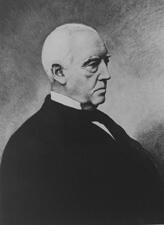
Joseph Parsons Comegys (December 29, 1813 – February 1, 1893) was an American judge, lawyer, and politician from Dover, in Kent County, Delaware. Over the course of a long public career, he served in the Delaware General Assembly, represented Delaware in the United States Senate from 1855 to 1857, and later became chief justice of the Delaware Supreme Court. He was associated politically with the Whig Party for much of his early career and later aligned with the Democratic Party; he has also been described as an Independent during his brief tenure in the Senate. Throughout his public life he contributed to the legislative and judicial development of Delaware during a period of significant national tension in the years leading up to the Civil War.
Comegys was born at “Cherbourg,” a family estate in Kent County, Delaware, near Dover, the son of former Delaware governor Cornelius P. Comegys and Ruhamah Marim Comegys. Raised in a prominent political family, he was exposed early to public affairs and the legal profession. He attended the old academy at Dover, a principal local institution of learning in the early nineteenth century, where he received a classical education that prepared him for the study of law and public service.
After completing his preparatory education, Comegys read law in the office of John M. Clayton, one of Delaware’s leading lawyers and a future U.S. senator and cabinet officer. Under Clayton’s tutelage he acquired a thorough grounding in legal practice and was admitted to the bar in 1835. He then commenced the practice of law in Dover, building a reputation as a capable attorney. Strengthening his personal and professional ties to the Clayton family, he married Clayton’s niece, Margaret A. Douglass; the couple had three children. His growing legal practice and family connections placed him at the center of Delaware’s political and legal circles.
Comegys entered elective office as a member of the Delaware House of Representatives, to which he was elected twice. He served in the 1843–1844 and 1849–1850 sessions of the General Assembly. At that time, elections in Delaware were held on the first Tuesday after November 1, and members of the General Assembly took office on the first Tuesday of January, with state representatives serving two-year terms. As a legislator, Comegys was identified with the Whig Party and participated in debates over state policy during a period marked by national disputes over economic development and slavery. In 1852 he further contributed to Delaware’s constitutional framework as a member of the commission chosen by the General Assembly to revise the state constitution, helping to shape the legal and institutional structure of state government.
Comegys’s service in the United States Senate occurred during a particularly significant period in American history, as sectional tensions over slavery and states’ rights were intensifying. Following the death of his former mentor, U.S. Senator John M. Clayton, Comegys was appointed on November 19, 1856, by the Delaware legislature to fill the resulting vacancy. Under the system then in place, U.S. senators from Delaware were chosen by the General Assembly and ordinarily took office on March 4 for six-year terms. Comegys, identified in some contemporary accounts as an Independent and in others as a Whig transitioning toward Democratic affiliation, served from November 19, 1856, until January 14, 1857, when his elected successor qualified. During this single term in office he participated in the legislative process and represented the interests of his Delaware constituents in the Senate at a time when the nation was grappling with the political aftermath of the Kansas–Nebraska Act and the approach of the 1856 presidential election. He did not stand for election to a full term and returned to private life upon the seating of his successor.
After leaving the Senate, Comegys resumed his legal practice in Dover, where he remained an influential figure at the bar for many years. As national politics realigned following the collapse of the Whig Party, he became associated with the Democratic Party in Delaware, reflecting the shifting partisan landscape of the mid-nineteenth century. His long experience as a legislator and his reputation as a careful lawyer led to his selection for judicial office later in life. On May 18, 1876, he was appointed chief justice of the Delaware Supreme Court, the state’s highest judicial post. In that capacity he presided over the administration of justice in Delaware for nearly seventeen years, overseeing a period of legal development that spanned the end of Reconstruction and the emergence of the Gilded Age. He served as chief justice until January 26, 1893, only days before his death.
Joseph Parsons Comegys died in Dover, Delaware, on February 1, 1893. He was buried in the Old Presbyterian Cemetery in Dover, on the grounds of what is now the Delaware State Museum. His career, extending from antebellum legislative service through a brief tenure in the United States Senate and culminating in his long service as chief justice, reflected both the political evolution of Delaware and the broader transformations of American public life in the nineteenth century.
Congressional Record